

200
C. ALBERS
effect. If R = 0.8, about 85% of the hydrogen ions from the carbonic
acid are mopped up by the concomitant change in the oxygenation and
only 15% have to be buffered according to Eq. (14). As a result the
arteriovenous pH difference is low, at least in mammals, where the p H
of the mixed venous blood from the right heart has a p H which is about
0.03-0.05 lower than that of the arterial blood. In fish the difference may
be higher because of the lower buffer capacity. For instance, in the dogfish the difference in p H between arterial and venous blood has been
found to be 0.07 ( Baumgarten-Schumann and Piiper, 1969).
4. THE EFFECT OF TEMPERATURE
As pointed out earlier, temperature affects the dissociation constants
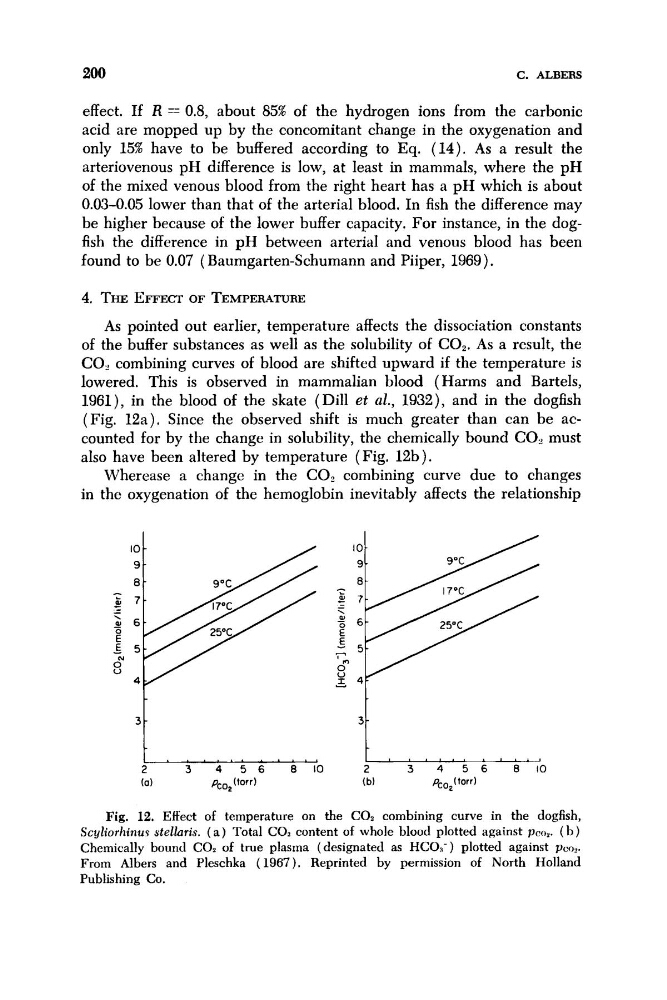
of the buffer substances as well as the solubility of CO,. As a result, the
CO, combining curves of blood are shifted upward if the temperature is
lowered. This is observed in mammalian blood (Harms and Bartels,
1961), in the blood of the skate (Dill et al., 1932), and in the dogfish
(Fig. 12a). Since the observed shift is much greater than can be accounted for by the change in solubility, the chemically bound CO, must
also have been altered by temperature (Fig. 12b).
Wherease a change in the C 0 2 combining curve due to changes
in the oxygenation of the hemoglobin inevitably affects the relationship
3
0 ”
V I
L
t
3t
2
3
4
5 6
8 1 0
t
3
2
3
4
5 6
8 10
Fig. 12. Effect of temperature on the CO, combining curve in the dogfish,
Scyliorhinus stelluris. ( a ) Total CO? content of whole blood plotted against pco,. ( b )
Chemically bound CO, of true plasma (designated as HCO;) plotted against pco,.
From Albers and Pleschka (1967). Reprinted by permission of North Holland
Publishing Co.
C. ALBERS
effect. If R = 0.8, about 85% of the hydrogen ions from the carbonic
acid are mopped up by the concomitant change in the oxygenation and
only 15% have to be buffered according to Eq. (14). As a result the
arteriovenous pH difference is low, at least in mammals, where the p H
of the mixed venous blood from the right heart has a p H which is about
0.03-0.05 lower than that of the arterial blood. In fish the difference may
be higher because of the lower buffer capacity. For instance, in the dogfish the difference in p H between arterial and venous blood has been
found to be 0.07 ( Baumgarten-Schumann and Piiper, 1969).
4. THE EFFECT OF TEMPERATURE
As pointed out earlier, temperature affects the dissociation constants
of the buffer substances as well as the solubility of CO,. As a result, the
CO, combining curves of blood are shifted upward if the temperature is
lowered. This is observed in mammalian blood (Harms and Bartels,
1961), in the blood of the skate (Dill et al., 1932), and in the dogfish
(Fig. 12a). Since the observed shift is much greater than can be accounted for by the change in solubility, the chemically bound CO, must
also have been altered by temperature (Fig. 12b).
Wherease a change in the C 0 2 combining curve due to changes
in the oxygenation of the hemoglobin inevitably affects the relationship
3
0 ”
V I
L
t
3t
2
3
4
5 6
8 1 0
t
3
2
3
4
5 6
8 10
Fig. 12. Effect of temperature on the CO, combining curve in the dogfish,
Scyliorhinus stelluris. ( a ) Total CO? content of whole blood plotted against pco,. ( b )
Chemically bound CO, of true plasma (designated as HCO;) plotted against pco,.
From Albers and Pleschka (1967). Reprinted by permission of North Holland
Publishing Co.