

5. ACID-BASE BALANCE
195
other than carbonic acid are buffered within the red cells and are also
exchanged for chloride ( Ferguson and Black, 1941).
4. TRUE PLASMA VERSUS SEPARATED PLASMA
Because of the interaction between cells and plasma it is necessary
to introduce the distinction between true plasma and separated plasma.
If red cells are spun down, the remaining plasma may be equilibrated
with various C 0 2 tensions. The resulting CO, combining curve is, as a
rule, flat and shows a smaller C 0 2 combining power than does whole
blood. Since the only buffer substances present are the plasma proteins,
the buffer capacity (see below) of such plasma is very low. Plasma
equilibrated with CO? without red cells present is called “separated
plasma.” If we equilibrate whole blood with various CO, tensions and
spin the red cells under paraffin oil, analyze the plasma for C o n , and
plot the CO, concentrations against the pco2, we obtain a steep COz
combining curve with a CO, combining power greater than that of
whole blood and with a much greater buffer capacity (Fig. 9).
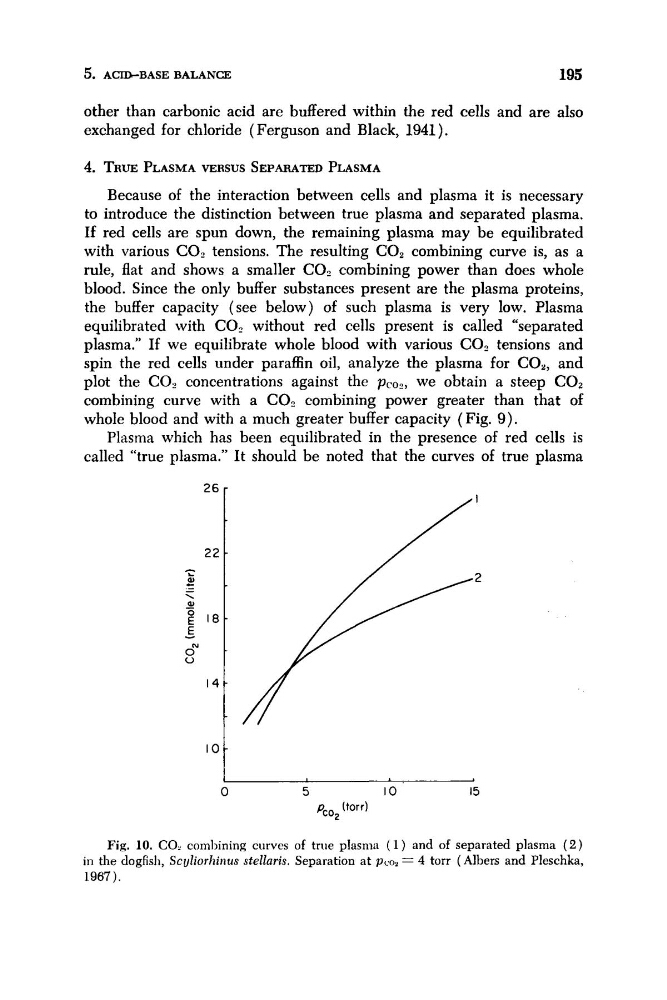
Plasma which has been equilibrated in the presence of red cells is
called “true plasma.” It should be noted that the curves of true plasma
26 r
Fig. 10. CO, combining curves of true plasma ( 1 ) and of separated plasma ( 2 )
in the dogfish, Scyliorhinus stellaris. Separation at pCoz = 4 torr ( Albers and Pleschka,
1967).
195
other than carbonic acid are buffered within the red cells and are also
exchanged for chloride ( Ferguson and Black, 1941).
4. TRUE PLASMA VERSUS SEPARATED PLASMA
Because of the interaction between cells and plasma it is necessary
to introduce the distinction between true plasma and separated plasma.
If red cells are spun down, the remaining plasma may be equilibrated
with various C 0 2 tensions. The resulting CO, combining curve is, as a
rule, flat and shows a smaller C 0 2 combining power than does whole
blood. Since the only buffer substances present are the plasma proteins,
the buffer capacity (see below) of such plasma is very low. Plasma
equilibrated with CO? without red cells present is called “separated
plasma.” If we equilibrate whole blood with various CO, tensions and
spin the red cells under paraffin oil, analyze the plasma for C o n , and
plot the CO, concentrations against the pco2, we obtain a steep COz
combining curve with a CO, combining power greater than that of
whole blood and with a much greater buffer capacity (Fig. 9).
Plasma which has been equilibrated in the presence of red cells is
called “true plasma.” It should be noted that the curves of true plasma
26 r
Fig. 10. CO, combining curves of true plasma ( 1 ) and of separated plasma ( 2 )
in the dogfish, Scyliorhinus stellaris. Separation at pCoz = 4 torr ( Albers and Pleschka,
1967).