

194
16
14
C. ALBERS
-
-
True plasma
E
- 8 -
Whole blood
6 -
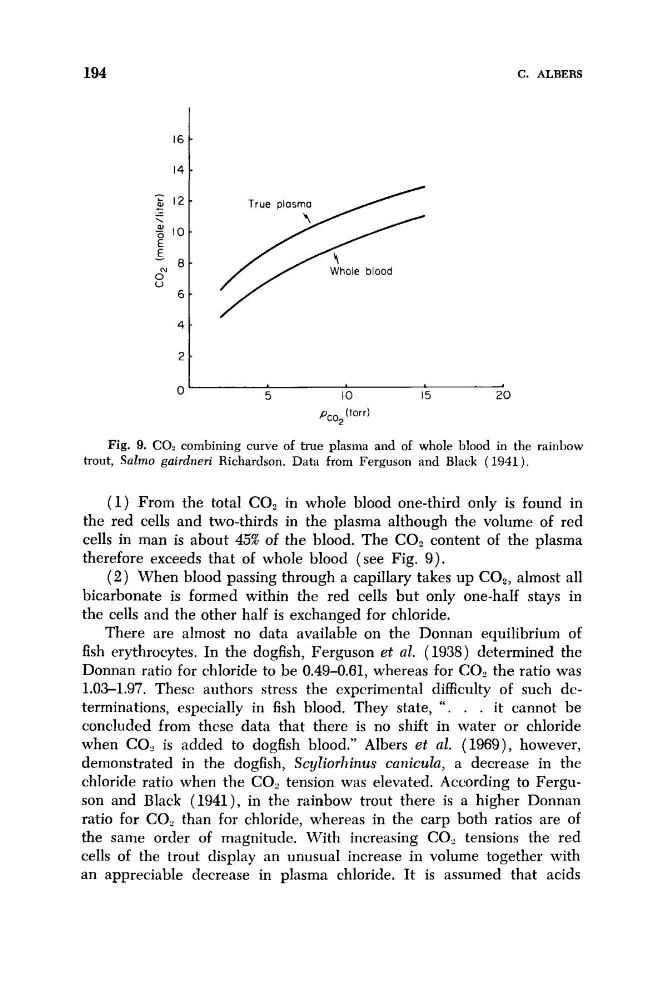
Fig. 9. CO? combining curve of true plasma and of whole blood in the rainbow
trout, Salmo gairdneri Richardson. Data from Ferguson and Black ( 1941 ) .
( 1 ) From the total CO, in whole blood one-third only is found in
the red cells and two-thirds in the plasma although the volume of red
cells in man is about 45% of the blood. The C 0 2 content of the plasma
therefore exceeds that of whole blood (see Fig. 9).
( 2 ) When blood passing through a capillary takes up COz, almost all
bicarbonate is formed within the red cells but only one-half stays in
the cells and the other half is exchanged for chloride.
There are almost no data available on the Donnan equilibrium of
fish erythrocytes. In the dogfish, Ferguson et al. (1938) determined the
Donnan ratio for chloride to be 0.49-0.61, whereas for C 0 2 the ratio was
1.03-1.97. These authors stress the experimental difficulty of such determinations, especially in fish blood. They state, “. . . it cannot be
concluded from thcse data that there is no shift in water or chloride
when CO, is added to dogfish blood.” Albers et al. (1969), however,
demonstrated in the dogfish, Scyliorhinus canicula, a decrease in the
chloride ratio when the CO, tension was elevated. According to Ferguson and Black (1941), in the rainbow trout there is a higher Donnan
ratio for CO, than for chloride, whereas in the carp both ratios are of
the same order of magnitude. With increasing CO, tensions the red
cells of the trout display an unusual increase in volume together with
an appreciable decrease in plasma chloride. It is assumed that acids
16
14
C. ALBERS
-
-
True plasma
E
- 8 -
Whole blood
6 -
Fig. 9. CO? combining curve of true plasma and of whole blood in the rainbow
trout, Salmo gairdneri Richardson. Data from Ferguson and Black ( 1941 ) .
( 1 ) From the total CO, in whole blood one-third only is found in
the red cells and two-thirds in the plasma although the volume of red
cells in man is about 45% of the blood. The C 0 2 content of the plasma
therefore exceeds that of whole blood (see Fig. 9).
( 2 ) When blood passing through a capillary takes up COz, almost all
bicarbonate is formed within the red cells but only one-half stays in
the cells and the other half is exchanged for chloride.
There are almost no data available on the Donnan equilibrium of
fish erythrocytes. In the dogfish, Ferguson et al. (1938) determined the
Donnan ratio for chloride to be 0.49-0.61, whereas for C 0 2 the ratio was
1.03-1.97. These authors stress the experimental difficulty of such determinations, especially in fish blood. They state, “. . . it cannot be
concluded from thcse data that there is no shift in water or chloride
when CO, is added to dogfish blood.” Albers et al. (1969), however,
demonstrated in the dogfish, Scyliorhinus canicula, a decrease in the
chloride ratio when the CO, tension was elevated. According to Ferguson and Black (1941), in the rainbow trout there is a higher Donnan
ratio for CO, than for chloride, whereas in the carp both ratios are of
the same order of magnitude. With increasing CO, tensions the red
cells of the trout display an unusual increase in volume together with
an appreciable decrease in plasma chloride. It is assumed that acids