

5. ACID-BASE BALANCE
193
total change in CO, when blood passes from an artery to a vein
( Roughton, 1964).
Whether or not carbamino compounds are formed in fish blood is
not known. Indirect evidence seems to rule out the presence of carbamino hemoglobin in the dogfish, Mustelus (Ferguson et al., 1938), and
in the carp (Ferguson and Black, 1941), whereas in the trout some caramino hemoglobin may be present (Ferguson and Black).
From the distribution of CO, between cells and plasma in the dogfish,
Ferguson et a2. (1938) conclude that substances other than hemoglobin
might be involved in the buffering of CO, within the red cell. Apart
from the so-called Y-bound CO, (an association of protein and bicarbonate), they point out that not yet identified substances in the nuclei
may participate in the buffering process. This seems to be an interesting
phenomenon which also could be of importance for the buffering in the
tissues. During heavy exercise it is claimed that creatinine diffuses out
of the muscles and increases the buffering capacity of the blood in the
trout (Black et al., 1959).
3. INTERACTION BETWEEN RED BLOOD CELLS AND PLASMA
Mammalian red blood cells are practically impermeable to cations
but are freely permeable to anions. Because of the negative charges of
the nondiffusing protein inside the red blood cell, a Donnan equilibrium
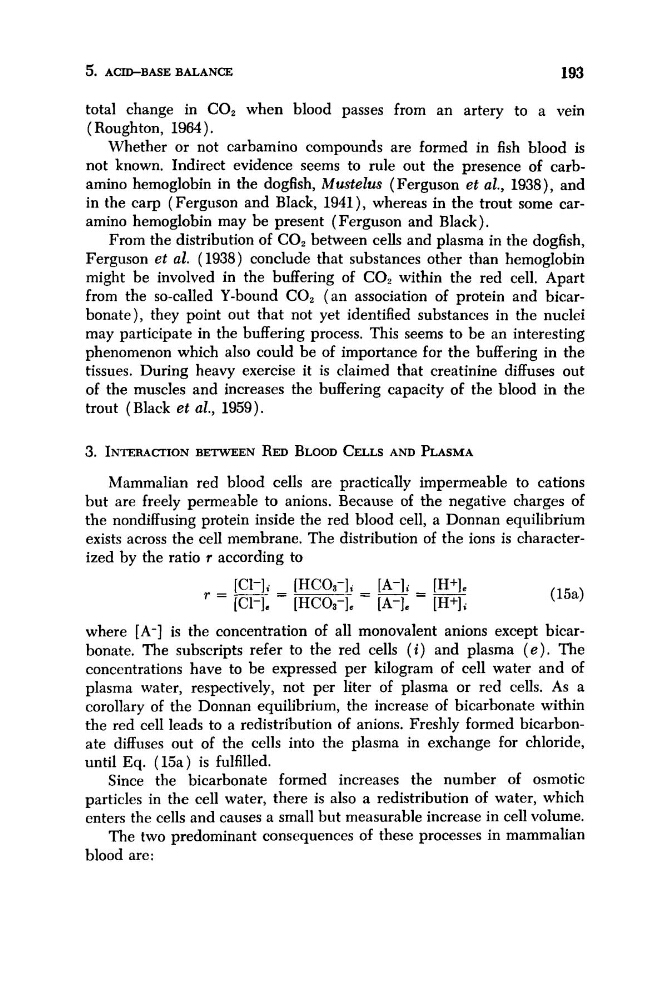
exists across the cell membrane. The distribution of the ions is characterized by the ratio r according to
where [A-] is the concentration of all monovalent anions except bicarbonate. The subscripts refer to the red cells ( i ) and plasma ( e ) . The
concentrations have to be expressed per kilogram of cell water and of
plasma water, respectively, not per liter of plasma or red cells. As a
corollary of the Donnan equilibrium, the increase of bicarbonate within
the red cell leads to a redistribution of anions. Freshly formed bicarbonate diffuses out of the cells into the plasma in exchange for chloride,
until Eq. (15a) is fulfilled.
Since the bicarbonate formed increases the number of osmotic
particles in the cell water, there is also a redistribution of water, which
enters the cells and causes a small but measurable increase in cell volume.
The two predominant consequences of these processes in mammalian
blood are:
193
total change in CO, when blood passes from an artery to a vein
( Roughton, 1964).
Whether or not carbamino compounds are formed in fish blood is
not known. Indirect evidence seems to rule out the presence of carbamino hemoglobin in the dogfish, Mustelus (Ferguson et al., 1938), and
in the carp (Ferguson and Black, 1941), whereas in the trout some caramino hemoglobin may be present (Ferguson and Black).
From the distribution of CO, between cells and plasma in the dogfish,
Ferguson et a2. (1938) conclude that substances other than hemoglobin
might be involved in the buffering of CO, within the red cell. Apart
from the so-called Y-bound CO, (an association of protein and bicarbonate), they point out that not yet identified substances in the nuclei
may participate in the buffering process. This seems to be an interesting
phenomenon which also could be of importance for the buffering in the
tissues. During heavy exercise it is claimed that creatinine diffuses out
of the muscles and increases the buffering capacity of the blood in the
trout (Black et al., 1959).
3. INTERACTION BETWEEN RED BLOOD CELLS AND PLASMA
Mammalian red blood cells are practically impermeable to cations
but are freely permeable to anions. Because of the negative charges of
the nondiffusing protein inside the red blood cell, a Donnan equilibrium
exists across the cell membrane. The distribution of the ions is characterized by the ratio r according to
where [A-] is the concentration of all monovalent anions except bicarbonate. The subscripts refer to the red cells ( i ) and plasma ( e ) . The
concentrations have to be expressed per kilogram of cell water and of
plasma water, respectively, not per liter of plasma or red cells. As a
corollary of the Donnan equilibrium, the increase of bicarbonate within
the red cell leads to a redistribution of anions. Freshly formed bicarbonate diffuses out of the cells into the plasma in exchange for chloride,
until Eq. (15a) is fulfilled.
Since the bicarbonate formed increases the number of osmotic
particles in the cell water, there is also a redistribution of water, which
enters the cells and causes a small but measurable increase in cell volume.
The two predominant consequences of these processes in mammalian
blood are: