

180
.
45 -
40 -
35 -
30 -
25 -
20 -
10C. ALBERS
Temp (“C)
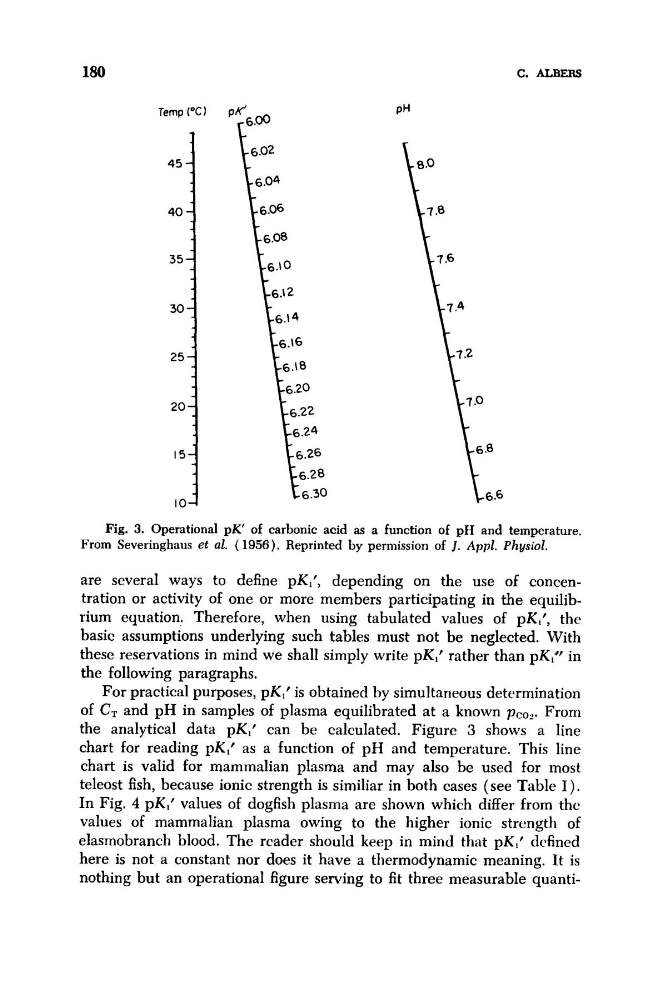
Fig. 3. Operational pK’ of carbonic acid as a function of pH and temperature.
From Severinghaus et al. ( 1956). Reprinted by permission of J. A p p l . Physiol.
are several ways to define pK,’, depending on the use of concentration or activity of one or more members participating in the equilibrium equation. Therefore, when using tabulated values of pK,’, the
basic assumptions underlying such tables must not be neglected. With
these reservations in mind we shall simply write pK,’ rather than pK,”’ in
the following paragraphs.
For practical purposes, pK,’ is obtained by simultaneous determination
of C, and p H in samples of plasma equilibrated at a known pco,. From
the analytical data pK,’ can be calculated. Figure 3 shows a line
chart for reading pK,’ as a function of p H and temperature. This line
chart is valid for mammalian plasma and may also be used for most
teleost fish, because ionic strength is similiar in both cases (see Table I ) .
In Fig. 4 pK,‘ values of dogfish plasma are shown which differ from the
values of mammalian plasma owing to the higher ionic strength of
elasmobranch blood. The rcader should keep in mind that pK,’ dcfined
here is not a constant nor does it have a thermodynamic meaning. It is
nothing but an operational figure serving to fit three measurable quanti-
.
45 -
40 -
35 -
30 -
25 -
20 -
10C. ALBERS
Temp (“C)
Fig. 3. Operational pK’ of carbonic acid as a function of pH and temperature.
From Severinghaus et al. ( 1956). Reprinted by permission of J. A p p l . Physiol.
are several ways to define pK,’, depending on the use of concentration or activity of one or more members participating in the equilibrium equation. Therefore, when using tabulated values of pK,’, the
basic assumptions underlying such tables must not be neglected. With
these reservations in mind we shall simply write pK,’ rather than pK,”’ in
the following paragraphs.
For practical purposes, pK,’ is obtained by simultaneous determination
of C, and p H in samples of plasma equilibrated at a known pco,. From
the analytical data pK,’ can be calculated. Figure 3 shows a line
chart for reading pK,’ as a function of p H and temperature. This line
chart is valid for mammalian plasma and may also be used for most
teleost fish, because ionic strength is similiar in both cases (see Table I ) .
In Fig. 4 pK,‘ values of dogfish plasma are shown which differ from the
values of mammalian plasma owing to the higher ionic strength of
elasmobranch blood. The rcader should keep in mind that pK,’ dcfined
here is not a constant nor does it have a thermodynamic meaning. It is
nothing but an operational figure serving to fit three measurable quanti-