

5. ACID-BASE BALANCE
181
P K’
6‘o t
7.2
7.4
7.6
7.8
8.0
8.2
PH
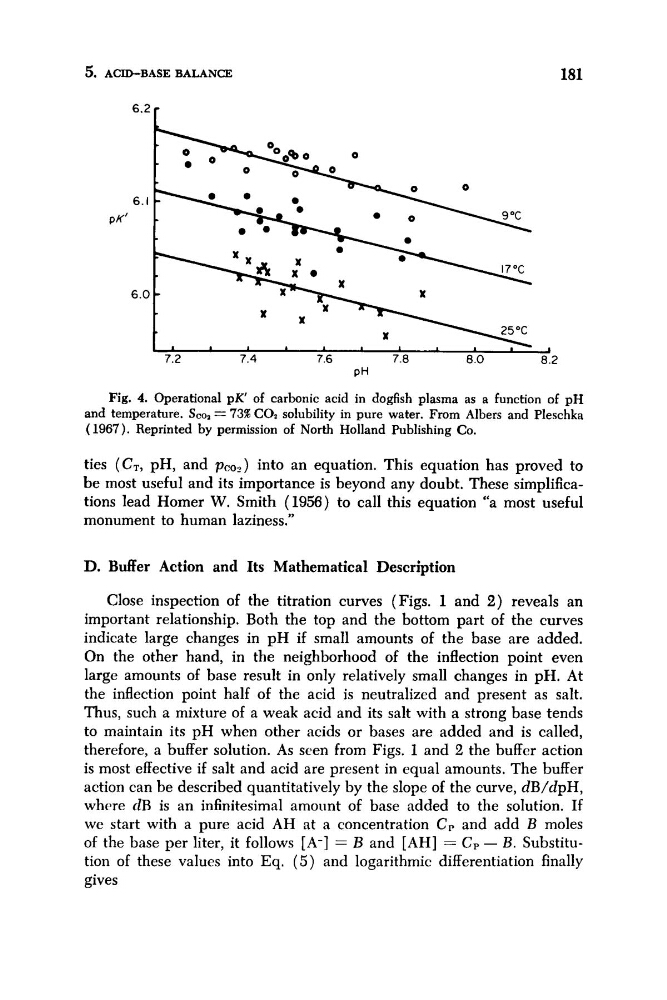
Fig. 4. Operational pK’ of carbonic acid in dogfish plasma as a function of pH
and temperature. S ~ O ,
= 73% COZ solubility in pure water. From Albers and Pleschka
(1967). Reprinted by permission of North Holland Publishing Co.
ties (CT, pH, and pco2) into an equation. This equation has proved to
be most useful and its importance is beyond any doubt. These simplifications lead Homer W. Smith (1956) to call this equation “a most useful
monument to human laziness.”
D. Buffer Action and Its Mathematical Description
Close inspection of the titration curves (Figs. 1 and 2) reveals an
important relationship. Both the top and the bottom part of the curves
indicate large changes in p H if small amounts of the base are added.
On the other hand, in the neighborhood of the inflection point even
large amounts of base result in only relatively small changes in pH. At
the inflection point half of the acid is neutralized and present as salt.
Thus, such a mixture of a weak acid and its salt with a strong base tends
to maintain its pH when other acids or bases are added and is called,
therefore, a buffer solution. As seen from Figs. 1 and 2 the buffer action
is most effective if salt and acid are present in equal amounts. The buffer
action can be described quantitatively by the slope of the curve, dB/dpH,
where dB is an infinitesimal amount of base added to the solution. If
we start with a pure acid AH at a concentration Cp and add B moles
of the base per liter, it follows [A-] = B and [AH] = Cp - B. Substitution of these values into Eq. ( 5 ) and logarithmic differentiation finally
gives
181
P K’
6‘o t
7.2
7.4
7.6
7.8
8.0
8.2
PH
Fig. 4. Operational pK’ of carbonic acid in dogfish plasma as a function of pH
and temperature. S ~ O ,
= 73% COZ solubility in pure water. From Albers and Pleschka
(1967). Reprinted by permission of North Holland Publishing Co.
ties (CT, pH, and pco2) into an equation. This equation has proved to
be most useful and its importance is beyond any doubt. These simplifications lead Homer W. Smith (1956) to call this equation “a most useful
monument to human laziness.”
D. Buffer Action and Its Mathematical Description
Close inspection of the titration curves (Figs. 1 and 2) reveals an
important relationship. Both the top and the bottom part of the curves
indicate large changes in p H if small amounts of the base are added.
On the other hand, in the neighborhood of the inflection point even
large amounts of base result in only relatively small changes in pH. At
the inflection point half of the acid is neutralized and present as salt.
Thus, such a mixture of a weak acid and its salt with a strong base tends
to maintain its pH when other acids or bases are added and is called,
therefore, a buffer solution. As seen from Figs. 1 and 2 the buffer action
is most effective if salt and acid are present in equal amounts. The buffer
action can be described quantitatively by the slope of the curve, dB/dpH,
where dB is an infinitesimal amount of base added to the solution. If
we start with a pure acid AH at a concentration Cp and add B moles
of the base per liter, it follows [A-] = B and [AH] = Cp - B. Substitution of these values into Eq. ( 5 ) and logarithmic differentiation finally
gives