

5. ACID-BASE BALANCE
179
At the high body temperature of mammals the concentration of
carbonate ions is practically zero. In fish, however, a small fraction of
the chemically bound CO, is present as carbonate. Therefore, we also
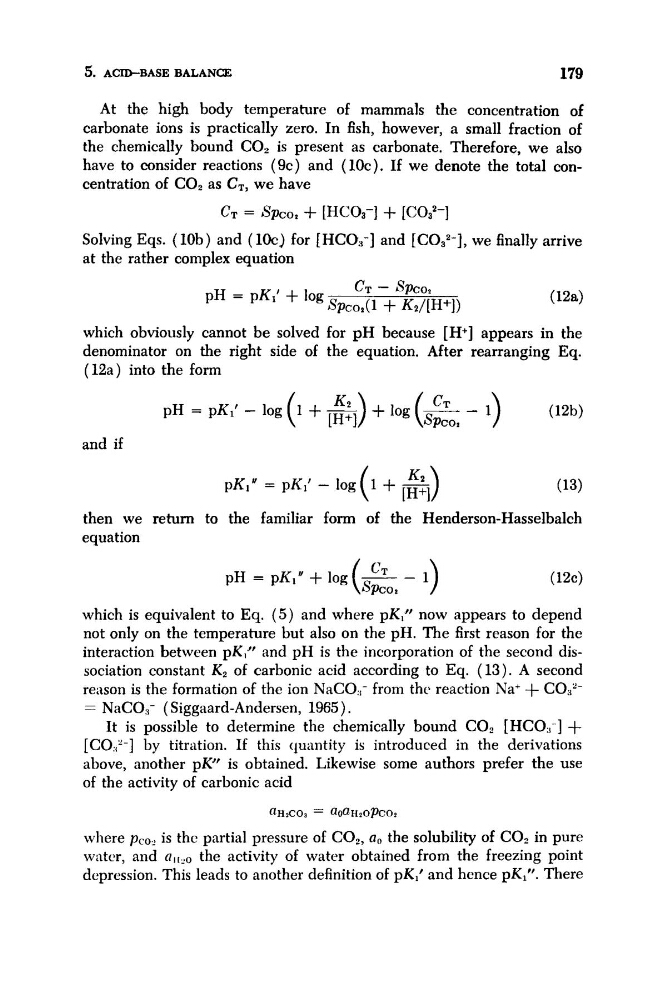
have to consider reactions (9c) and (1Oc). If we denote the total concentration of CO, as CT, we have
CT = Spco, + [HCOa-] + [CO32-]
Solving Eqs. ( lob) and ( 1%) for [HCO,-] and [C03*-], we finally arrive
at the rather complex equation
which obviously cannot be solved for pH because [H’] appears in the
denominator on the right side of the equation. After rearranging Eq.
(12a) into the form
and if
PKIK = pK,’ - log 1 + -
( ,
:
:
I
)
then we return to the familiar form of the Henderson-Hasselbalch
equation
which is equivalent to Eq. ( 5 ) and where pK,@‘ now appears to depend
not only on the temperature but also on the pH. The first reason for the
interaction between pK,”’ and pH is the incorporation of the second dissociation constant K , of carbonic acid according to Eq. (13). A second
reason is the formation of the ion NaCO:,- from the reaction Na’ + COS2= NaC0,- ( Siggaard-Andersen, 1965).
It is possible to determine the chemically bound CO, [HCO,-] +
[CO:,’-] by titration. If this quantity is introduced in the derivations
above, another pK*‘ is obtained. Likewise some authors prefer the use
of the activity of carbonic acid
flH2COa = flOaH20pC0*
where pco2 is thc partial pressure of COz, a. the solubility of CO, in pure
water, and a,,,, the activity of water obtained from the freezing point
depression. This leads to another definition of pK,’ and hence pK,”. There
179
At the high body temperature of mammals the concentration of
carbonate ions is practically zero. In fish, however, a small fraction of
the chemically bound CO, is present as carbonate. Therefore, we also
have to consider reactions (9c) and (1Oc). If we denote the total concentration of CO, as CT, we have
CT = Spco, + [HCOa-] + [CO32-]
Solving Eqs. ( lob) and ( 1%) for [HCO,-] and [C03*-], we finally arrive
at the rather complex equation
which obviously cannot be solved for pH because [H’] appears in the
denominator on the right side of the equation. After rearranging Eq.
(12a) into the form
and if
PKIK = pK,’ - log 1 + -
( ,
:
:
I
)
then we return to the familiar form of the Henderson-Hasselbalch
equation
which is equivalent to Eq. ( 5 ) and where pK,@‘ now appears to depend
not only on the temperature but also on the pH. The first reason for the
interaction between pK,”’ and pH is the incorporation of the second dissociation constant K , of carbonic acid according to Eq. (13). A second
reason is the formation of the ion NaCO:,- from the reaction Na’ + COS2= NaC0,- ( Siggaard-Andersen, 1965).
It is possible to determine the chemically bound CO, [HCO,-] +
[CO:,’-] by titration. If this quantity is introduced in the derivations
above, another pK*‘ is obtained. Likewise some authors prefer the use
of the activity of carbonic acid
flH2COa = flOaH20pC0*
where pco2 is thc partial pressure of COz, a. the solubility of CO, in pure
water, and a,,,, the activity of water obtained from the freezing point
depression. This leads to another definition of pK,’ and hence pK,”. There