

178
C. ALBERS
where S is the solubility coefficient in millimoles per liter per torr and
pco, the partial prcssure of C 0 2 in torr. Tables of S commonly refer to
the sum of physically dissolved CO? and carbonic acid according to Eq.
(9a). If a liquid has been equilibrated with a gas mixture containing
CO, until the number of CO, molecules escaping from the liquid into
the gas phase equals the number of CO, molecules entering the liquid
from the gas phase, the net exchange between the two phases is zero.
For this state of equilibrium it is said that the liquid phase has the same
partial pressure of CO, as has the gas phase, whether or not the liquid
is still in contact with the gas phase. Even if a liquid has never been
in contact with a gas phase, gaseous components derived from chemical
reactions exert a partial pressure which is linked to the amount of dissolved gas by the solubility coefficient S by Eq. ( 8 ) . It is possible to
calculate the partial pressure of CO, from analytical data as well as
to measure it directly with membrane-covered glass electrodes.
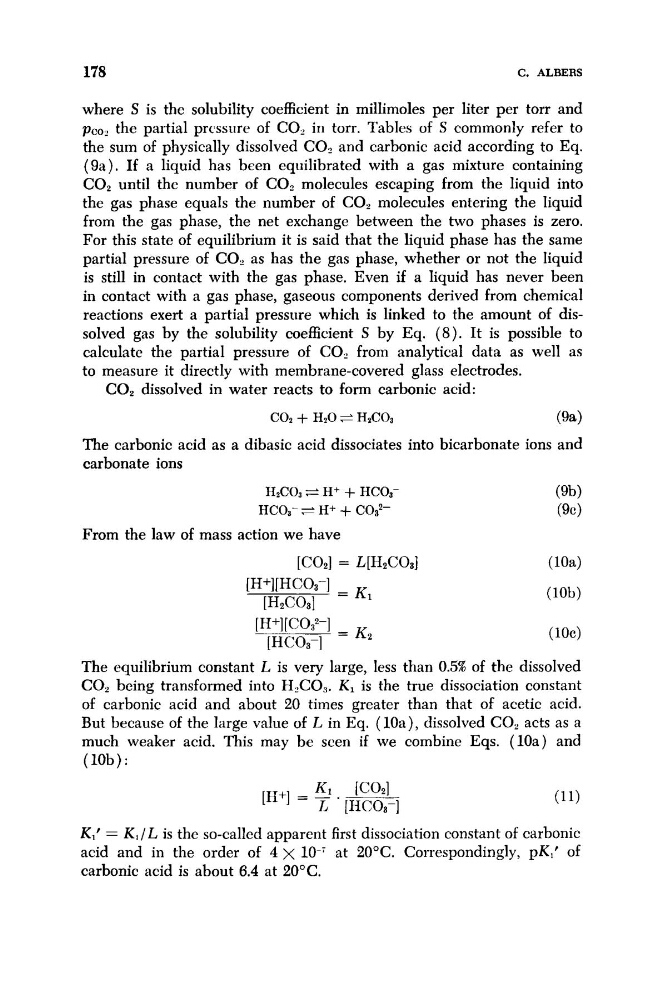
CO, dissolved in water reacts to form carbonic acid:
COz + Hz0 H&O3
(9a)
The carbonic acid as a dibasic acid dissociates into bicarbonate ions and
carbonate ions
From the law of mass action we have
The equilibrium constant L is very large, less than 0.5% of the dissolved
CO, being transformed into H,CO,. K , is the true dissociation constant
of carbonic acid and about 20 times greater than that of acetic acid.
But because of the large value of L in Eq. (lOa), dissolved CO, acts as a
much weaker acid. This may bc seen if we combine Eqs. (loa) and
(lob) :
K,' = K , I L is the so-called apparent first dissociation constant of carbonic
acid and in the order of 4 x lo-: at 20°C. Correspondingly, pK,' of
carbonic acid is about 6.4 at 20°C.
C. ALBERS
where S is the solubility coefficient in millimoles per liter per torr and
pco, the partial prcssure of C 0 2 in torr. Tables of S commonly refer to
the sum of physically dissolved CO? and carbonic acid according to Eq.
(9a). If a liquid has been equilibrated with a gas mixture containing
CO, until the number of CO, molecules escaping from the liquid into
the gas phase equals the number of CO, molecules entering the liquid
from the gas phase, the net exchange between the two phases is zero.
For this state of equilibrium it is said that the liquid phase has the same
partial pressure of CO, as has the gas phase, whether or not the liquid
is still in contact with the gas phase. Even if a liquid has never been
in contact with a gas phase, gaseous components derived from chemical
reactions exert a partial pressure which is linked to the amount of dissolved gas by the solubility coefficient S by Eq. ( 8 ) . It is possible to
calculate the partial pressure of CO, from analytical data as well as
to measure it directly with membrane-covered glass electrodes.
CO, dissolved in water reacts to form carbonic acid:
COz + Hz0 H&O3
(9a)
The carbonic acid as a dibasic acid dissociates into bicarbonate ions and
carbonate ions
From the law of mass action we have
The equilibrium constant L is very large, less than 0.5% of the dissolved
CO, being transformed into H,CO,. K , is the true dissociation constant
of carbonic acid and about 20 times greater than that of acetic acid.
But because of the large value of L in Eq. (lOa), dissolved CO, acts as a
much weaker acid. This may bc seen if we combine Eqs. (loa) and
(lob) :
K,' = K , I L is the so-called apparent first dissociation constant of carbonic
acid and in the order of 4 x lo-: at 20°C. Correspondingly, pK,' of
carbonic acid is about 6.4 at 20°C.