

4. THE CIRCULATORY SYSTEM
145
I
I
0.5 sec
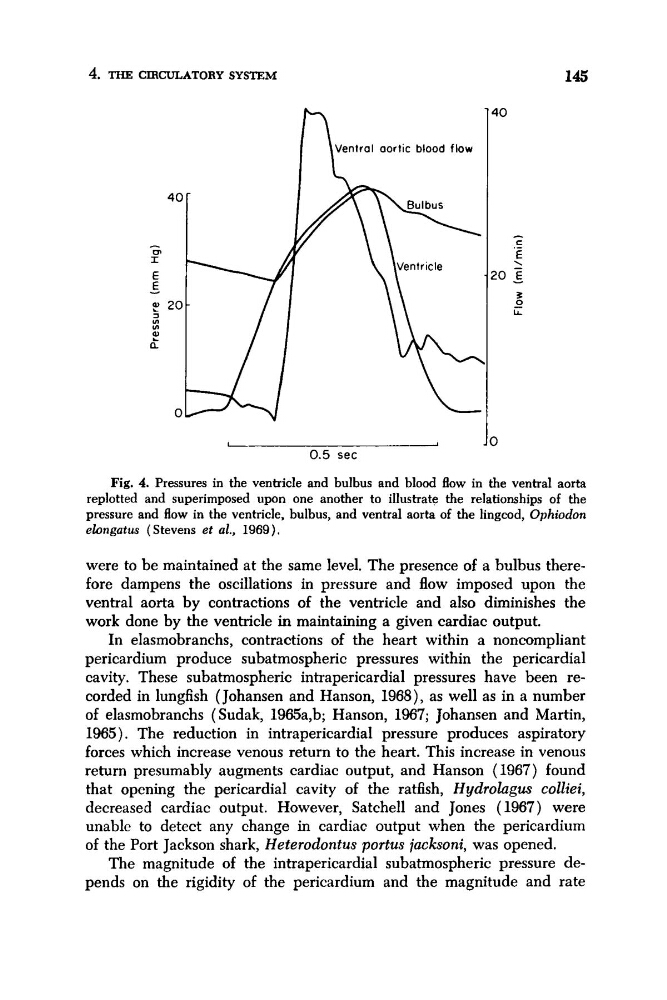
Fig. 4. Pressures in the ventricle and bulbus and blood flow in the ventral aorta
replotted and superimposed upon one another to illustrate the relationships of the
pressure and flow in the ventricle, bulbus, and ventral aorta of the lingcod, Ophiodon
elongatus (Stevens et al., 1969).
were to be maintained at the same level. The presence of a bulbus therefore dampens the oscillations in pressure and flow imposed upon the
ventral aorta by contractions of the ventricle and also diminishes the
work done by the ventricle in maintaining a given cardiac output.
In elasmobranchs, contractions of the heart within a noncompliant
pericardium produce subatmospheric pressures within the pericardial
cavity. These subatmospheric intrapericardial pressures have been recorded in lungfish (Johansen and Hanson, 1968), as well as in a number
of elasmobranchs ( Sudak, 196!5a,b; Hanson, 1967; Johansen and Martin,
1965). The reduction in intrapericardial pressure produces aspiratory
forces which increase venous return to the heart. This increase in venous
return presumably augments cardiac output, and Hanson (1967) found
that opening the pericardial cavity of the ratfish, Hydrolagzcs colliei,
decreased cardiac output. However, Satchel1 and Jones ( 1967) were
unable to detect any change in cardiac output when the pericardium
of the Port Jackson shark, Heterodontus portus jacksoni, was opened.
The magnitude of the intrapericardial subatmospheric pressure depends on the rigidity of the pericardium and the magnitude and rate
145
I
I
0.5 sec
Fig. 4. Pressures in the ventricle and bulbus and blood flow in the ventral aorta
replotted and superimposed upon one another to illustrate the relationships of the
pressure and flow in the ventricle, bulbus, and ventral aorta of the lingcod, Ophiodon
elongatus (Stevens et al., 1969).
were to be maintained at the same level. The presence of a bulbus therefore dampens the oscillations in pressure and flow imposed upon the
ventral aorta by contractions of the ventricle and also diminishes the
work done by the ventricle in maintaining a given cardiac output.
In elasmobranchs, contractions of the heart within a noncompliant
pericardium produce subatmospheric pressures within the pericardial
cavity. These subatmospheric intrapericardial pressures have been recorded in lungfish (Johansen and Hanson, 1968), as well as in a number
of elasmobranchs ( Sudak, 196!5a,b; Hanson, 1967; Johansen and Martin,
1965). The reduction in intrapericardial pressure produces aspiratory
forces which increase venous return to the heart. This increase in venous
return presumably augments cardiac output, and Hanson (1967) found
that opening the pericardial cavity of the ratfish, Hydrolagzcs colliei,
decreased cardiac output. However, Satchel1 and Jones ( 1967) were
unable to detect any change in cardiac output when the pericardium
of the Port Jackson shark, Heterodontus portus jacksoni, was opened.
The magnitude of the intrapericardial subatmospheric pressure depends on the rigidity of the pericardium and the magnitude and rate