

FISH NUTRPPION
463
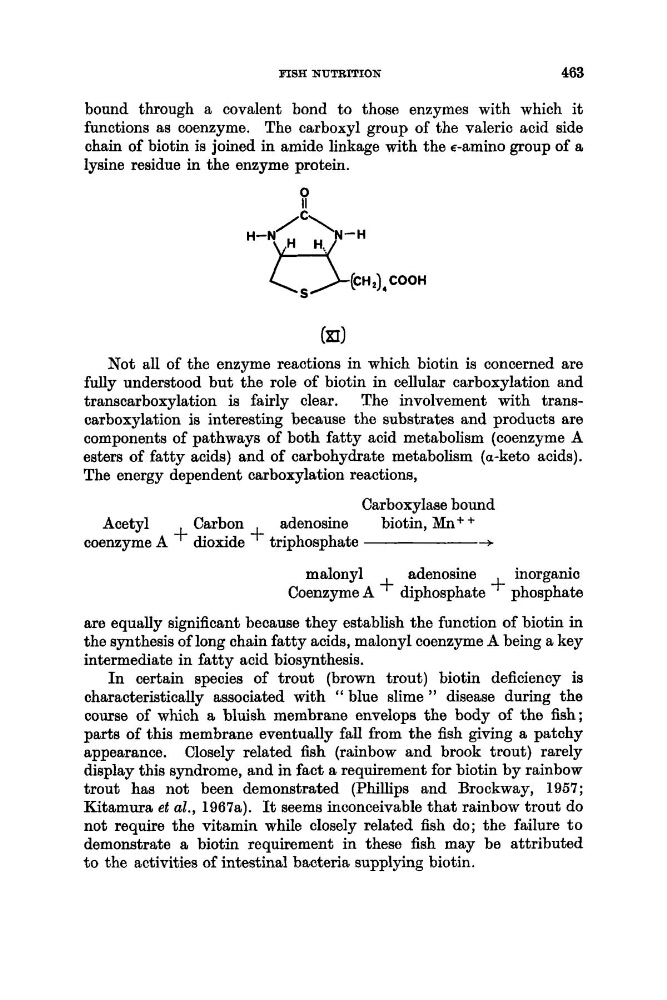
bound through a covalent bond to those enzymes with which it
functions as coenzyme. The carboxyl group of the valeric acid side
chain of biotin is joined in amide linkage with the €-amino group of a
lysine residue in the enzyme protein.
0
II
(d
Not all of the enzyme reactions in which biotin is concerned are
fully understood but the role of biotin in cellular carboxylation and
transcarboxylation is fairly clear. The involvement with transcarboxylation is interesting because the substrates and products are
components of pathways of both fatty acid metabolism (coenzyme A
esters of fatty acids) and of carbohydrate metabolism (a-keto acids).
The energy dependent carboxylation reactions,
Carboxylase bound
Acetyl
Carbon
adenosine
biotin, Mn+ +
coenzyme A -k dioxide -l- triphosphate
-+
malonyl
adenosine
inorganic
Coenzyme A 4- diphosphate + phosphate
are equally significant because they establish the function of biotin in
the synthesis of long chain fatty acids, malonyl coenzyme A being a key
intermediate in fatty acid biosynthesis.
In certain species of trout (brown trout) biotin deficiency is
characteristically associated with " blue slime '' disease during the
course of which a bluish membrane envelops the body of the fish;
parts of this membrane eventually fall from the fish giving a patchy
appearance. Closely related fish (rainbow and brook trout) rarely
display this syndrome, and in fact a requirement for biotin by rainbow
trout has not been demonstrated (Phillips and Brockway, 1957;
Kitsmura et al., 1967a). It seems inconceivable that rainbow trout do
not require the vitamin while closely related fish do; the failure t o
demonstrate a biotin requirement in these fish may be attributed
t o the activities of intestinal bacteria supplying biotin.
463
bound through a covalent bond to those enzymes with which it
functions as coenzyme. The carboxyl group of the valeric acid side
chain of biotin is joined in amide linkage with the €-amino group of a
lysine residue in the enzyme protein.
0
II
(d
Not all of the enzyme reactions in which biotin is concerned are
fully understood but the role of biotin in cellular carboxylation and
transcarboxylation is fairly clear. The involvement with transcarboxylation is interesting because the substrates and products are
components of pathways of both fatty acid metabolism (coenzyme A
esters of fatty acids) and of carbohydrate metabolism (a-keto acids).
The energy dependent carboxylation reactions,
Carboxylase bound
Acetyl
Carbon
adenosine
biotin, Mn+ +
coenzyme A -k dioxide -l- triphosphate
-+
malonyl
adenosine
inorganic
Coenzyme A 4- diphosphate + phosphate
are equally significant because they establish the function of biotin in
the synthesis of long chain fatty acids, malonyl coenzyme A being a key
intermediate in fatty acid biosynthesis.
In certain species of trout (brown trout) biotin deficiency is
characteristically associated with " blue slime '' disease during the
course of which a bluish membrane envelops the body of the fish;
parts of this membrane eventually fall from the fish giving a patchy
appearance. Closely related fish (rainbow and brook trout) rarely
display this syndrome, and in fact a requirement for biotin by rainbow
trout has not been demonstrated (Phillips and Brockway, 1957;
Kitsmura et al., 1967a). It seems inconceivable that rainbow trout do
not require the vitamin while closely related fish do; the failure t o
demonstrate a biotin requirement in these fish may be attributed
t o the activities of intestinal bacteria supplying biotin.