

462
0. B. UOWEY AND J. R. SARGENT
the lamellae are clubbed, the filaments are eroded and the gills become
covered with an excess of mucus. Extremely poor weight gain was the
most prominent consequence of pantothenate deficiency in carp
(Ogino, 1967).
The pantothenate requirement of those species examined is about
1-2 mg/kg body weightlday.
6. Inositol
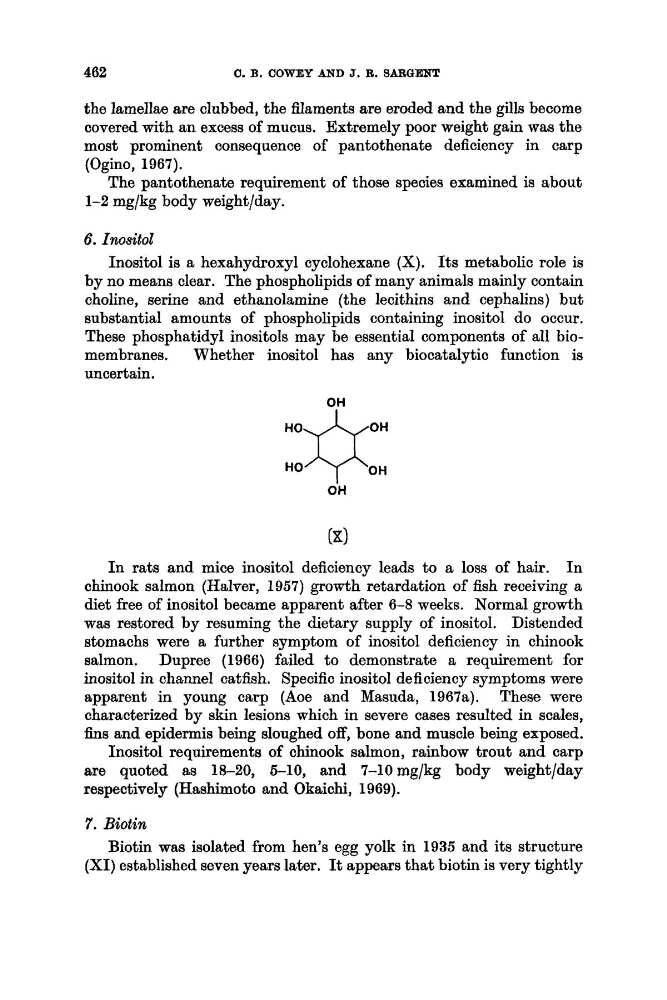
Inositol is a hexahydroxyl cyclohexane (X). Its metabolic role is
by no means clear. The phospholipids of many animals mainly contain
choline, serine and ethanolamine (the lecithins and cephalins) but
substantial amounts of phospholipids containing inositol do occur.
These phosphatidyl inositols may be essential components of all biomembranes. Whether inositol has any biocatalytic function is
uncertain.
HO
OH
(XI
In rats and mice inositol deficiency leads to a loss of hair. In
chinook salmon (Halver, 1957) growth retardation of fish receiving a
diet free of inositol became apparent after 6-8 weeks. Normal growth
was restored by resuming the dietary supply of inositol. Distended
stomachs were a further symptom of inositol deficiency in chinook
salmon. Dupree (1966) failed to demonstrate a requirement for
inositol in channel catfish. Specific inositol deficiency symptoms were
apparent in young carp (Aoe and Masuda, 1967a). These were
characterized by skin lesions which in severe cases resulted in scales,
h s and epidermis being sloughed off, bone and muscle being exposed.
Inositol requirements of chinook salmon, rainbow trout and carp
are quoted as 18-20, 6-10, and 7-10mglkg body weightlday
respectively (Hashimoto and Okaichi, 1969).
7. Biotin
Biotin was isolated from hen’s egg yolk in 1936 and its structure
(XI) established seven years later. It appears that biotin is very tightly
0. B. UOWEY AND J. R. SARGENT
the lamellae are clubbed, the filaments are eroded and the gills become
covered with an excess of mucus. Extremely poor weight gain was the
most prominent consequence of pantothenate deficiency in carp
(Ogino, 1967).
The pantothenate requirement of those species examined is about
1-2 mg/kg body weightlday.
6. Inositol
Inositol is a hexahydroxyl cyclohexane (X). Its metabolic role is
by no means clear. The phospholipids of many animals mainly contain
choline, serine and ethanolamine (the lecithins and cephalins) but
substantial amounts of phospholipids containing inositol do occur.
These phosphatidyl inositols may be essential components of all biomembranes. Whether inositol has any biocatalytic function is
uncertain.
HO
OH
(XI
In rats and mice inositol deficiency leads to a loss of hair. In
chinook salmon (Halver, 1957) growth retardation of fish receiving a
diet free of inositol became apparent after 6-8 weeks. Normal growth
was restored by resuming the dietary supply of inositol. Distended
stomachs were a further symptom of inositol deficiency in chinook
salmon. Dupree (1966) failed to demonstrate a requirement for
inositol in channel catfish. Specific inositol deficiency symptoms were
apparent in young carp (Aoe and Masuda, 1967a). These were
characterized by skin lesions which in severe cases resulted in scales,
h s and epidermis being sloughed off, bone and muscle being exposed.
Inositol requirements of chinook salmon, rainbow trout and carp
are quoted as 18-20, 6-10, and 7-10mglkg body weightlday
respectively (Hashimoto and Okaichi, 1969).
7. Biotin
Biotin was isolated from hen’s egg yolk in 1936 and its structure
(XI) established seven years later. It appears that biotin is very tightly