

FISH NUTRITION
461
live weight) Kashiwada and Teshima (1966) inferred that intestinal
bacteria synthesized sufficient nicotinic acid to meet the requirements
of the fish.
The nicotinic acid requirements of fish seem to vary both with the
species concerned and with the method of assessment. For example
with rainbow trout liver, storage methods (Phillips and Brockway,
1967) have indicated greater daily requirements, 3-4 mg/kg body
weightlday, than have weight gain methods, 0.02-01 mg/kg body
weightlday (McLaren et al., 1947).
5. Pantothenic acid
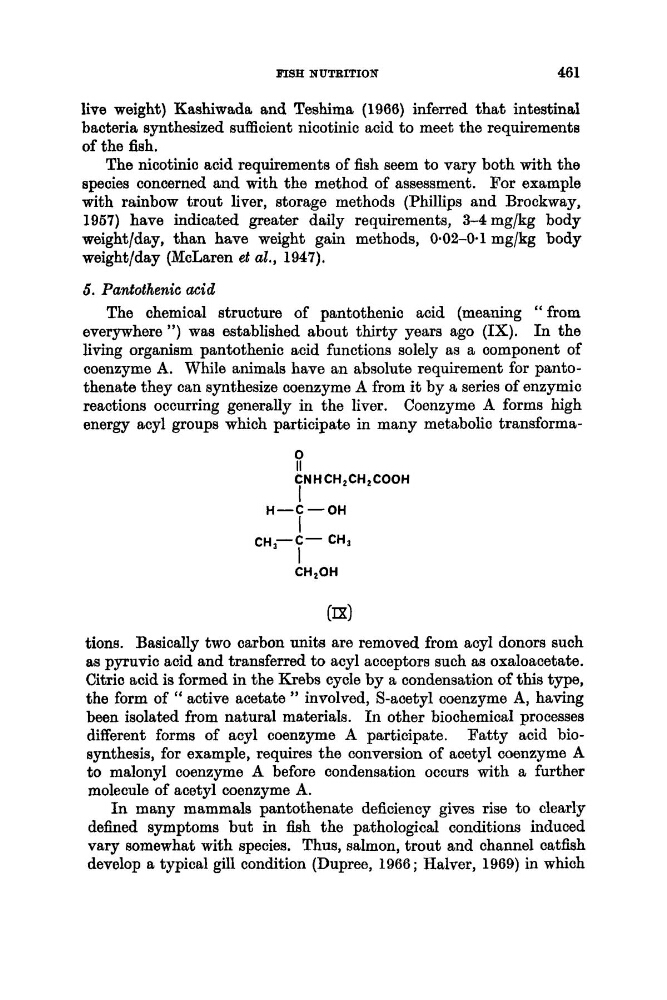
The chemical structure of pantothenic acid (meaning “from
everywhere ”) was established about thirty years ago (IX). In the
living organism pantothenic acid functions solely as a component of
coenzyme A. While animals have an absolute requirement for pantothenate they can synthesize coenzyme A from it by a series of enzymic
reactions occurring generally in the liver. Coenzyme A forms high
energy acyl groups which participate in many metabolic transforma0
II
CNH CH,CH,COOH
I
I
I
H-C-OH
CH3-cCH3
CHZOH
(a
tions. Basically two carbon units are removed from acyl donors such
as pyruvic acid and transferred to acyl acceptors such as oxaloacetate.
Citric acid is formed in the Krebs cycle by a condensation of this type,
the form of “ active acetate ” involved, S-acetyl coenzyme A, having
been isolated from natural materials. In other biochemical processes
different forms of acyl coenzyme A participate. Fatty acid biosynthesis, for example, requires the conversion of acetyl coenzyme A
to malonyl coenzyme A before condensation occurs with a further
molecule of acetyl coenzyme A.
In many mammals pantothenate deficiency gives rise to clearly
defined symptoms but in fish the pathological conditions induced
vary somewhat with species. Thus, salmon, trout and channel catfish
develop a typical gill condition (Dupree, 1966; Halver, 1969) in which
461
live weight) Kashiwada and Teshima (1966) inferred that intestinal
bacteria synthesized sufficient nicotinic acid to meet the requirements
of the fish.
The nicotinic acid requirements of fish seem to vary both with the
species concerned and with the method of assessment. For example
with rainbow trout liver, storage methods (Phillips and Brockway,
1967) have indicated greater daily requirements, 3-4 mg/kg body
weightlday, than have weight gain methods, 0.02-01 mg/kg body
weightlday (McLaren et al., 1947).
5. Pantothenic acid
The chemical structure of pantothenic acid (meaning “from
everywhere ”) was established about thirty years ago (IX). In the
living organism pantothenic acid functions solely as a component of
coenzyme A. While animals have an absolute requirement for pantothenate they can synthesize coenzyme A from it by a series of enzymic
reactions occurring generally in the liver. Coenzyme A forms high
energy acyl groups which participate in many metabolic transforma0
II
CNH CH,CH,COOH
I
I
I
H-C-OH
CH3-cCH3
CHZOH
(a
tions. Basically two carbon units are removed from acyl donors such
as pyruvic acid and transferred to acyl acceptors such as oxaloacetate.
Citric acid is formed in the Krebs cycle by a condensation of this type,
the form of “ active acetate ” involved, S-acetyl coenzyme A, having
been isolated from natural materials. In other biochemical processes
different forms of acyl coenzyme A participate. Fatty acid biosynthesis, for example, requires the conversion of acetyl coenzyme A
to malonyl coenzyme A before condensation occurs with a further
molecule of acetyl coenzyme A.
In many mammals pantothenate deficiency gives rise to clearly
defined symptoms but in fish the pathological conditions induced
vary somewhat with species. Thus, salmon, trout and channel catfish
develop a typical gill condition (Dupree, 1966; Halver, 1969) in which