

460
U. B. COWEY AND J. R. SAFWENT
The vitamin B, requirement of different fish falls within the range
0.15-0.43 mg/kg body weight/day (Hashimoto and Okaichi, 1969).
It should be appreciated however that many factors, both internal and
external, may influence the requirement. The amount of vitamin B,
needed to satisfy one function may differ from that necessary for
another chemical function. Frequently growth response alone is the
criterion for arriving at a, vitamin requirement. It should be borne in
mind that this criterion may be inappropriate because some biochemical systems may have ceased to function before growth is affected.
4. Nicotinic acid
Nicotinic acid was prepared in the laboratory and isolated from
natural materials many years before its nutritional significance became
apparent. I n fact nicotinamide had been isolated from the hydrogen
transporting coenzymes I and I1 somewhat before the curative actions
of nicotinic acid and nicotinamide on human pellagra and canine black
tongue were recognized.
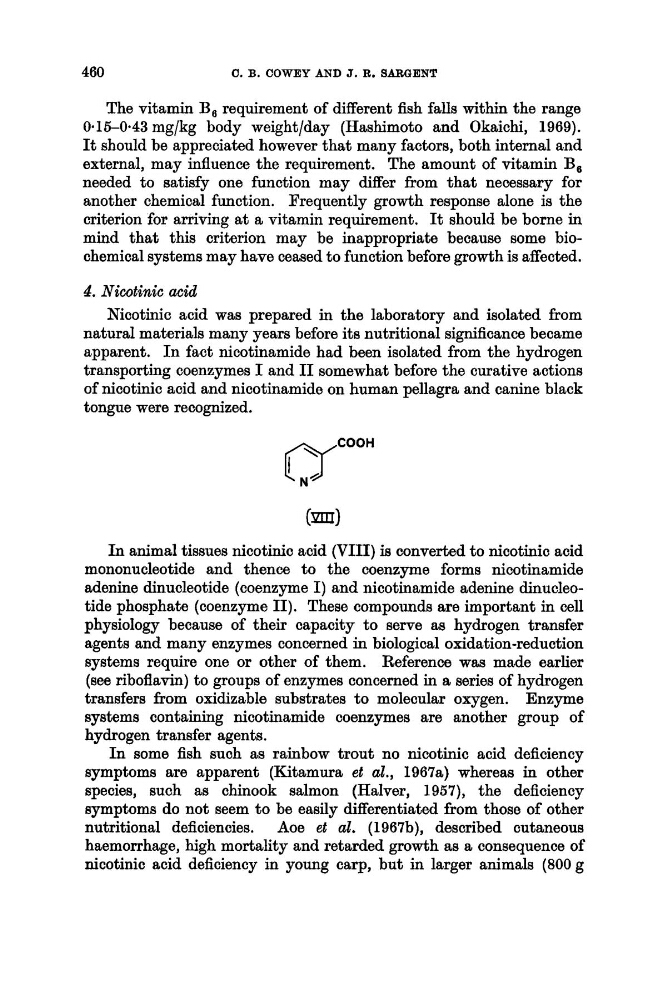
In animal tissues nicotinic acid (VIII) is converted to nicotinic acid
mononucleotide and thence to the coenzyme forms nicotinamide
adenine dinucleotide (coenzyme I) and nicotinamide adenine dinucleotide phosphate (coenzyme 11). These compounds are important in cell
physiology because of their capacity to serve as hydrogen transfer
agents and many enzymes concerned in biological oxidation-reduction
systems require one or other of them. Reference was made earlier
(see riboflavin) to groups of enzymes concerned in a series of hydrogen
transfers from oxidizable substrates to molecular oxygen. Enzyme
systems containing nicotinamide coenzymes are another group of
hydrogen transfer agents.
In some fish such as rainbow trout no nicotinic acid deficiency
symptoms are apparent (Kitamura et al., 1967a) whereas in other
species, such as chinook salmon (Halver, 1957), the deficiency
symptoms do not seem to be easily differentiated from those of other
nutritional deficiencies. Aoe et al. (1 967b), described cutaneous
haemorrhage, high mortality and retarded growth as a consequence of
nicotinic acid deficiency in young carp, but in larger animals (800g
U. B. COWEY AND J. R. SAFWENT
The vitamin B, requirement of different fish falls within the range
0.15-0.43 mg/kg body weight/day (Hashimoto and Okaichi, 1969).
It should be appreciated however that many factors, both internal and
external, may influence the requirement. The amount of vitamin B,
needed to satisfy one function may differ from that necessary for
another chemical function. Frequently growth response alone is the
criterion for arriving at a, vitamin requirement. It should be borne in
mind that this criterion may be inappropriate because some biochemical systems may have ceased to function before growth is affected.
4. Nicotinic acid
Nicotinic acid was prepared in the laboratory and isolated from
natural materials many years before its nutritional significance became
apparent. I n fact nicotinamide had been isolated from the hydrogen
transporting coenzymes I and I1 somewhat before the curative actions
of nicotinic acid and nicotinamide on human pellagra and canine black
tongue were recognized.
In animal tissues nicotinic acid (VIII) is converted to nicotinic acid
mononucleotide and thence to the coenzyme forms nicotinamide
adenine dinucleotide (coenzyme I) and nicotinamide adenine dinucleotide phosphate (coenzyme 11). These compounds are important in cell
physiology because of their capacity to serve as hydrogen transfer
agents and many enzymes concerned in biological oxidation-reduction
systems require one or other of them. Reference was made earlier
(see riboflavin) to groups of enzymes concerned in a series of hydrogen
transfers from oxidizable substrates to molecular oxygen. Enzyme
systems containing nicotinamide coenzymes are another group of
hydrogen transfer agents.
In some fish such as rainbow trout no nicotinic acid deficiency
symptoms are apparent (Kitamura et al., 1967a) whereas in other
species, such as chinook salmon (Halver, 1957), the deficiency
symptoms do not seem to be easily differentiated from those of other
nutritional deficiencies. Aoe et al. (1 967b), described cutaneous
haemorrhage, high mortality and retarded growth as a consequence of
nicotinic acid deficiency in young carp, but in larger animals (800g