

FISH NUTRITION
455
protein, the myofibrillar fraction (myosin and actomyosin) being
significantly decreased in the a-tocopherol deficient fish while a relative
increase in stroma protein occurred.
The concentration of a-tocopherol in the major muscle tissues of a
number of fish fell in the range 210-330pg/g lipid (Ackman and
Cormier, 1967). Lipids from cod (Gadus morhua L.) and mackerel
(Scomber scombrus L.) livers showed slightly higher values (430 p.g/g
lipid). Red muscle from the lateral line of cod was richer (630 pg/g
lipid) in a-tocopherol than white muscle tissue. This higher a-tocopherol level in the red muscle was ascribed by Ackman and Cormier to
its greater metabolic activity rather than with the minor differences
in type of lipid.
a-Tocopherol requirement in fish is of the order of 3-10 mg per
100 g dry diet.
4. Vitamin K
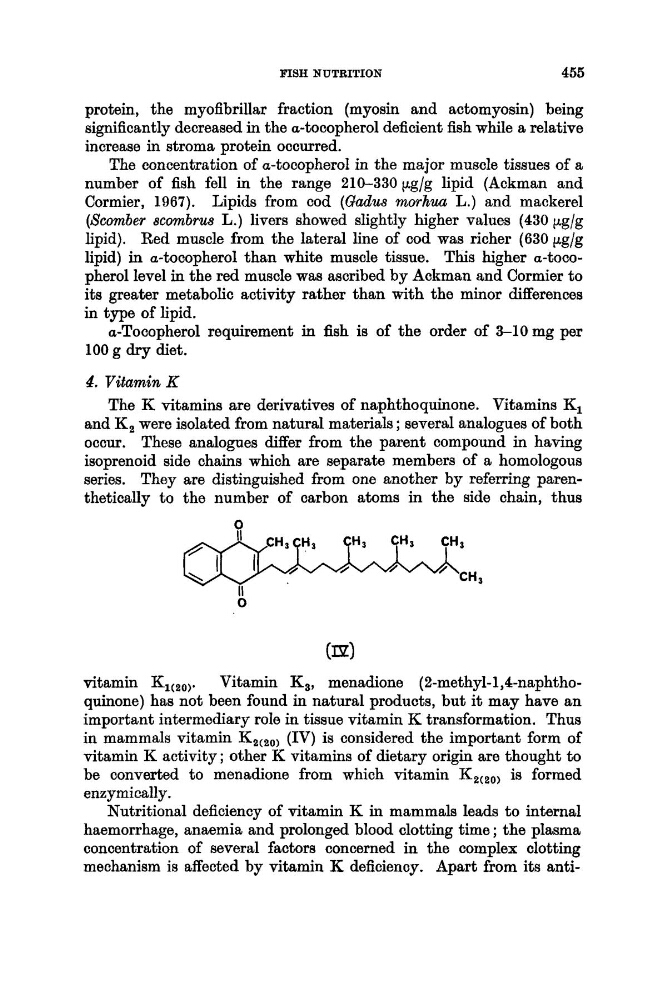
The K vitamins are derivatives of naphthoquinone. Vitamins K,
and K, were isolated from natural materials ; several analogues of both
occur. These analogues differ from the parent compound in having
isoprenoid side chains which are separate members of a homologous
series. They are distinguished from one another by referring parenthetically to the number of carbon atoms in the side chain, thus
0
(m)
vitamin K,(,,,.
Vitamin K,, menadione (2-methyl-1,4-naphthoquinone) has not been found in natural products, but it may have an
important intermediary role in tissue vitamin K transformation. Thus
in mammals vitamin KZo,, (IV) is considered the important form of
vitamin K activity ; other K vitamins of dietary origin are thought to
be converted to menadione from which vitamin K,(,,, is formed
enz ymically .
Nutritional deficiency of vitamin K in mammals leads to internal
haemorrhage, anaemia and prolonged blood clotting time ; the plasma
concentration of several factors concerned in the complex clotting
mechanism is affected by vitamin K deficiency. Apart from its anti-
455
protein, the myofibrillar fraction (myosin and actomyosin) being
significantly decreased in the a-tocopherol deficient fish while a relative
increase in stroma protein occurred.
The concentration of a-tocopherol in the major muscle tissues of a
number of fish fell in the range 210-330pg/g lipid (Ackman and
Cormier, 1967). Lipids from cod (Gadus morhua L.) and mackerel
(Scomber scombrus L.) livers showed slightly higher values (430 p.g/g
lipid). Red muscle from the lateral line of cod was richer (630 pg/g
lipid) in a-tocopherol than white muscle tissue. This higher a-tocopherol level in the red muscle was ascribed by Ackman and Cormier to
its greater metabolic activity rather than with the minor differences
in type of lipid.
a-Tocopherol requirement in fish is of the order of 3-10 mg per
100 g dry diet.
4. Vitamin K
The K vitamins are derivatives of naphthoquinone. Vitamins K,
and K, were isolated from natural materials ; several analogues of both
occur. These analogues differ from the parent compound in having
isoprenoid side chains which are separate members of a homologous
series. They are distinguished from one another by referring parenthetically to the number of carbon atoms in the side chain, thus
0
(m)
vitamin K,(,,,.
Vitamin K,, menadione (2-methyl-1,4-naphthoquinone) has not been found in natural products, but it may have an
important intermediary role in tissue vitamin K transformation. Thus
in mammals vitamin KZo,, (IV) is considered the important form of
vitamin K activity ; other K vitamins of dietary origin are thought to
be converted to menadione from which vitamin K,(,,, is formed
enz ymically .
Nutritional deficiency of vitamin K in mammals leads to internal
haemorrhage, anaemia and prolonged blood clotting time ; the plasma
concentration of several factors concerned in the complex clotting
mechanism is affected by vitamin K deficiency. Apart from its anti-