

456
U. B. COWEY AND J. R. SARQENT
haemorrhagic role vitamin K may also function in coupled electron
transport and phosphorylation, because a competitive inhibitor of
vitamin K, dicoumarol, uncouples these processes in mammalian
mitochondria.
Information on the role of vitamin K in fish is sparse. Halver (1957)
reported vitamin K essential for normal growth in chinook salmon.
Poston (1962) using brook trout compared growth rate, blood
coagulation time and microhaematocrit of fish receiving a complete
diet with those receiving a diet deficient in vitamin K. Omission of
vitamin K from the diet increased coagulation time and depressed
microhaematocrit but had no effect on growth rate. Poston also
examined the effect of added sulphonamide (sulphoguanidine) in both
the aforementioned diets. This would effectively suppress any
vitamin K synthesis by intestinal bacteria. In the event no such
synthesis appeared to occur.
B. Water soluble vitamins
1. Thiamine
Thiamine was first isolated in 1926 and its structure elucidated
during the nineteen thirties. Thiamine functions metabolically as a
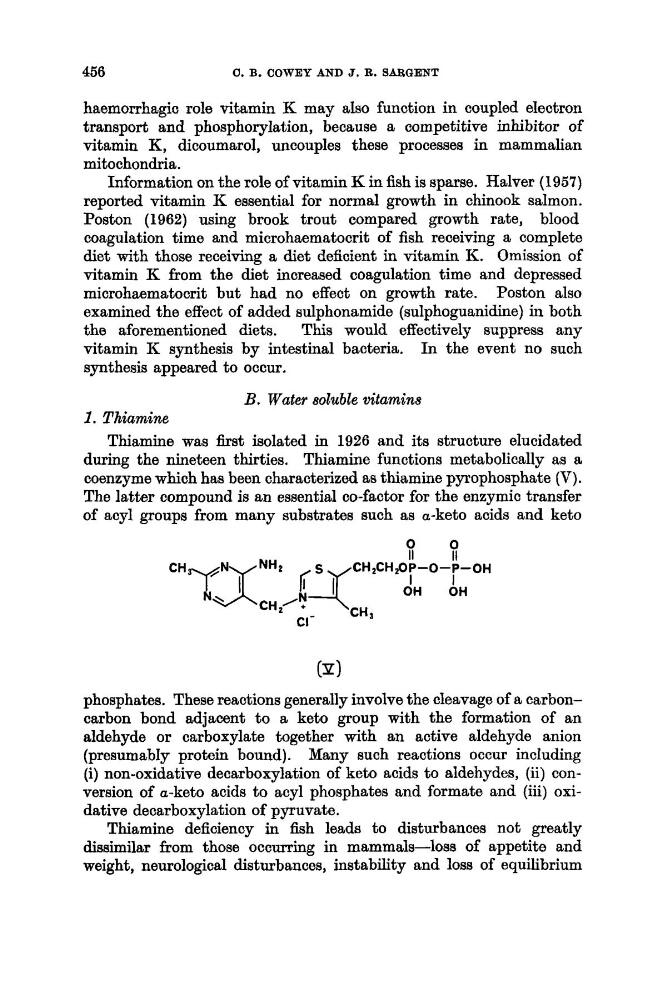
coenzyme which has been characterized as thiamine pyrophosphate (V).
The latter compound is an essential co-factor for the enzymic transfer
of acyl groups from many substrates such as a-keto acids and keto
(TI
phosphates. These reactions generally involve the cleavage of a carboncarbon bond adjacent to a keto group with the formation of an
aldehyde or carboxylate together with an active aldehyde anion
(presumably protein bound). Many such reactions occur incIuding
(i) non-oxidative decarboxylation of keto acids to aldehydes, (ii) conversion of a-keto acids to acyl phosphates and formate and (iii) oxidative decarboxylation of pyruvate.
Thiamine deficiency in fish leads to disturbances not greatly
dissimilar from those occurring in mammals-loss of appetite and
weight, neurological disturbances, instability and loss of equilibrium
U. B. COWEY AND J. R. SARQENT
haemorrhagic role vitamin K may also function in coupled electron
transport and phosphorylation, because a competitive inhibitor of
vitamin K, dicoumarol, uncouples these processes in mammalian
mitochondria.
Information on the role of vitamin K in fish is sparse. Halver (1957)
reported vitamin K essential for normal growth in chinook salmon.
Poston (1962) using brook trout compared growth rate, blood
coagulation time and microhaematocrit of fish receiving a complete
diet with those receiving a diet deficient in vitamin K. Omission of
vitamin K from the diet increased coagulation time and depressed
microhaematocrit but had no effect on growth rate. Poston also
examined the effect of added sulphonamide (sulphoguanidine) in both
the aforementioned diets. This would effectively suppress any
vitamin K synthesis by intestinal bacteria. In the event no such
synthesis appeared to occur.
B. Water soluble vitamins
1. Thiamine
Thiamine was first isolated in 1926 and its structure elucidated
during the nineteen thirties. Thiamine functions metabolically as a
coenzyme which has been characterized as thiamine pyrophosphate (V).
The latter compound is an essential co-factor for the enzymic transfer
of acyl groups from many substrates such as a-keto acids and keto
(TI
phosphates. These reactions generally involve the cleavage of a carboncarbon bond adjacent to a keto group with the formation of an
aldehyde or carboxylate together with an active aldehyde anion
(presumably protein bound). Many such reactions occur incIuding
(i) non-oxidative decarboxylation of keto acids to aldehydes, (ii) conversion of a-keto acids to acyl phosphates and formate and (iii) oxidative decarboxylation of pyruvate.
Thiamine deficiency in fish leads to disturbances not greatly
dissimilar from those occurring in mammals-loss of appetite and
weight, neurological disturbances, instability and loss of equilibrium