

454
0. B. OOWEY AND J. R. SARGENT
CH,
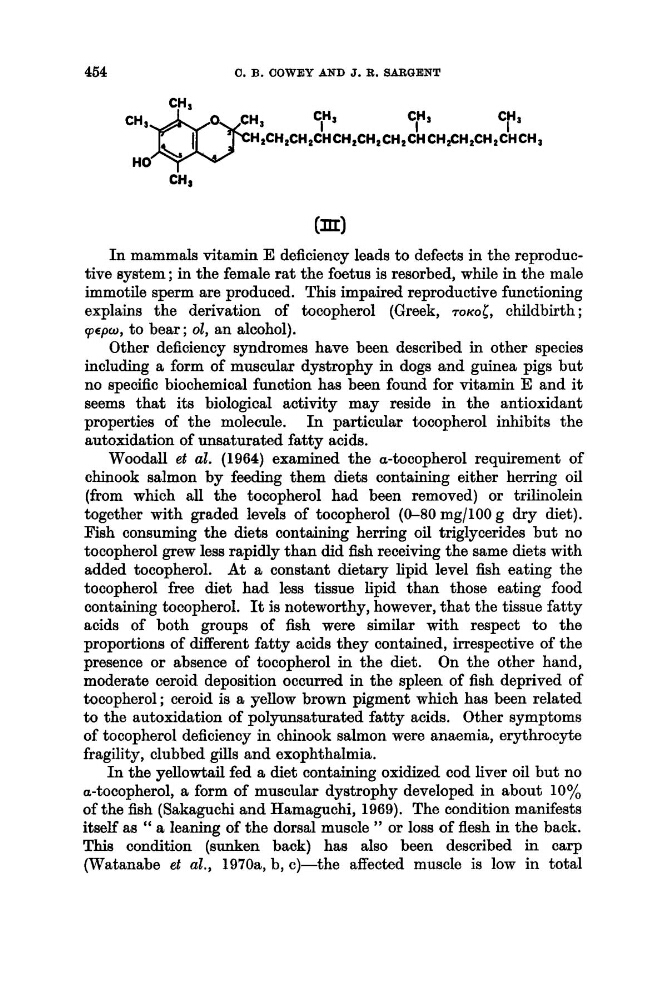
(m)
In mammals vitamin E deficiency leads to defects in the reproductive system ; in the female rat the foetus is resorbed, while in the male
immotile sperm are produced. This impaired reproductive functioning
explains the derivation of tocopherol (Greek, TOKO(, childbirth ;
qxpw, to bear; ol, an alcohol).
Other deficiency syndromes have been described in other species
including a form of muscular dystrophy in dogs and guinea pigs but
no specific biochemical function has been found for vitamin E and it
seems that its biological activity may reside in the antioxidant
properties of the molecule. I n particular tocopherol inhibits the
autoxidation of unsaturated fatty acids.
Woodall et al. (1964) examined the a-tocopherol requirement of
chinook salmon by feeding them diets containing either herring oil
(from which all the tocopherol had been removed) or trilinolein
together with graded levels of tocopherol (0-80 mg/lOO g dry diet).
Fish consuming the diets containing herring oil triglycerides but no
tocopherol grew less rapidly than did fish receiving the same diets with
added tocopherol. At a constant dietary lipid level fish eating the
tocopherol free diet had less tissue lipid than those eating food
containing tocopherol. It is noteworthy, however, that the tissue fatty
acids of both groups of fish were similar with respect to the
proportions of different fatty acids they contained, irrespective of the
presence or absence of tocopherol in the diet. On the other hand,
moderate ceroid deposition occurred in the spleen of fish deprived of
tocopherol ; ceroid is a yellow brown pigment which has been related
to the autoxidation of polyunsaturated fatty acids. Other symptoms
of tocopherol deficiency in chinook salmon were anaemia, erythrocyte
fragility, clubbed gills and exophthalmia.
In the yellowtail fed a diet containing oxidized cod liver oil but no
a-tocopherol, a form of muscular dystrophy developed in about 10%
of the fish (Sakaguchi and Hamaguchi, 1969). The condition manifests
itself as “ a leaning of the dorsal muscle ” or loss of flesh in the back.
This condition (sunken back) has also been described in carp
(Watanabe et al., 1970a, b, c)-the affected muscle is low in total
0. B. OOWEY AND J. R. SARGENT
CH,
(m)
In mammals vitamin E deficiency leads to defects in the reproductive system ; in the female rat the foetus is resorbed, while in the male
immotile sperm are produced. This impaired reproductive functioning
explains the derivation of tocopherol (Greek, TOKO(, childbirth ;
qxpw, to bear; ol, an alcohol).
Other deficiency syndromes have been described in other species
including a form of muscular dystrophy in dogs and guinea pigs but
no specific biochemical function has been found for vitamin E and it
seems that its biological activity may reside in the antioxidant
properties of the molecule. I n particular tocopherol inhibits the
autoxidation of unsaturated fatty acids.
Woodall et al. (1964) examined the a-tocopherol requirement of
chinook salmon by feeding them diets containing either herring oil
(from which all the tocopherol had been removed) or trilinolein
together with graded levels of tocopherol (0-80 mg/lOO g dry diet).
Fish consuming the diets containing herring oil triglycerides but no
tocopherol grew less rapidly than did fish receiving the same diets with
added tocopherol. At a constant dietary lipid level fish eating the
tocopherol free diet had less tissue lipid than those eating food
containing tocopherol. It is noteworthy, however, that the tissue fatty
acids of both groups of fish were similar with respect to the
proportions of different fatty acids they contained, irrespective of the
presence or absence of tocopherol in the diet. On the other hand,
moderate ceroid deposition occurred in the spleen of fish deprived of
tocopherol ; ceroid is a yellow brown pigment which has been related
to the autoxidation of polyunsaturated fatty acids. Other symptoms
of tocopherol deficiency in chinook salmon were anaemia, erythrocyte
fragility, clubbed gills and exophthalmia.
In the yellowtail fed a diet containing oxidized cod liver oil but no
a-tocopherol, a form of muscular dystrophy developed in about 10%
of the fish (Sakaguchi and Hamaguchi, 1969). The condition manifests
itself as “ a leaning of the dorsal muscle ” or loss of flesh in the back.
This condition (sunken back) has also been described in carp
(Watanabe et al., 1970a, b, c)-the affected muscle is low in total