

THE BIOLOGY O F WOOD-BORING TEREDINID MOLLUSCS
387
Posteriorly four ducts are discernible, two afferent and two efferent
renals. The kidney opens into the epibranchial chamber through the
renal pores beneath the visceral ganglion. Communication with the
pericardium is maintained through the afferent renal or reno-pericardial ducts by way of the reno-pericardial openings.
White (1942) who described the pericardial glands in the lamellibranchs in detail, distinguished between an “ auricular ” position when
the modified region of the pericardial wall is in close relation with the
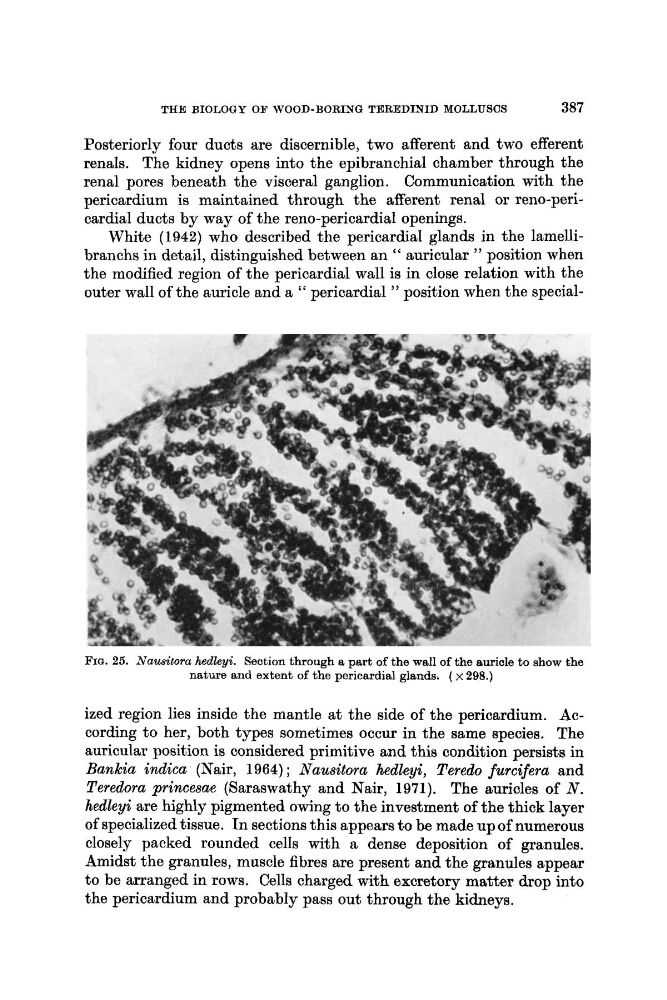
outer wall of the auricle and a ‘‘ pericardial ” position when the specialFlu. 26. Nausitora hedleyi. Section through a part of the wall of the auricle to show the
nature and extent of the pericardial glands. ( x 298.)
ized region lies inside the mantle at the side of the pericardium. According to her, both types sometimes occur in the same species. The
auricular position is considered primitive and this condition persists in
Bankia indica (Nair, 1964) ; Nausitora hedleyi, Teredo furcifera and
Teredora princesae (Saraswathy and Nair, 1971). The auricles of N .
hedleyi are highly pigmented owing to the investment of the thick layer
of specialized tissue. In sections this appears to be made up of numerous
closely packed rounded cells with a dense deposition of granules.
Amidst the granules, muscle fibres are present and the granules appear
to be arranged in rows. Cells charged with excretory matter drop into
the pericardium and probably pass out through the kidneys.
387
Posteriorly four ducts are discernible, two afferent and two efferent
renals. The kidney opens into the epibranchial chamber through the
renal pores beneath the visceral ganglion. Communication with the
pericardium is maintained through the afferent renal or reno-pericardial ducts by way of the reno-pericardial openings.
White (1942) who described the pericardial glands in the lamellibranchs in detail, distinguished between an “ auricular ” position when
the modified region of the pericardial wall is in close relation with the
outer wall of the auricle and a ‘‘ pericardial ” position when the specialFlu. 26. Nausitora hedleyi. Section through a part of the wall of the auricle to show the
nature and extent of the pericardial glands. ( x 298.)
ized region lies inside the mantle at the side of the pericardium. According to her, both types sometimes occur in the same species. The
auricular position is considered primitive and this condition persists in
Bankia indica (Nair, 1964) ; Nausitora hedleyi, Teredo furcifera and
Teredora princesae (Saraswathy and Nair, 1971). The auricles of N .
hedleyi are highly pigmented owing to the investment of the thick layer
of specialized tissue. In sections this appears to be made up of numerous
closely packed rounded cells with a dense deposition of granules.
Amidst the granules, muscle fibres are present and the granules appear
to be arranged in rows. Cells charged with excretory matter drop into
the pericardium and probably pass out through the kidneys.