

386
N. BALAKRISHNAN NllIR AND M. SARASWATHY
globin is of advantage in view of the importance of these muscles in
boring. Ansell and Nair (1968) demonstrated the occurrence of haemocoelic erythrocytes in the blood of Xylophuga dorsalis, the first record of
these in a member of the Adesmacea. The isolated instances of the
incidence of haemoglobin in solution in the haemolymph, in the
ctenidium, and in the haemocoelic erythrocytes elsewhere in the
Bivalvia have been reviewed by Read (1966).
11. The excretory system
Excretion is effected in shipworms as in other molluscs by two sets
of organs, the kidneys and the pericardial glands. Sigerfoos (1908) gave
the first detailed description of the kidney in Bankia gouldi without
mentioning the pericardial glands. Nair (1964) has described both kidney and pericardial glands in Bankia indica and Lane (1959) gave a
brief account of the disposition of the renal organs in Teredo sp. Detailed descriptions of the kidney and the pericardial glands in Nausitora
hedleyi, Teredo furcifera and Teredora princesae have been given by
Saraswathy and Nair (1971).
The kidney lies between the posterior adductor muscle and the
visceralganglion above the pericardium. Behind the posterior adductor
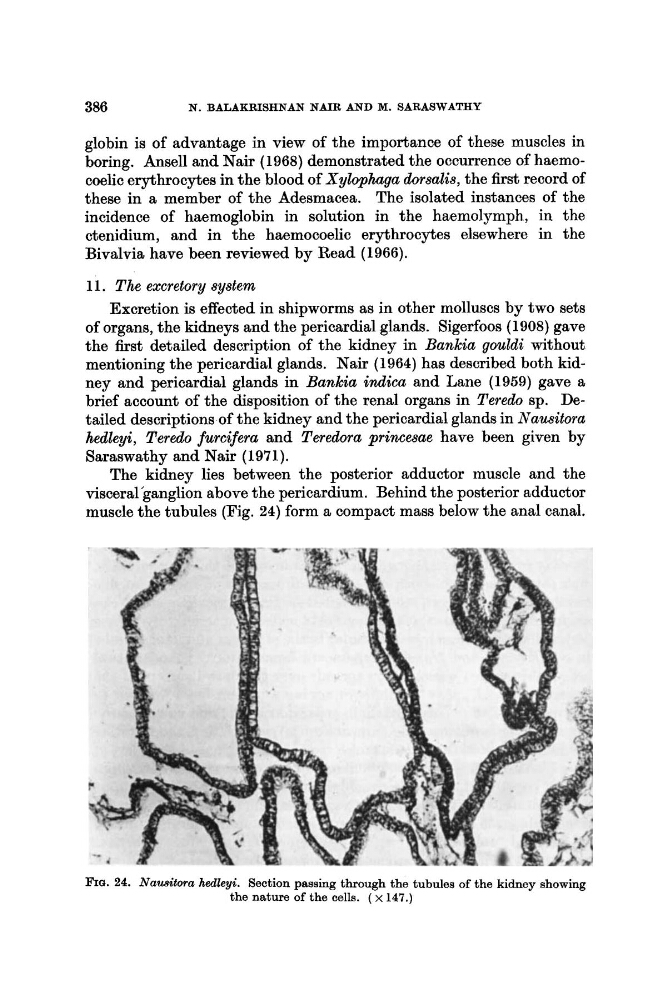
muscle the tubules (Fig. 24) form a compact mass below the anal canal.
FIa. 24. Nausitora hedleyi. Section passing through the tubules of the kidney showing
the nature of the cells. ( x 147.)
N. BALAKRISHNAN NllIR AND M. SARASWATHY
globin is of advantage in view of the importance of these muscles in
boring. Ansell and Nair (1968) demonstrated the occurrence of haemocoelic erythrocytes in the blood of Xylophuga dorsalis, the first record of
these in a member of the Adesmacea. The isolated instances of the
incidence of haemoglobin in solution in the haemolymph, in the
ctenidium, and in the haemocoelic erythrocytes elsewhere in the
Bivalvia have been reviewed by Read (1966).
11. The excretory system
Excretion is effected in shipworms as in other molluscs by two sets
of organs, the kidneys and the pericardial glands. Sigerfoos (1908) gave
the first detailed description of the kidney in Bankia gouldi without
mentioning the pericardial glands. Nair (1964) has described both kidney and pericardial glands in Bankia indica and Lane (1959) gave a
brief account of the disposition of the renal organs in Teredo sp. Detailed descriptions of the kidney and the pericardial glands in Nausitora
hedleyi, Teredo furcifera and Teredora princesae have been given by
Saraswathy and Nair (1971).
The kidney lies between the posterior adductor muscle and the
visceralganglion above the pericardium. Behind the posterior adductor
muscle the tubules (Fig. 24) form a compact mass below the anal canal.
FIa. 24. Nausitora hedleyi. Section passing through the tubules of the kidney showing
the nature of the cells. ( x 147.)