

THE BIOLOGY O F WOOD-BORING TEREDINID MOLLUSCS
353
slightly bent inwards, appears a spherical knob-like thickening which
forms a movable articulation with a knob borne by the opposite valve.
This articulation is a feature peculiar to teredines and some pholads.
Dorsally the margin of the middle lobe curves inwards forming a pronounced umbonal region, the tip or umbonal knob constituting a freely
movable articulation with the similar process of the opposite valve.
The elastic ligament is greatly reduced. The movement of the shell is
around the axis formed by the umbonal knob and the ventral knob.
The anterior and posterior adductor muscles can now oppose each
other in action. Extending from the umbonal knob on the inner side of
the shell is a broad sickle-shaped blade-like process, the apophysis,
accommodated within the concavity of the middle lobe. This plate
serves for the origin of the pedal retractor group of muscles.
The shape of the larval shell of Teredo is that of a typical bivalve
with equal convex valves nearly circular in outline. The valves are
united by a well-developed hinge. After settlement and metamorphosis
the pattern of growth along concentric lines changes to very unequal
growth in different parts of the valves causing a transformation of the
shell from the typical bivalve type. The condyles and the apophysis
soon develop and the ventral edges of the valves grow faster than the
remainder, causing them to gape before and behind. With the disappearance of the hinge apparatus and the development of additional
articulation in the form of the condyles, the valves, instead of articulating at the hinge, begin to rock upon the knobs along a median transverse axis.
The ventral edges of the valves grow faster than the rest of the shell
causing the formation in the anterior edge of what soon becomes a
right angle (Sigerfoos, 1908, Nair, 1956a). The median portion thus
becomes the most prominent part of the shell. The posterior border
also grows rapidly and flares outward so as to give better attachment
for the posterior adductor muscle. A small portion of the dorsal
anterior edge also flares outward, providing a face for the insertion of
the anterior adductor muscle.
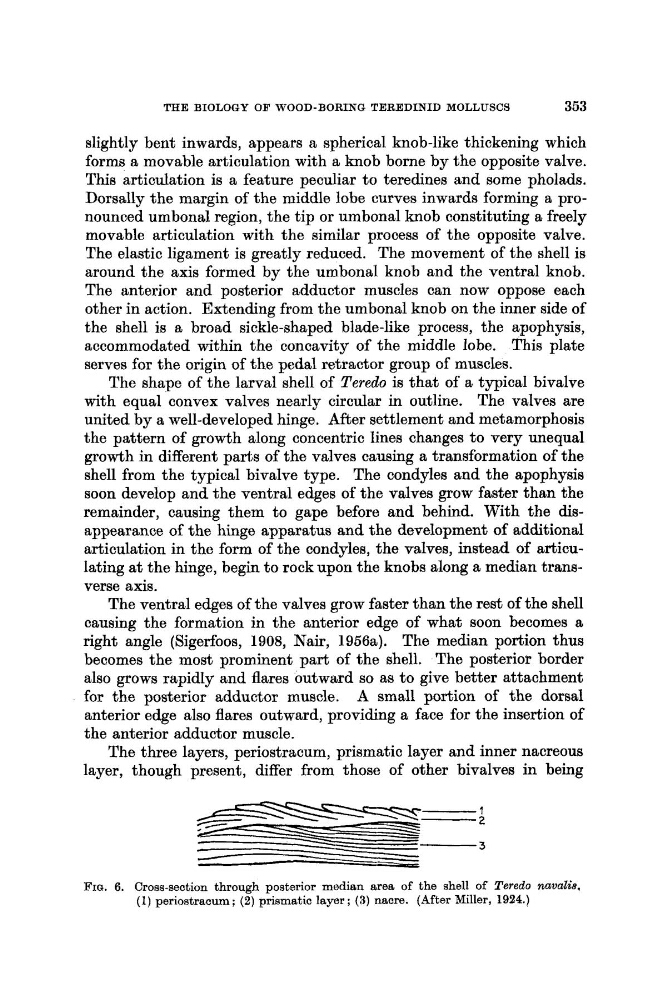
The three layers, periostracum, prismatic layer and inner nacreous
layer, though present, differ from those of other bivalves in being
FIQ. 6. Cross-section through posterior median area of the shell of Teredo navalia.
(1) periostracum; (2) prismatic layer; (3) nacre. (After Miller, 1924.)
353
slightly bent inwards, appears a spherical knob-like thickening which
forms a movable articulation with a knob borne by the opposite valve.
This articulation is a feature peculiar to teredines and some pholads.
Dorsally the margin of the middle lobe curves inwards forming a pronounced umbonal region, the tip or umbonal knob constituting a freely
movable articulation with the similar process of the opposite valve.
The elastic ligament is greatly reduced. The movement of the shell is
around the axis formed by the umbonal knob and the ventral knob.
The anterior and posterior adductor muscles can now oppose each
other in action. Extending from the umbonal knob on the inner side of
the shell is a broad sickle-shaped blade-like process, the apophysis,
accommodated within the concavity of the middle lobe. This plate
serves for the origin of the pedal retractor group of muscles.
The shape of the larval shell of Teredo is that of a typical bivalve
with equal convex valves nearly circular in outline. The valves are
united by a well-developed hinge. After settlement and metamorphosis
the pattern of growth along concentric lines changes to very unequal
growth in different parts of the valves causing a transformation of the
shell from the typical bivalve type. The condyles and the apophysis
soon develop and the ventral edges of the valves grow faster than the
remainder, causing them to gape before and behind. With the disappearance of the hinge apparatus and the development of additional
articulation in the form of the condyles, the valves, instead of articulating at the hinge, begin to rock upon the knobs along a median transverse axis.
The ventral edges of the valves grow faster than the rest of the shell
causing the formation in the anterior edge of what soon becomes a
right angle (Sigerfoos, 1908, Nair, 1956a). The median portion thus
becomes the most prominent part of the shell. The posterior border
also grows rapidly and flares outward so as to give better attachment
for the posterior adductor muscle. A small portion of the dorsal
anterior edge also flares outward, providing a face for the insertion of
the anterior adductor muscle.
The three layers, periostracum, prismatic layer and inner nacreous
layer, though present, differ from those of other bivalves in being
FIQ. 6. Cross-section through posterior median area of the shell of Teredo navalia.
(1) periostracum; (2) prismatic layer; (3) nacre. (After Miller, 1924.)