

354
X i . BALAKRISHNAN NAIR AND M. SARASWATHY
1
2
3
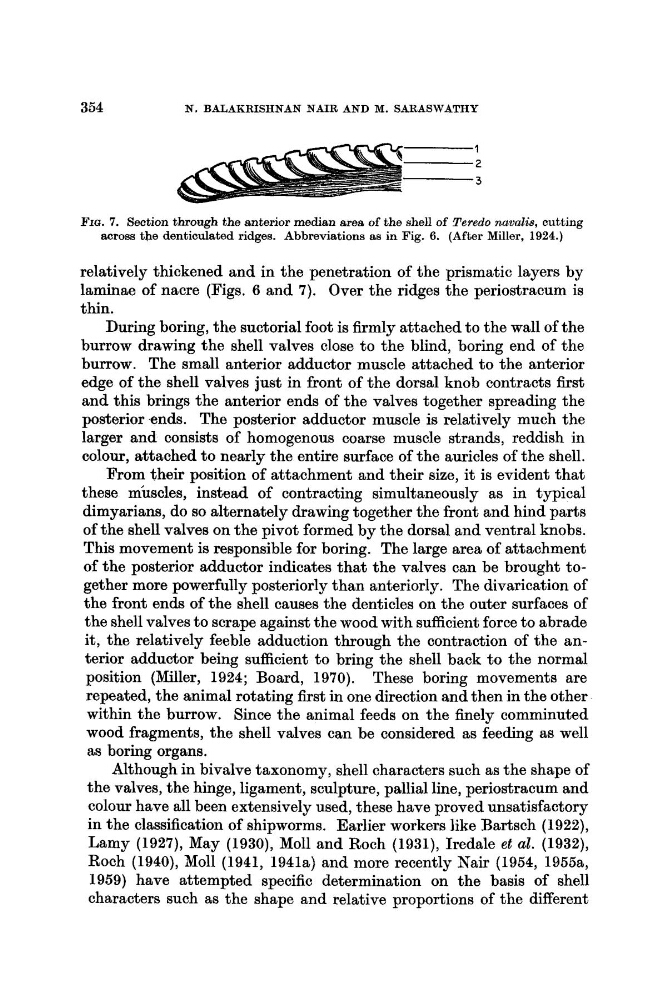
Fra. 7. Section through the anterior median area of the shell of Teredo Itavnlis, cutting
across the denticdated ridges. Abbreviations as in Fig. 6. (After Miller, 1924.)
relatively thickened and in the penetration of the prismatic layers by
laminae of nacre (Figs. 6 and 7). Over the ridges the periostracum is
thin.
During boring, the suctorial foot is f?rmly attached to the wall of the
burrow drawing the shell valves close to the blind, boring end of the
burrow. The small anterior adductor muscle attached to the anterior
edge of the shell valves just in front of the dorsal knob contracts first
and this brings the anterior ends of the valves together spreading the
posterior ends. The posterior adductor muscle is relatively much the
larger and consists of homogenous coarse muscle strands, reddish in
colour, attached to nearly the entire surface of the auricles of the shell.
From their position of attachment and their size, it is evident that
these muscles, instead of contracting simultaneously as in typical
dimyarians, do so alternately drawing together the front and hind parts
of the shell valves on the pivot formed by the dorsal and ventral knobs.
This movement is responsible for boring. The large area of attachment
of the posterior adductor indicates that the valves can be brought together more powerfully posteriorly than anteriorly. The divarication of
the front ends of the shell causes the denticles on the outer surfaces of
the shell valves to scrape against the wood with sufficient force to abrade
it, the relatively feeble adduction through the contraction of the anterior adductor being sufficient t o bring the shell back to the normal
position (Miller, 1924; Board, 1970). These boring movements are
repeated, the animal rotating first in one direction and then in the other
within the burrow. Since the animal feeds on the finely comminuted
wood fragments, the shell valves can be considered as feeding as well
as boring organs.
Although in bivalve taxonomy, shell characters such as the shape of
the valves, the hinge, ligament, sculpture, pallial line, periostracum and
colour have all been extensively used, these have proved unsatisfactory
in the classification of shipworms. Earlier workers like Bartsch (1922),
Lamy (1927), May (1930), Moll and Roch (1931), Iredale et al. (1932),
Roch (1940), Moll (1941, 1941a) and more recently Nair (1954, 1955a,
1959) have attempted specific determination on the basis of shell
characters such as the shape and relative proportions of the different
X i . BALAKRISHNAN NAIR AND M. SARASWATHY
1
2
3
Fra. 7. Section through the anterior median area of the shell of Teredo Itavnlis, cutting
across the denticdated ridges. Abbreviations as in Fig. 6. (After Miller, 1924.)
relatively thickened and in the penetration of the prismatic layers by
laminae of nacre (Figs. 6 and 7). Over the ridges the periostracum is
thin.
During boring, the suctorial foot is f?rmly attached to the wall of the
burrow drawing the shell valves close to the blind, boring end of the
burrow. The small anterior adductor muscle attached to the anterior
edge of the shell valves just in front of the dorsal knob contracts first
and this brings the anterior ends of the valves together spreading the
posterior ends. The posterior adductor muscle is relatively much the
larger and consists of homogenous coarse muscle strands, reddish in
colour, attached to nearly the entire surface of the auricles of the shell.
From their position of attachment and their size, it is evident that
these muscles, instead of contracting simultaneously as in typical
dimyarians, do so alternately drawing together the front and hind parts
of the shell valves on the pivot formed by the dorsal and ventral knobs.
This movement is responsible for boring. The large area of attachment
of the posterior adductor indicates that the valves can be brought together more powerfully posteriorly than anteriorly. The divarication of
the front ends of the shell causes the denticles on the outer surfaces of
the shell valves to scrape against the wood with sufficient force to abrade
it, the relatively feeble adduction through the contraction of the anterior adductor being sufficient t o bring the shell back to the normal
position (Miller, 1924; Board, 1970). These boring movements are
repeated, the animal rotating first in one direction and then in the other
within the burrow. Since the animal feeds on the finely comminuted
wood fragments, the shell valves can be considered as feeding as well
as boring organs.
Although in bivalve taxonomy, shell characters such as the shape of
the valves, the hinge, ligament, sculpture, pallial line, periostracum and
colour have all been extensively used, these have proved unsatisfactory
in the classification of shipworms. Earlier workers like Bartsch (1922),
Lamy (1927), May (1930), Moll and Roch (1931), Iredale et al. (1932),
Roch (1940), Moll (1941, 1941a) and more recently Nair (1954, 1955a,
1959) have attempted specific determination on the basis of shell
characters such as the shape and relative proportions of the different