

SCATOLOCTCAL STUDIES O F THE BIVALVIA (ITOLLTSCA)
337
of mucous substance. The balls thus formed by the same animal within
a short time vary greatly in size and shape. For an animal with shells
7.7 cm long, the diameter of faecal balls fluctuates in the range 1.8 mm
to 2.1 mm and that of constituent rods 0.15 mm t o 0.20 mm.
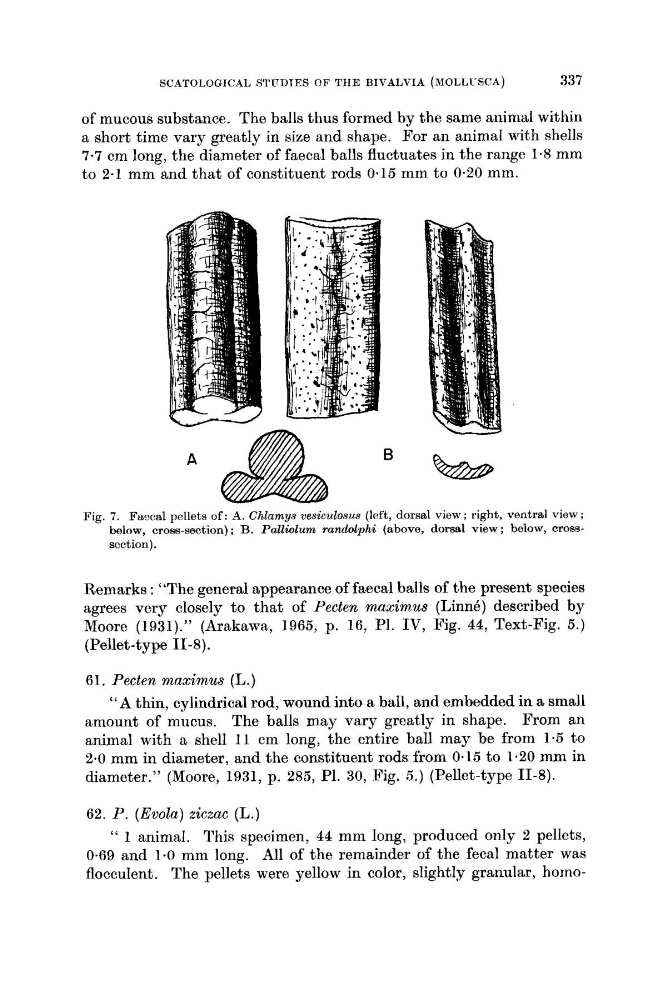
Fig. 7. Fascal pellets of: A. Chlamys wesiculosus (left, dorsal view ; right, ventral view ;
below, cross-section) ; B. PaZZiolum randolphi (above, dorsal view ; below, crosssection).
Remarks : “The general appearance of faecal balls of the present species
agrees very closely to that of Pecten maximus (LinnB) described by
Moore (1931).” (Arakawa, 1965, p. 16, P1. IV, Fig. 44, Text-Fig. 5 . )
(Pellet -type 11- 8).
61. Pecten maximus (L.)
“ A thin, cylindrical rod, wound into a ball, and embedded in a small
amount of mucus.
From an
animal with a shell 11 cm long, the entire ball may be from 1.5 t o
2.0 mm in diameter, and the constituent rods from 0.15 to 1.20 mm in
diameter.” (Moore, 1931, p. 285, P1. 30, Fig. 5 . ) (Pellet-type 11-8).
The balls may vary greatly in shape.
62. P. (Evola) ziczac (L.)
“ 1 animal. This specimen, 44 mm long, produced only 2 pellets,
0.69 and 1.0 mm long. All of the remainder of the fecal matter was
flocculent. The pellets were yellow in color, slightly granular, homo-
337
of mucous substance. The balls thus formed by the same animal within
a short time vary greatly in size and shape. For an animal with shells
7.7 cm long, the diameter of faecal balls fluctuates in the range 1.8 mm
to 2.1 mm and that of constituent rods 0.15 mm t o 0.20 mm.
Fig. 7. Fascal pellets of: A. Chlamys wesiculosus (left, dorsal view ; right, ventral view ;
below, cross-section) ; B. PaZZiolum randolphi (above, dorsal view ; below, crosssection).
Remarks : “The general appearance of faecal balls of the present species
agrees very closely to that of Pecten maximus (LinnB) described by
Moore (1931).” (Arakawa, 1965, p. 16, P1. IV, Fig. 44, Text-Fig. 5 . )
(Pellet -type 11- 8).
61. Pecten maximus (L.)
“ A thin, cylindrical rod, wound into a ball, and embedded in a small
amount of mucus.
From an
animal with a shell 11 cm long, the entire ball may be from 1.5 t o
2.0 mm in diameter, and the constituent rods from 0.15 to 1.20 mm in
diameter.” (Moore, 1931, p. 285, P1. 30, Fig. 5 . ) (Pellet-type 11-8).
The balls may vary greatly in shape.
62. P. (Evola) ziczac (L.)
“ 1 animal. This specimen, 44 mm long, produced only 2 pellets,
0.69 and 1.0 mm long. All of the remainder of the fecal matter was
flocculent. The pellets were yellow in color, slightly granular, homo-