

33 0
K O H M A N Y . ARAKAWA
shape, although it is assumed that the normal faeces are formed much
more tightly in the shape of a ball of the size variable with individuals.
They are soft and fragile in consistency, usually carrying a large amount
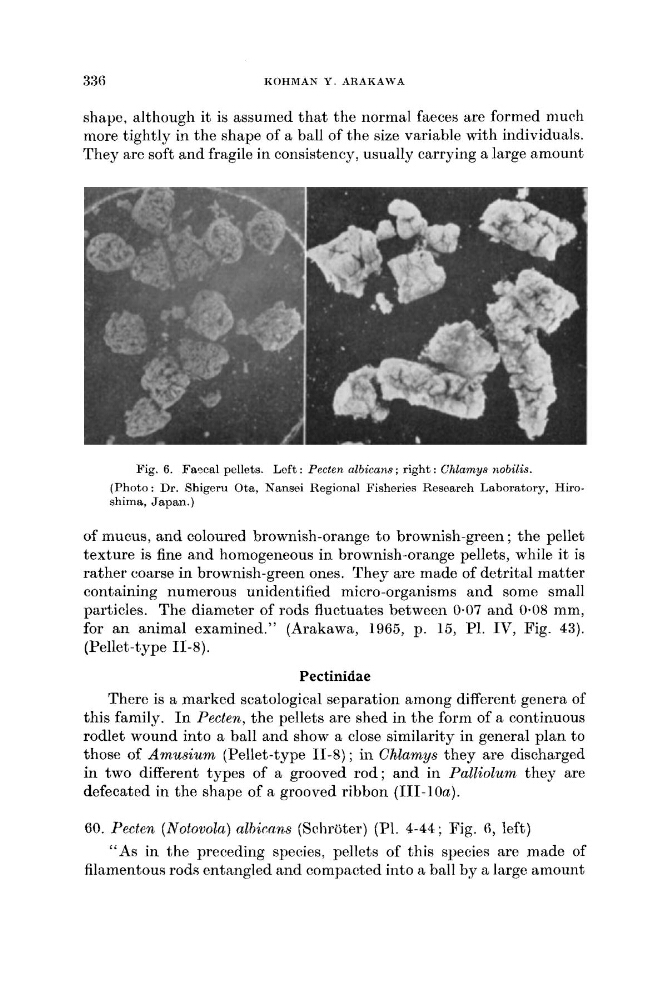
Fig. 6. Fagcal pellets. Loft : Pecten alhicans ; right : Chlamys nohilis.
(Photo : Dr. Shigeru Ota, Nansei Regional Fisheries Research Laboratory, Hiroshima, Japan.)
of mucus, and coloured brownish-orange to brownish-green ; the pellet
texture is fine and homogeneous in brownish-orange pellets, while it is
rather coarse in brownish-green ones. They are made of detrital matter
containing numerous unidentified micro-organisms and some small
particles. The diameter of rods fluctuates between 0.07 and 0.08 mm,
for an animal examined.” (Arakawa, 1965, p. 15, P1. IV, Fig. 43).
(Pellet-type 11-8).
Pectinidae
There is a marked scatological separation among different genera of
this family. I n Pecten, the pellets are shed in the form of a continuous
rodlet wound into a ball and show a close similarity in general plan to
those of Amusium (Pellet-type 11-8) ; in GhEamys they are discharged
in two different types of a grooved rod; and in Palliolum they are
defecated in the shape of a grooved ribbon (111-loa).
60. Pecten (Notovola) nlhicans (Schriiter) (Pl. 4-44; Fig. 6, left)
“As in the preceding species, pellets of this species are made of
filamentous rods entangled and compacted into a ball by a large amount
K O H M A N Y . ARAKAWA
shape, although it is assumed that the normal faeces are formed much
more tightly in the shape of a ball of the size variable with individuals.
They are soft and fragile in consistency, usually carrying a large amount
Fig. 6. Fagcal pellets. Loft : Pecten alhicans ; right : Chlamys nohilis.
(Photo : Dr. Shigeru Ota, Nansei Regional Fisheries Research Laboratory, Hiroshima, Japan.)
of mucus, and coloured brownish-orange to brownish-green ; the pellet
texture is fine and homogeneous in brownish-orange pellets, while it is
rather coarse in brownish-green ones. They are made of detrital matter
containing numerous unidentified micro-organisms and some small
particles. The diameter of rods fluctuates between 0.07 and 0.08 mm,
for an animal examined.” (Arakawa, 1965, p. 15, P1. IV, Fig. 43).
(Pellet-type 11-8).
Pectinidae
There is a marked scatological separation among different genera of
this family. I n Pecten, the pellets are shed in the form of a continuous
rodlet wound into a ball and show a close similarity in general plan to
those of Amusium (Pellet-type 11-8) ; in GhEamys they are discharged
in two different types of a grooved rod; and in Palliolum they are
defecated in the shape of a grooved ribbon (111-loa).
60. Pecten (Notovola) nlhicans (Schriiter) (Pl. 4-44; Fig. 6, left)
“As in the preceding species, pellets of this species are made of
filamentous rods entangled and compacted into a ball by a large amount