

338
KOHMAN Y. ARAKAWA
geneous, and irregular in shape. Moore (1931) observed that all species
of this family which he examined shed rod-like pellets having a triangular or trefoil cross-section. The authors feel that those shed by P.
ziczac and examined by us were either starvation pellets or were pseudofeces which are given off by all filter-feeding animals.” (Manning and
Kumpf, 1959, p. 303.)
63. Chlamys (Cryptopecten) vesiculoides (Dkr) (Fig. 7A)
Pellets are shed in the form of a grooved rod with trilobed section.
Of three longitudinal grooves, the ventral one is shallow and wide,
while the other two are deep and narrow. I n detailed structure, the
pellets consist of two distinctive constituents : the basal part is ribbonshaped with smooth surface and greyish-green in colour, whereas the
dorsal part is rod-shaped with uneven surface and dark grey. The
coarse materials of food localize in the basal part and finer ones
above (Pellet-type IIA-9).
Locality : Suruga Bay (80 m deep), Japan.
Measurements: Breadth of pellets shed by an animal of shell length
13.5 mm is 0.4 mm.
A
B
C
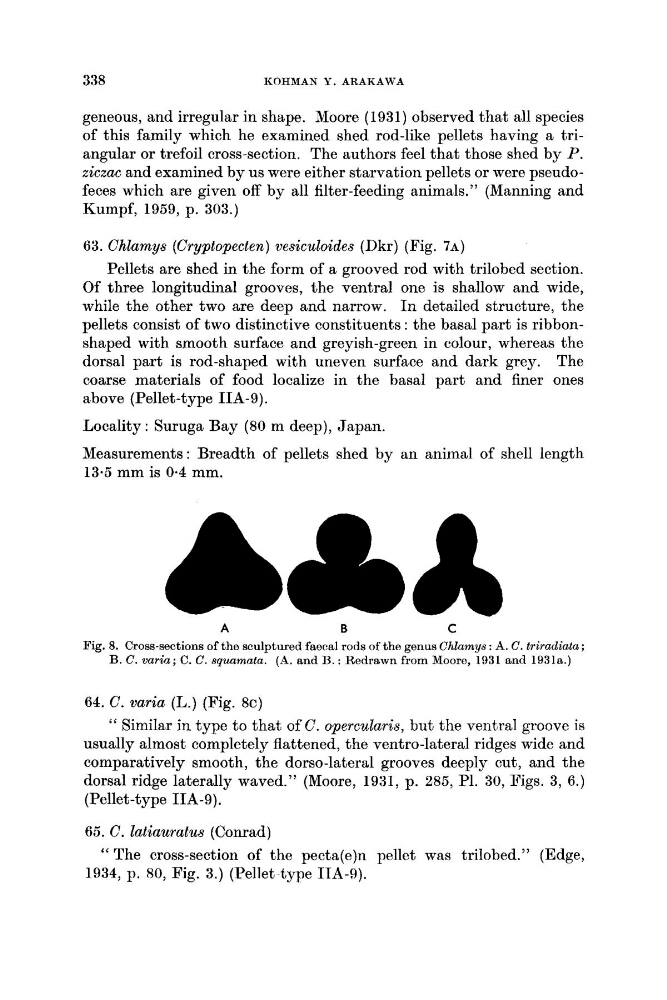
Fig. 8. Cross-sections of the sculptured faecal rods of the genus Chlamys : A. C. triradiata;
B. C . waria; C. C . spuamata. (A. and B. : Redrawn from Moore, 1931 and 1931a.)
64. C. waria (L.) (Fig. 8c)
‘‘ Similar in type to that of C . opercularis, but the ventral groove is
usually almost completely flattened, the ventro-lateral ridges wide and
comparatively smooth, the dorso-lateral grooves deeply cut, and the
dorsal ridge laterally waved.” (Moore, 1931, p. 285, P1. 30, Figs. 3, 6.)
(Pellet-type IIA-9).
65. C. Zatiauratus (Conrad)
1934, p. 80, Fig. 3.) (Pellet-type ITA-9).
“ The cross-section of the pecta(e)n pellet was trilobed.” (Edge,
KOHMAN Y. ARAKAWA
geneous, and irregular in shape. Moore (1931) observed that all species
of this family which he examined shed rod-like pellets having a triangular or trefoil cross-section. The authors feel that those shed by P.
ziczac and examined by us were either starvation pellets or were pseudofeces which are given off by all filter-feeding animals.” (Manning and
Kumpf, 1959, p. 303.)
63. Chlamys (Cryptopecten) vesiculoides (Dkr) (Fig. 7A)
Pellets are shed in the form of a grooved rod with trilobed section.
Of three longitudinal grooves, the ventral one is shallow and wide,
while the other two are deep and narrow. I n detailed structure, the
pellets consist of two distinctive constituents : the basal part is ribbonshaped with smooth surface and greyish-green in colour, whereas the
dorsal part is rod-shaped with uneven surface and dark grey. The
coarse materials of food localize in the basal part and finer ones
above (Pellet-type IIA-9).
Locality : Suruga Bay (80 m deep), Japan.
Measurements: Breadth of pellets shed by an animal of shell length
13.5 mm is 0.4 mm.
A
B
C
Fig. 8. Cross-sections of the sculptured faecal rods of the genus Chlamys : A. C. triradiata;
B. C . waria; C. C . spuamata. (A. and B. : Redrawn from Moore, 1931 and 1931a.)
64. C. waria (L.) (Fig. 8c)
‘‘ Similar in type to that of C . opercularis, but the ventral groove is
usually almost completely flattened, the ventro-lateral ridges wide and
comparatively smooth, the dorso-lateral grooves deeply cut, and the
dorsal ridge laterally waved.” (Moore, 1931, p. 285, P1. 30, Figs. 3, 6.)
(Pellet-type IIA-9).
65. C. Zatiauratus (Conrad)
1934, p. 80, Fig. 3.) (Pellet-type ITA-9).
“ The cross-section of the pecta(e)n pellet was trilobed.” (Edge,