

8. VISION AND BIOLUMINESCENCE
247
the previous authors selected experimental animals a t random from the
catch. These observations require to be repeated under controlled
conditions in the laboratory before it can be accepted that there is or
is not a seasonal cycle in spontaneous luminescence. Observations
of the luminescence of M . norvegica are then required in the sea to
determine whether their behaviour in the laboratory corresponds to
that in the natural environment.
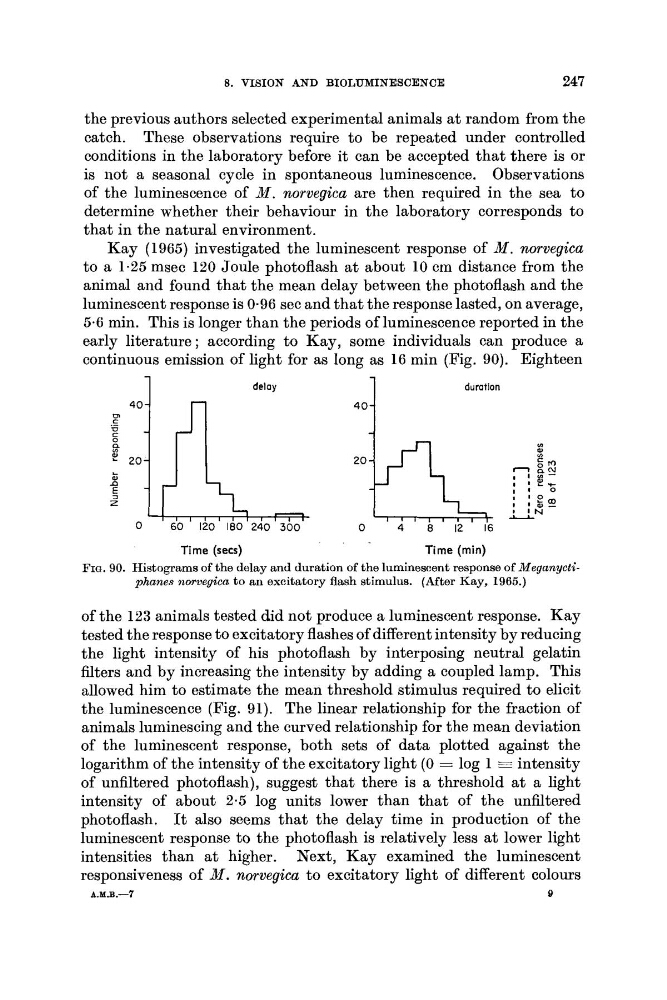
Kay (1965) investigated the luminescent response of M . norvegica
to a 1.25 msec 120 Joule photoflash a t about 10 cm distance from the
animal and found that the mean delay between the photoflash and the
luminescent response is 0-96 sec and that the response lasted, on average,
5.6 min. This is longer than the periods of luminescence reported in the
early literature; according to Kay, some individuals can produce a
continuous emission of light for as long as 16 min (Fig. 90). Eighteen
duration
1
delay
1
T i m e (secs)
T i m e (min)
FIG. 90. Histograms of the delay and duration of the luminescent response of Meganyctiphanes norvegica to an excitatory flash stimulus. (After Kay, 1965.)
of the 123 animals tested did not produce a luminescent response. Kay
tested the response to excitatory flashes of different intensity by reducing
the light intensity of his photoflash by interposing neutral gelatin
filters and by increasing the intensity by adding a coupled lamp. This
allowed him to estimate the mean threshold stimulus required to elicit
the luminescence (Fig. 91). The linear relationship for the fraction of
animals luminescing and the curved relationship for the mean deviation
of the luminescent response, both sets of data plotted against the
logarithm of the intensity of the excitatory light (0 = log 1 = intensity
of unfiltered photoflash), suggest that there is a threshold a t a light
intensity of about 2.5 log units lower than that of the unfiltered
photoflash. It also seems that the delay time in production of the
luminescent response to the photoflash is relatively less at lower light
intensities than a t higher. Next, Kay examined the luminescent
responsiveness of M . norvegica to excitatory light of different colours
A.?d.B.-7
g
247
the previous authors selected experimental animals a t random from the
catch. These observations require to be repeated under controlled
conditions in the laboratory before it can be accepted that there is or
is not a seasonal cycle in spontaneous luminescence. Observations
of the luminescence of M . norvegica are then required in the sea to
determine whether their behaviour in the laboratory corresponds to
that in the natural environment.
Kay (1965) investigated the luminescent response of M . norvegica
to a 1.25 msec 120 Joule photoflash a t about 10 cm distance from the
animal and found that the mean delay between the photoflash and the
luminescent response is 0-96 sec and that the response lasted, on average,
5.6 min. This is longer than the periods of luminescence reported in the
early literature; according to Kay, some individuals can produce a
continuous emission of light for as long as 16 min (Fig. 90). Eighteen
duration
1
delay
1
T i m e (secs)
T i m e (min)
FIG. 90. Histograms of the delay and duration of the luminescent response of Meganyctiphanes norvegica to an excitatory flash stimulus. (After Kay, 1965.)
of the 123 animals tested did not produce a luminescent response. Kay
tested the response to excitatory flashes of different intensity by reducing
the light intensity of his photoflash by interposing neutral gelatin
filters and by increasing the intensity by adding a coupled lamp. This
allowed him to estimate the mean threshold stimulus required to elicit
the luminescence (Fig. 91). The linear relationship for the fraction of
animals luminescing and the curved relationship for the mean deviation
of the luminescent response, both sets of data plotted against the
logarithm of the intensity of the excitatory light (0 = log 1 = intensity
of unfiltered photoflash), suggest that there is a threshold a t a light
intensity of about 2.5 log units lower than that of the unfiltered
photoflash. It also seems that the delay time in production of the
luminescent response to the photoflash is relatively less at lower light
intensities than a t higher. Next, Kay examined the luminescent
responsiveness of M . norvegica to excitatory light of different colours
A.?d.B.-7
g