

248
THE BIOLOQY OF EUPHAUSIIDS
and found, as would be expected, that they responded to blue-green
light and not to red. The filters used were narrow-band gelatin filters
which decreased the intensity of the excitatory light so much that few
of the animals responded. If, however, low concentrations of 5-hydroxytryptamine are added to the water in which the animals are living then
a luminescent response to the photoflash is more easily elicited from
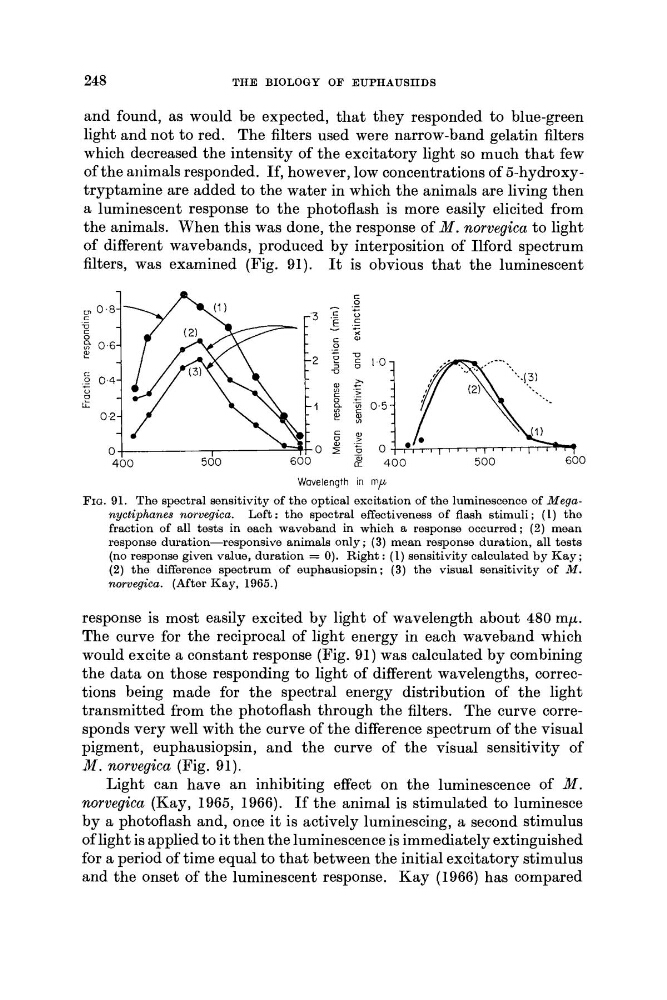
the animals. When this was done, the response of M . norvegica to light
of different wavebands, produced by interposition of Ilford spectrum
filters, was examined (Fig. 91). It is obvious that the luminescent
0.5
400
500
600
Wavelength in m,u
FIQ. 91. The spectral sensitivity of the optical excitation of the luminescence of Meganyctiphanes norvegica. Left : the spectral effectiveness of flash stimuli ; (1) the
fraction of all tests in each waveband in which a response occurred; (2) mean
response duration-responsive animals only ; (3) mean response duration, all tests
(no response given value, duration = 0). Right : (1) sensitivity calculated by Kay ;
(2) the difference spectrum of euphsusiopsin; (3) the visual sensitivity of M .
norvegica. (After Kay, 1965.)
response is most easily excited by light of wavelength about 480 mp.
The curve for the reciprocal of light energy in each waveband which
would excite a constant response (Fig. 91) was calculated by combining
the data on those responding to light of different wavelengths, corrections being made for the spectral energy distribution of the light
transmitted from the photoflash through the filters. The curve corresponds very well with the curve of the difference spectrum of the visual
pigment, euphausiopsin, and the curve of the visual sensitivity of
M . norvegica (Fig. 91).
Light can have an inhibiting effect on the luminescence of M .
norvegica (Kay, 1965, 1966). If the animal is stimulated to luminesce
by a photoflash and, once it is actively luminescing, a second stimulus
of light is applied to it then the luminescence is immediately extinguished
for a period of time equal to that between the initial excitatory stimulus
and the onset of the luminescent response. Kay (1966) has compared
THE BIOLOQY OF EUPHAUSIIDS
and found, as would be expected, that they responded to blue-green
light and not to red. The filters used were narrow-band gelatin filters
which decreased the intensity of the excitatory light so much that few
of the animals responded. If, however, low concentrations of 5-hydroxytryptamine are added to the water in which the animals are living then
a luminescent response to the photoflash is more easily elicited from
the animals. When this was done, the response of M . norvegica to light
of different wavebands, produced by interposition of Ilford spectrum
filters, was examined (Fig. 91). It is obvious that the luminescent
0.5
400
500
600
Wavelength in m,u
FIQ. 91. The spectral sensitivity of the optical excitation of the luminescence of Meganyctiphanes norvegica. Left : the spectral effectiveness of flash stimuli ; (1) the
fraction of all tests in each waveband in which a response occurred; (2) mean
response duration-responsive animals only ; (3) mean response duration, all tests
(no response given value, duration = 0). Right : (1) sensitivity calculated by Kay ;
(2) the difference spectrum of euphsusiopsin; (3) the visual sensitivity of M .
norvegica. (After Kay, 1965.)
response is most easily excited by light of wavelength about 480 mp.
The curve for the reciprocal of light energy in each waveband which
would excite a constant response (Fig. 91) was calculated by combining
the data on those responding to light of different wavelengths, corrections being made for the spectral energy distribution of the light
transmitted from the photoflash through the filters. The curve corresponds very well with the curve of the difference spectrum of the visual
pigment, euphausiopsin, and the curve of the visual sensitivity of
M . norvegica (Fig. 91).
Light can have an inhibiting effect on the luminescence of M .
norvegica (Kay, 1965, 1966). If the animal is stimulated to luminesce
by a photoflash and, once it is actively luminescing, a second stimulus
of light is applied to it then the luminescence is immediately extinguished
for a period of time equal to that between the initial excitatory stimulus
and the onset of the luminescent response. Kay (1966) has compared