

246
THE BIOLOGY OF EUPHAUSIIDS
found an increased number of individuals, between 30 and 40%,
responding during November and December in both years suggesting
that the hatched result in Fig. 88 is not peculiar. The individual
animal can be repeatedly subjected to this test with no harmful effects
developing. Consequently this is a very suitable experimental reaction
and Hardy and Kay (1964) and Kay (1965, 1966) have used a photoflash
to stimulate the animal and so make a fuller study of the relationships
between the optical stimulus and the bioluminescent response when
light is used as an excitatory and, a t times, as an inhibitory stimulus.
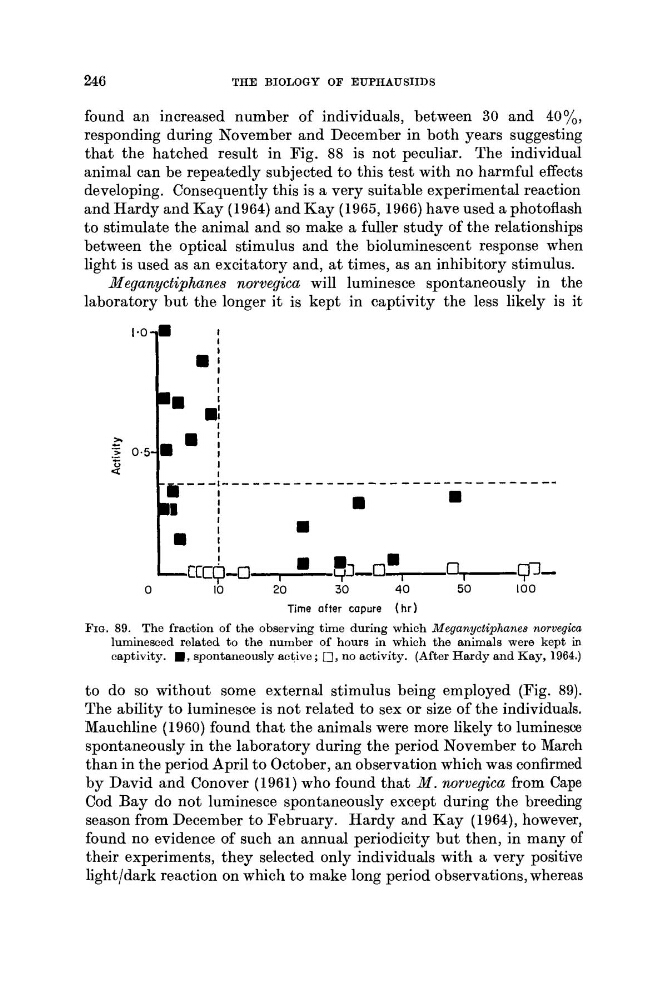
Meganyctiphanes norvegica will luminesce spontaneously in the
laboratory but the longer it is kept in captivity the less likely is it
Time after capure (hr)
FIG 89. The fraction of the observing time during which Meganyctiphanes norvegica
luminesced related to the number of hours in which the animals were kept in
captivity. ., spontaneously active; 0, no activity. (After Hardy and Kay, 1964.)
to do so without some external stimulus being employed (Fig. 89).
The ability to luminesce is not related to sex or size of the individuals.
Mauchline (1960) found that the animals were more likely to luminesce
spontaneously in the laboratory during the period November to March
than in the period April to October, an observation which was confirmed
by David and Conover (1961) who found that M . norvegica from Cape
Cod Bay do not luminesce spontaneously except during the breeding
season from December to February. Hardy and Kay (1964), however,
found no evidence of such an annual periodicity but then, in many of
their experiments, they selected only individuals with a very positive
lightldark reaction on which to make long period observations, whereas
THE BIOLOGY OF EUPHAUSIIDS
found an increased number of individuals, between 30 and 40%,
responding during November and December in both years suggesting
that the hatched result in Fig. 88 is not peculiar. The individual
animal can be repeatedly subjected to this test with no harmful effects
developing. Consequently this is a very suitable experimental reaction
and Hardy and Kay (1964) and Kay (1965, 1966) have used a photoflash
to stimulate the animal and so make a fuller study of the relationships
between the optical stimulus and the bioluminescent response when
light is used as an excitatory and, a t times, as an inhibitory stimulus.
Meganyctiphanes norvegica will luminesce spontaneously in the
laboratory but the longer it is kept in captivity the less likely is it
Time after capure (hr)
FIG 89. The fraction of the observing time during which Meganyctiphanes norvegica
luminesced related to the number of hours in which the animals were kept in
captivity. ., spontaneously active; 0, no activity. (After Hardy and Kay, 1964.)
to do so without some external stimulus being employed (Fig. 89).
The ability to luminesce is not related to sex or size of the individuals.
Mauchline (1960) found that the animals were more likely to luminesce
spontaneously in the laboratory during the period November to March
than in the period April to October, an observation which was confirmed
by David and Conover (1961) who found that M . norvegica from Cape
Cod Bay do not luminesce spontaneously except during the breeding
season from December to February. Hardy and Kay (1964), however,
found no evidence of such an annual periodicity but then, in many of
their experiments, they selected only individuals with a very positive
lightldark reaction on which to make long period observations, whereas