

7. CHEMICAL COMPOSITION
223
remaining 6% in the active state. Various geometric isomers of vitamin
A occur in eucaridan crustaceans. The vitamin A of the vertebrate liver
is the all-trans form (Fig. 73) but Wald and Brown (1956-57) discovered that nearly all the vitamin A in Meganyctiphanes norvegica
occurs as the 11-cis isomer (Fig. 77) and thought that the minor
constituent reported by Fisher et al. (1955) might be the isomer
11 : 13-di-cis vitamin A (neo-c) (Fig. 77). This was later confirmed by
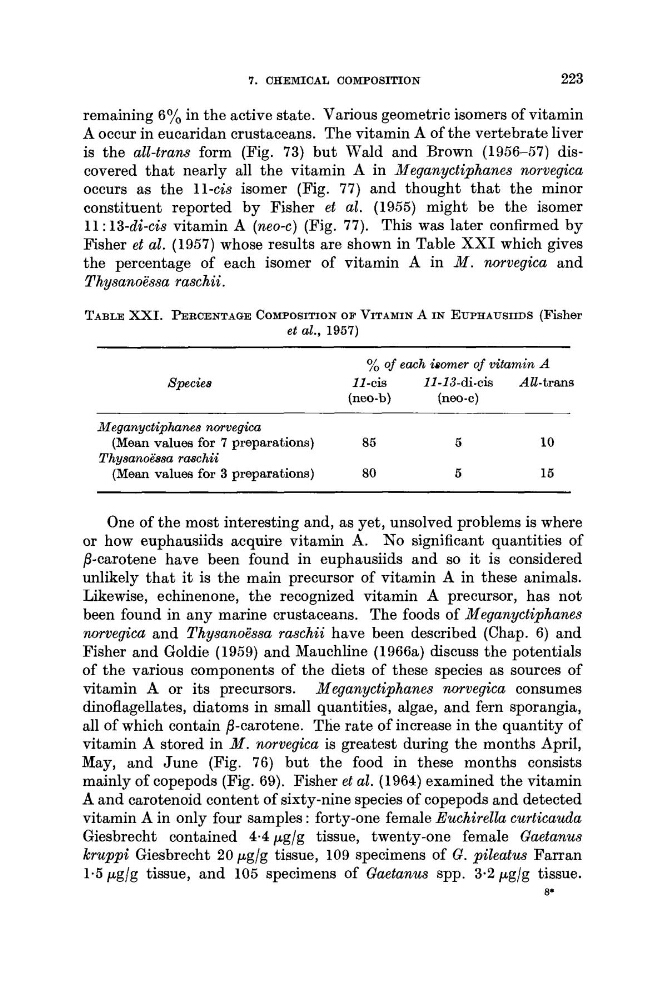
Fisher et al. (1957) whose results are shown in Table XXI which gives
the percentage of each isomer of vitamin A in M . norvegica and
Thysanoessa raschii.
TABLE XXI. PERCENTAGE COMPOSITION OF VITAMIN A IN EUPHAUSIIDS (Fisher
et al., 1957)
Species
yo of each ioomer of vitamin A
11-cis
11-13-di-cis All-trans
(neo-b)
(neo-c)
Meganyctiphanes norvegica
Thysanoessa rmchii
(Mean values for 7 preparations)
85
5
10
(Mean values for 3 preparations)
80
5
15
One of the most interesting and, as yet, unsolved problems is where
or how euphausiids acquire vitamin A. No significant quantities of
t3-carotene have been found in euphausiids and so it is considered
unlikely that it is the main precursor of vitamin A in these animals.
Likewise, echinenone, the recognized vitamin A precursor, has not
been found in any marine crustaceans. The foods of Meganyctiphanes
norvegica and Thysanoessa raschii have been described (Chap. 6) and
Fisher and Goldie (1959) and Mauchline (1966a) discuss the potentials
of the various components of the diets of these species as sources of
vitamin A or its precursors. Meganyctiphanes norvegica consumes
dinoflagellates, diatoms in small quantities, algae, and fern sporangia,
all of which contain p-carotene. The rate of increase in the quantity of
vitamin A stored in M . norvegica is greatest during the months April,
May, and June (Fig. 76) but the food in these months consists
mainly of copepods (Fig. 69). Fisher et al. (1964) examined the vitamin
A and carotenoid content of sixty-nine species of copepods and detected
vitamin A in only four samples : forty-one female Euchirella curticauda
Giesbrecht contained 4.4 pglg tissue, twenty-one female Gaetanus
kruppi Giesbrecht 20 pg/g tissue, 109 specimens of G . pileatus Farran
1.6 pglg tissue, and 105 specimens of Gaetanus spp. 3-2 pg/g tissue.
a*
223
remaining 6% in the active state. Various geometric isomers of vitamin
A occur in eucaridan crustaceans. The vitamin A of the vertebrate liver
is the all-trans form (Fig. 73) but Wald and Brown (1956-57) discovered that nearly all the vitamin A in Meganyctiphanes norvegica
occurs as the 11-cis isomer (Fig. 77) and thought that the minor
constituent reported by Fisher et al. (1955) might be the isomer
11 : 13-di-cis vitamin A (neo-c) (Fig. 77). This was later confirmed by
Fisher et al. (1957) whose results are shown in Table XXI which gives
the percentage of each isomer of vitamin A in M . norvegica and
Thysanoessa raschii.
TABLE XXI. PERCENTAGE COMPOSITION OF VITAMIN A IN EUPHAUSIIDS (Fisher
et al., 1957)
Species
yo of each ioomer of vitamin A
11-cis
11-13-di-cis All-trans
(neo-b)
(neo-c)
Meganyctiphanes norvegica
Thysanoessa rmchii
(Mean values for 7 preparations)
85
5
10
(Mean values for 3 preparations)
80
5
15
One of the most interesting and, as yet, unsolved problems is where
or how euphausiids acquire vitamin A. No significant quantities of
t3-carotene have been found in euphausiids and so it is considered
unlikely that it is the main precursor of vitamin A in these animals.
Likewise, echinenone, the recognized vitamin A precursor, has not
been found in any marine crustaceans. The foods of Meganyctiphanes
norvegica and Thysanoessa raschii have been described (Chap. 6) and
Fisher and Goldie (1959) and Mauchline (1966a) discuss the potentials
of the various components of the diets of these species as sources of
vitamin A or its precursors. Meganyctiphanes norvegica consumes
dinoflagellates, diatoms in small quantities, algae, and fern sporangia,
all of which contain p-carotene. The rate of increase in the quantity of
vitamin A stored in M . norvegica is greatest during the months April,
May, and June (Fig. 76) but the food in these months consists
mainly of copepods (Fig. 69). Fisher et al. (1964) examined the vitamin
A and carotenoid content of sixty-nine species of copepods and detected
vitamin A in only four samples : forty-one female Euchirella curticauda
Giesbrecht contained 4.4 pglg tissue, twenty-one female Gaetanus
kruppi Giesbrecht 20 pg/g tissue, 109 specimens of G . pileatus Farran
1.6 pglg tissue, and 105 specimens of Gaetanus spp. 3-2 pg/g tissue.
a*