

224
THE BIOLOGY O F EUPHAUSIIDS
Traces of carotene were detected in one sample each of Calanus
Jinmarchicus, Gaetanus miles Giesbrecht, and G. pileatus and in samples
of Chirudina streetsi Giesbrecht, Euchirella maxima Wolfenden,
Gaetanus minor Farran, Gaetanus spp., Metridia spp., Pleuromamma
spp., and Pseudochirella spp. Astaxanthin or its esters, however, are
by far the predominant, and probably the only, carotenoids in most of
the species analysed. Consequently, Meganyctiphanes norvegica is
obtaining astaxanthin in greater quantities than any other carotenoid
during the period April to June and Fisher et al. (1954) and Kon (1954)
suggest it as a possible precursor of vitamin A, and Fisher and Goldie
make the same suggestion.
Thysanoessa raschii has a less variable diet than Meganyctiphanes
norvegica and a comparison of the diets of these two species suggests
that detritus may be a source of vitamin A precursors (Mauchline,
1966a). The concentrations of vitamin A in Thysanoessa raschii are
higher than those in Neganyctiphanes norvegica (Table XVII) and the
seasonal concentrations are highest during the months December
through to April whereas in M . norvegica the seasonal levels are lowest
during this period (Fig. 76). Thysanoessa raschii feed much less extensively on copepods (Fig. 69) and so there is considerably less evidence
in this species to suggest that astaxanthin is the primary carotenoid
available in the diet. Detrital material, however, is more noticeable as
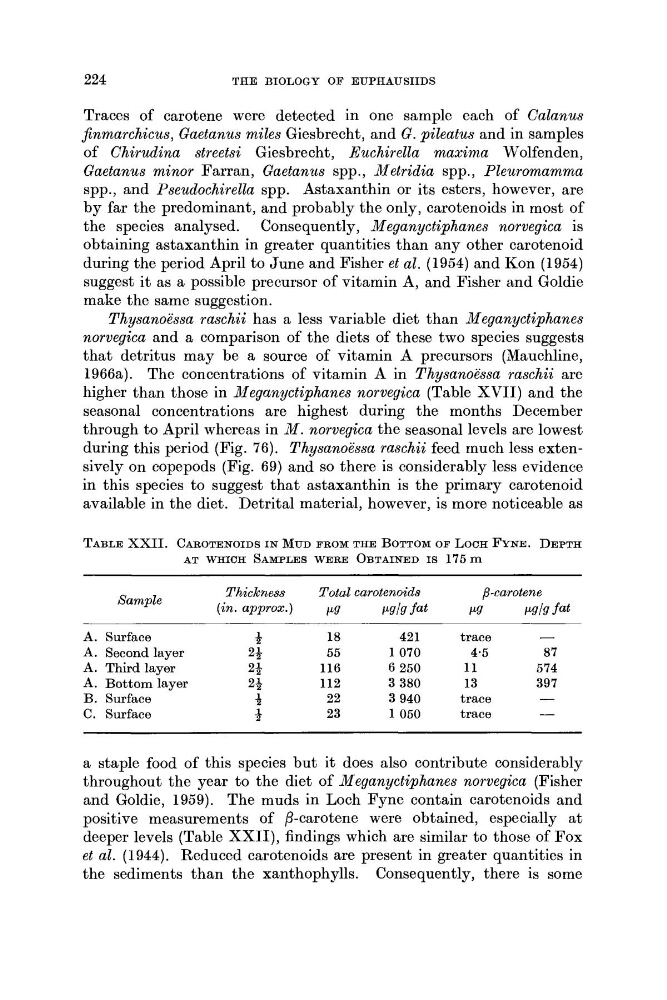
TABLE XXII. CAROTENOIDS IN MUD FROM THE BOTTOM OF LOCH FYNE. DEPTH
AT WHICH SAMPLES WERE OBTAINED IS 175m
~
Thickness
(in. approx.)
Sample
A. Surface
!
2
A. Second layer
24
A. Thirdlayer
2+
A. Bottom layer
2+
B. Surface
B
C. Surface
i l
Total carotenoids
PS
18
55
116
112
22
23
~
PSIS fat
42 1
1070
6 250
3 380
3 940
1050
,&carotene
PS
PSIS fat
trace
-
4.5
87
11
574
13
397
trace
-
trace
-
a staple food of this species but it does also contribute considerably
throughout the year to the diet of Meganyctiphanes norvegica (Fisher
and Goldie, 1959). The muds in Loch Fyne contain carotenoids and
positive measurements of p-carotene were obtained, especially at
deeper levels (Table XXII), findings which are similar to those of Fox
et al. (1944). Reduced carotenoids are present in greater quantities in
the sediments than the xanthophylls. Consequently, there is some
THE BIOLOGY O F EUPHAUSIIDS
Traces of carotene were detected in one sample each of Calanus
Jinmarchicus, Gaetanus miles Giesbrecht, and G. pileatus and in samples
of Chirudina streetsi Giesbrecht, Euchirella maxima Wolfenden,
Gaetanus minor Farran, Gaetanus spp., Metridia spp., Pleuromamma
spp., and Pseudochirella spp. Astaxanthin or its esters, however, are
by far the predominant, and probably the only, carotenoids in most of
the species analysed. Consequently, Meganyctiphanes norvegica is
obtaining astaxanthin in greater quantities than any other carotenoid
during the period April to June and Fisher et al. (1954) and Kon (1954)
suggest it as a possible precursor of vitamin A, and Fisher and Goldie
make the same suggestion.
Thysanoessa raschii has a less variable diet than Meganyctiphanes
norvegica and a comparison of the diets of these two species suggests
that detritus may be a source of vitamin A precursors (Mauchline,
1966a). The concentrations of vitamin A in Thysanoessa raschii are
higher than those in Neganyctiphanes norvegica (Table XVII) and the
seasonal concentrations are highest during the months December
through to April whereas in M . norvegica the seasonal levels are lowest
during this period (Fig. 76). Thysanoessa raschii feed much less extensively on copepods (Fig. 69) and so there is considerably less evidence
in this species to suggest that astaxanthin is the primary carotenoid
available in the diet. Detrital material, however, is more noticeable as
TABLE XXII. CAROTENOIDS IN MUD FROM THE BOTTOM OF LOCH FYNE. DEPTH
AT WHICH SAMPLES WERE OBTAINED IS 175m
~
Thickness
(in. approx.)
Sample
A. Surface
!
2
A. Second layer
24
A. Thirdlayer
2+
A. Bottom layer
2+
B. Surface
B
C. Surface
i l
Total carotenoids
PS
18
55
116
112
22
23
~
PSIS fat
42 1
1070
6 250
3 380
3 940
1050
,&carotene
PS
PSIS fat
trace
-
4.5
87
11
574
13
397
trace
-
trace
-
a staple food of this species but it does also contribute considerably
throughout the year to the diet of Meganyctiphanes norvegica (Fisher
and Goldie, 1959). The muds in Loch Fyne contain carotenoids and
positive measurements of p-carotene were obtained, especially at
deeper levels (Table XXII), findings which are similar to those of Fox
et al. (1944). Reduced carotenoids are present in greater quantities in
the sediments than the xanthophylls. Consequently, there is some