

SOME ASPECTS O F T H E BIOLOGY O F THE CHAETOGNATHS
353
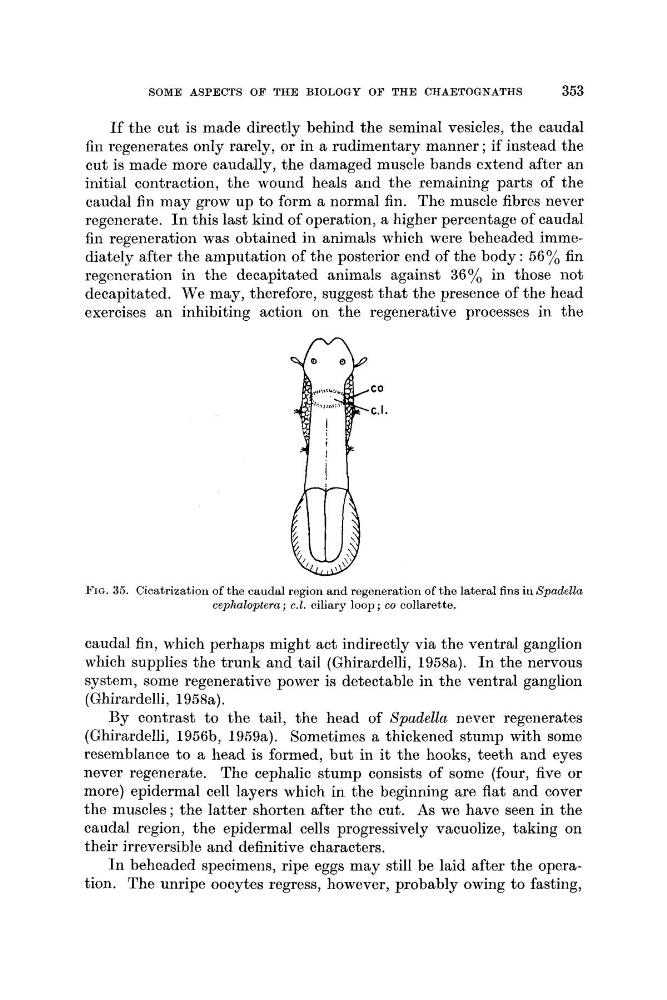
If the cut is made directly behind the seminal vesicles, the caudal
fin regenerates only rarely, or in a rudimentary manner ; if instead the
cut is made more caudally, the damaged muscle bands extend after an
initial contraction, the wound heals and the remaining parts of the
caudal fin may grow up to form a normal fin. The muscle fibres never
regenerat'e. I n this last kind of operation, a higher percentage of caudal
fin regeneration was obtained in animals which were beheaded immediately after the amputation of the posterior end of the body : 56% fin
regeneration in the decapitated animals against 36% in those not
decapitated. We may, therefore, suggest that the presence of the head
exercises an inhibiting action on the regenerative processes in the
co
C.I.
F I G . 35. Cicatrization of the caudal region and regeneration of the lateral fins in Spudella
cephuloptera ; c. Z. ciliary loop ; co collarette.
caudal fin, which perhaps might act indirectly via the ventral ganglion
which supplies the trunk and tail (Ghirardelli, 1958a). I n the nervous
system, some regenerative power is detectable in the ventral ganglion
(Ghirardelli, 1958a).
By contrast to the tail, the head of Spadella never regenerates
(Ghirardelli, 195613, 1959a). Sometimes a thickened stump with some
resemblance to a, head is formed, but in it the hooks, teeth and eyes
never regenerate. The cephalic stump consists of some (four, five or
more) epidermal cell layers which in the beginning are flat and cover
the muscles ; the latter shorten after the cut. As we have seen in the
caudal region, the epidermal cells progressively vacuolize, taking on
their irreversible and definitive characters.
In beheaded specimens, ripe eggs may still be laid after the operation. The unripe oocytes regress, however, probably owing to fasting,
353
If the cut is made directly behind the seminal vesicles, the caudal
fin regenerates only rarely, or in a rudimentary manner ; if instead the
cut is made more caudally, the damaged muscle bands extend after an
initial contraction, the wound heals and the remaining parts of the
caudal fin may grow up to form a normal fin. The muscle fibres never
regenerat'e. I n this last kind of operation, a higher percentage of caudal
fin regeneration was obtained in animals which were beheaded immediately after the amputation of the posterior end of the body : 56% fin
regeneration in the decapitated animals against 36% in those not
decapitated. We may, therefore, suggest that the presence of the head
exercises an inhibiting action on the regenerative processes in the
co
C.I.
F I G . 35. Cicatrization of the caudal region and regeneration of the lateral fins in Spudella
cephuloptera ; c. Z. ciliary loop ; co collarette.
caudal fin, which perhaps might act indirectly via the ventral ganglion
which supplies the trunk and tail (Ghirardelli, 1958a). I n the nervous
system, some regenerative power is detectable in the ventral ganglion
(Ghirardelli, 1958a).
By contrast to the tail, the head of Spadella never regenerates
(Ghirardelli, 195613, 1959a). Sometimes a thickened stump with some
resemblance to a, head is formed, but in it the hooks, teeth and eyes
never regenerate. The cephalic stump consists of some (four, five or
more) epidermal cell layers which in the beginning are flat and cover
the muscles ; the latter shorten after the cut. As we have seen in the
caudal region, the epidermal cells progressively vacuolize, taking on
their irreversible and definitive characters.
In beheaded specimens, ripe eggs may still be laid after the operation. The unripe oocytes regress, however, probably owing to fasting,