

354
ELVEZIO GHIRARDELLI
because obviously the decapitated animals cannot take food (Ghirardelli, 195613).
Contrary t o what Pierce (1951) stated, I have been unable to observe
even in Sagitta instances in which one may state with certainty that the
head has regenerated. I have been able to section some specimens
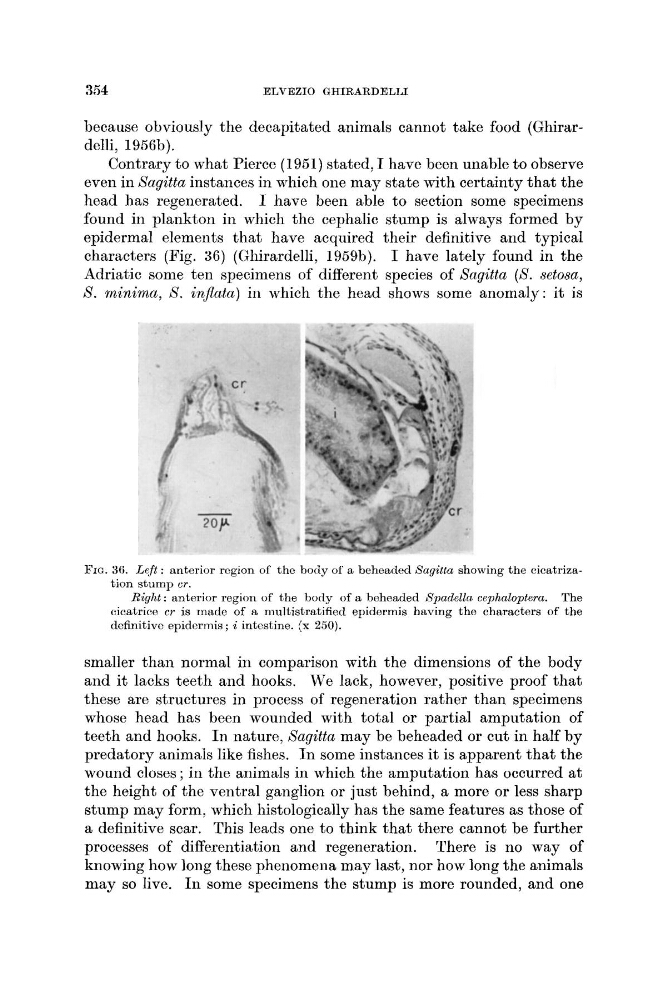
found in plankton in which the cephalic stump is always formed by
epidermal elements that have acquired their definitive and typical
characters (Fig. 36) (Ghirardelli, 1959b). I have lately found in the
Adriatic some ten specimens of different species of Sagitta (8. setosa,
S. minima, S. inJlata) in which the head shows some anomaly: it is
FIG. 38. Left : anterior region of thc body of a beheaded Sagitta showing the cicatrization stump cr.
The
cicatrice cr is m a d e of a multistratified epidermis having the characters of the
definitive epidermis ; i intestine. (x 250).
Right : anterior region of the body of a bcheaded Spudella cephuloptera.
smaller than normal in comparison with the dimensions of the body
and it lacks teeth and hooks. We lack, however, positive proof that
these are structures in process of regeneration rather than specimens
whose head has been wounded with total or partial amputation of
teeth and hooks. I n nature, Sagitta may be beheaded or cut in half by
predatory animals like fishes. I n some instances it is apparent that the
wound closes ; in the animals in which the amputation has occurred at
the height of the ventral ganglion or just behind, a more or less sharp
stump may form, which histologically has the same features as those of
a definitive scar. This leads one to think that there cannot be further
processes of differentiation and regeneration. There is no way of
knowing how long these phenomena may last, nor how long the animals
may so live. I n some specimens the stump is more rounded, and one
ELVEZIO GHIRARDELLI
because obviously the decapitated animals cannot take food (Ghirardelli, 195613).
Contrary t o what Pierce (1951) stated, I have been unable to observe
even in Sagitta instances in which one may state with certainty that the
head has regenerated. I have been able to section some specimens
found in plankton in which the cephalic stump is always formed by
epidermal elements that have acquired their definitive and typical
characters (Fig. 36) (Ghirardelli, 1959b). I have lately found in the
Adriatic some ten specimens of different species of Sagitta (8. setosa,
S. minima, S. inJlata) in which the head shows some anomaly: it is
FIG. 38. Left : anterior region of thc body of a beheaded Sagitta showing the cicatrization stump cr.
The
cicatrice cr is m a d e of a multistratified epidermis having the characters of the
definitive epidermis ; i intestine. (x 250).
Right : anterior region of the body of a bcheaded Spudella cephuloptera.
smaller than normal in comparison with the dimensions of the body
and it lacks teeth and hooks. We lack, however, positive proof that
these are structures in process of regeneration rather than specimens
whose head has been wounded with total or partial amputation of
teeth and hooks. I n nature, Sagitta may be beheaded or cut in half by
predatory animals like fishes. I n some instances it is apparent that the
wound closes ; in the animals in which the amputation has occurred at
the height of the ventral ganglion or just behind, a more or less sharp
stump may form, which histologically has the same features as those of
a definitive scar. This leads one to think that there cannot be further
processes of differentiation and regeneration. There is no way of
knowing how long these phenomena may last, nor how long the animals
may so live. I n some specimens the stump is more rounded, and one