

DISEASES OF MARINE FISHES
17
sprattus (L.) from the eastern North Atlantic (Thomson and Robertson,
1926). and the Atlantic herring, (‘lupea hrtrcrrgits. from the Baltic Sea
(Dogiel, 1939 ; I)ollfus, 1956), Barents Sea (l’olyaiiski, 1955), IVhite
Sea (Shulmaii and Shulman-i\lbova, 1953), North Sea (Kabata, 1963),
and the western North Atlantic (Sindermann, 1961a). It occurred in
over 50% of sardines sampled by Pinto (op. cit.) and thus must be
considered a significant limitation t o the reproductive potential of that
species.
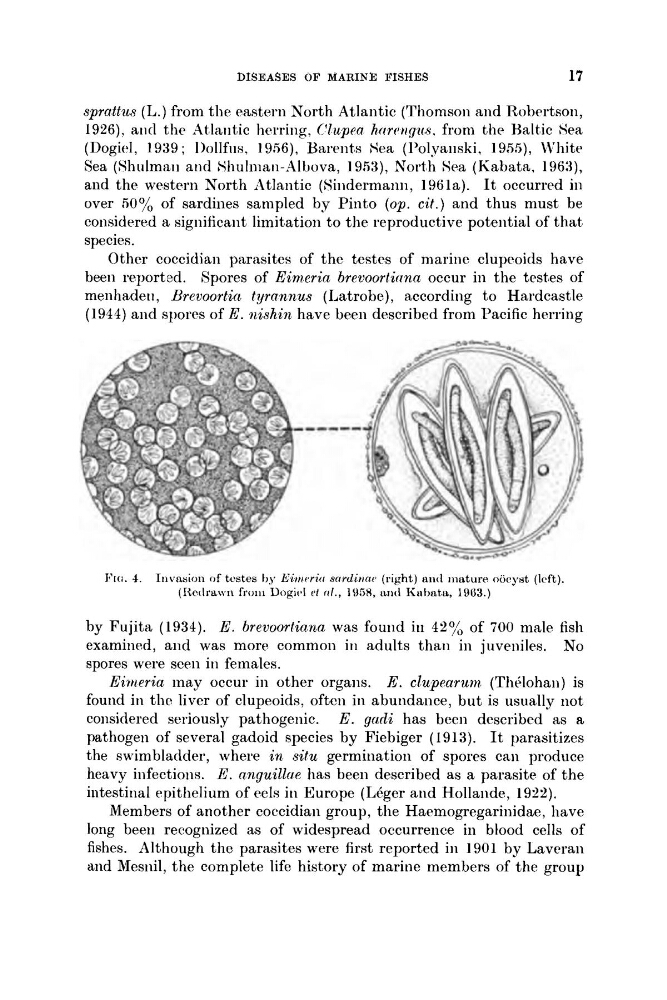
Other coccidiaii parasites of the testes of marine clupeoids have
been reported. Spores of Eirrieria brevoortitrnn occur in the testes of
menhaden, Brevoortici tyrannus (Latrobe), according to Hardcastle
(1944) and spores of E. nishin have been described from Pacific herring
by Fujita (1934). E. brevoortiana was found in 420,: of 700 male fish
examined, and was more common in adults than in juveniles. No
spores were sceii in females.
E. clupearum (Th6lohan) is
fourid in the liver of clupeoids, oftcii in abundance, but is usually not
considered seriously pathogenic. E . gadi has been described as R
pathogen of several gadoid species by Fiebiger (1913). It parasitizes
the swimbladder, where in situ germination of spores can produce
heavy infections. E. crnguillae has been described as a parasite of the
intestinal epithelium of eels in Europe (Leger and Hollaiide, 1922).
Members of another coccidiaii group, the Haemogregarinidae, have
long been recognized as of widespread occurrence in blood cells of
fishes. Although the parasites were first reported in 1901 by Laveran
a i d Mesnil, the complete life history of marine members of the group
Eiweria may occur in other organs.
17
sprattus (L.) from the eastern North Atlantic (Thomson and Robertson,
1926). and the Atlantic herring, (‘lupea hrtrcrrgits. from the Baltic Sea
(Dogiel, 1939 ; I)ollfus, 1956), Barents Sea (l’olyaiiski, 1955), IVhite
Sea (Shulmaii and Shulman-i\lbova, 1953), North Sea (Kabata, 1963),
and the western North Atlantic (Sindermann, 1961a). It occurred in
over 50% of sardines sampled by Pinto (op. cit.) and thus must be
considered a significant limitation t o the reproductive potential of that
species.
Other coccidiaii parasites of the testes of marine clupeoids have
been reported. Spores of Eirrieria brevoortitrnn occur in the testes of
menhaden, Brevoortici tyrannus (Latrobe), according to Hardcastle
(1944) and spores of E. nishin have been described from Pacific herring
by Fujita (1934). E. brevoortiana was found in 420,: of 700 male fish
examined, and was more common in adults than in juveniles. No
spores were sceii in females.
E. clupearum (Th6lohan) is
fourid in the liver of clupeoids, oftcii in abundance, but is usually not
considered seriously pathogenic. E . gadi has been described as R
pathogen of several gadoid species by Fiebiger (1913). It parasitizes
the swimbladder, where in situ germination of spores can produce
heavy infections. E. crnguillae has been described as a parasite of the
intestinal epithelium of eels in Europe (Leger and Hollaiide, 1922).
Members of another coccidiaii group, the Haemogregarinidae, have
long been recognized as of widespread occurrence in blood cells of
fishes. Although the parasites were first reported in 1901 by Laveran
a i d Mesnil, the complete life history of marine members of the group
Eiweria may occur in other organs.