

134
MALCOLM R. CLARKE
warm current; such types are recognized from the situation of visible
surface boundary zones.
At dusk the squids rise to within 40 m of the surface; at about
midnight they sink or scatter and then rise again to the surface briefly
just before dawn (Sasaki, 1921). During the day they are thought to
swim at 100-200 m (Sasaki, 1921; Suzuki, 1963).
Although previous workers (Sasaki, 1921) have unravelled a few
D
0
\
I
P
n oc
oe
O t s p
F
C
d’
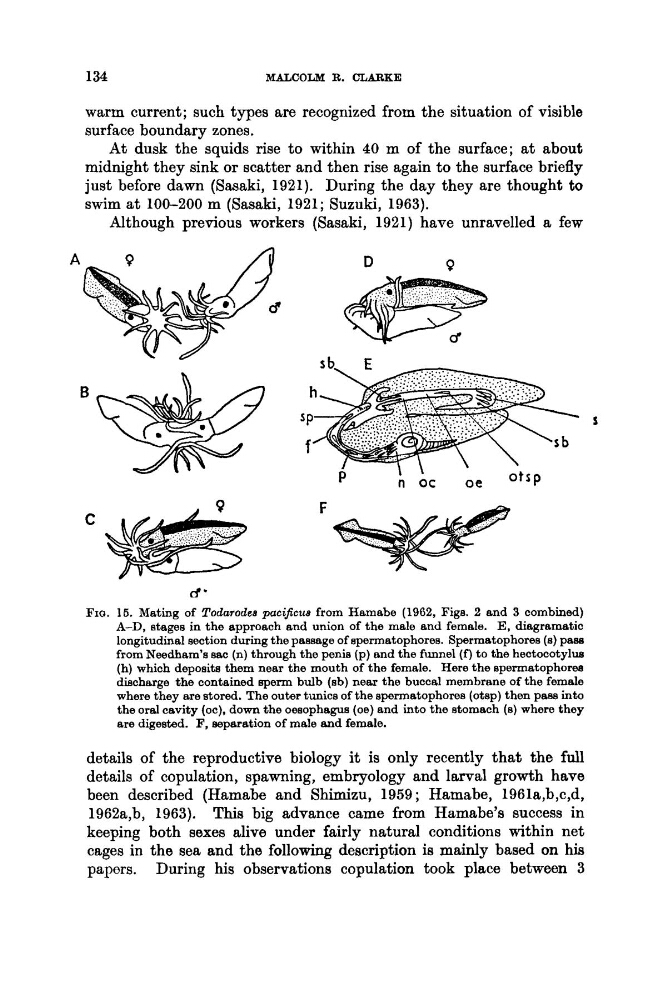
FIG. 16. Mating of Todarodea paci$cuo from Hamabe (1962, Figs. 2 and 3 combined)
A-D, stages in the approach and union of the male and female. E, diagramatic
longitudinal section during the passage of spermatophores. Spermatophores (a) pafrom Needham’s sac (n) through the penis (p) end the funnel (f) to the hectocotylua
(h) which deposits them near the mouth of the female. Here the spermatophorea
diacharge the contained sperm bulb (sb) near the buccal membrane of the female
where they are stored. The outer tunics of the spermatophores (otsp) then pass into
the oral cavity (oc), down the oesophagus (oe) and into the stomach (a) where they
are digested. F, aeparation of male and female.
details of the reproductive biology it is only recently that the full
details of copulation, spawning, embryology and larval growth have
been described (Hamabe and Shimizu, 1959 ; Hamabe, 1961a,b,c,d,
1962a,b, 1963). This big advance came from Hamabe’s success in
keeping both sexes alive under fairly natural conditions within net
cages in the sea and the following description is mainly based on his
papers. During his observations copulation took place between 3
MALCOLM R. CLARKE
warm current; such types are recognized from the situation of visible
surface boundary zones.
At dusk the squids rise to within 40 m of the surface; at about
midnight they sink or scatter and then rise again to the surface briefly
just before dawn (Sasaki, 1921). During the day they are thought to
swim at 100-200 m (Sasaki, 1921; Suzuki, 1963).
Although previous workers (Sasaki, 1921) have unravelled a few
D
0
\
I
P
n oc
oe
O t s p
F
C
d’
FIG. 16. Mating of Todarodea paci$cuo from Hamabe (1962, Figs. 2 and 3 combined)
A-D, stages in the approach and union of the male and female. E, diagramatic
longitudinal section during the passage of spermatophores. Spermatophores (a) pafrom Needham’s sac (n) through the penis (p) end the funnel (f) to the hectocotylua
(h) which deposits them near the mouth of the female. Here the spermatophorea
diacharge the contained sperm bulb (sb) near the buccal membrane of the female
where they are stored. The outer tunics of the spermatophores (otsp) then pass into
the oral cavity (oc), down the oesophagus (oe) and into the stomach (a) where they
are digested. F, aeparation of male and female.
details of the reproductive biology it is only recently that the full
details of copulation, spawning, embryology and larval growth have
been described (Hamabe and Shimizu, 1959 ; Hamabe, 1961a,b,c,d,
1962a,b, 1963). This big advance came from Hamabe’s success in
keeping both sexes alive under fairly natural conditions within net
cages in the sea and the following description is mainly based on his
papers. During his observations copulation took place between 3