

REVIEW OF THE SYSTEMATICS AND ECOLOGY OF OCEANIO SQUIDS
135
males of 23-1-24-3 cm and 3 females of 254-26.7 cm (mantle length).
At sunrise the squids became excited and copulation, lasting a few
seconds, followed. Mating was achieved by the male interlocking
arms with the female and then coming to lie underneath her (Fig. 16).
Spermatophores were then transmitted to the mouth of the female
from the cirrus by the male, with his hectocotylized arm (Fig. 15).
When the spermatophores were in the female's mouth the sperm bulbs
were discharged and the outer tunics of the spermatophores were
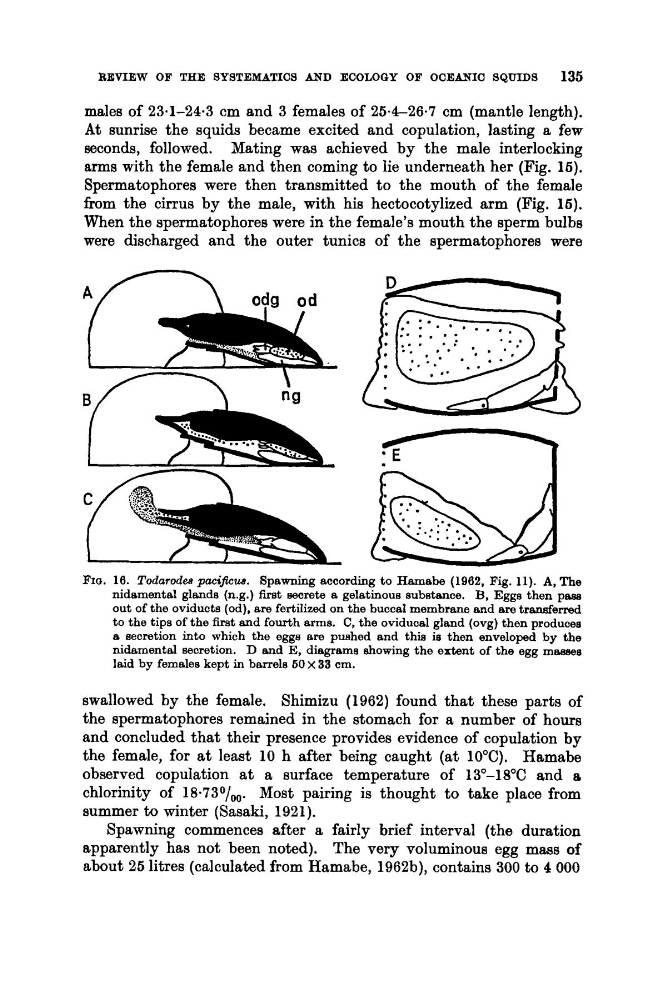
FIQ. 16. Todarodea pacijicua. Spawning according to Hamabe (1962, Fig. 11). A, The
nidamental glands (n.g.) first secrete a gelatinous substance. B, Eggs then pess
out of the oviducts (od), are fertilized on the buccal membrane and are transferred
t o the tips of the first and fourth arms. C, the oviducal gland (ovg) then produces
a secretion into which the eggs are pushed and this is then enveloped by the
nidamental secretion. D and E, diagrams showing the extent of the egg mBsaee
laid by females kept in barrels 60 x 33 cm.
swallowed by the female. Shimizu (1962) found that these parts of
the spermatophores remained in the stomach for a number of hours
and concluded that their presence provides evidence of copulation by
the female, for at least 10 h after being caught (at 10°C). Hamabe
observed copulation at a surface temperature of 13"-1SoC and a
chlorinity of 18-73°/0,. Most pairing is thought to take place from
summer to winter (Sasaki, 1921).
Spawning commences after a fairly brief interval (the duration
apparently has not been noted). The very voluminous egg mass of
about 25 litres (calculated from Hamabe, 1962b), contains 300 to 4 000
135
males of 23-1-24-3 cm and 3 females of 254-26.7 cm (mantle length).
At sunrise the squids became excited and copulation, lasting a few
seconds, followed. Mating was achieved by the male interlocking
arms with the female and then coming to lie underneath her (Fig. 16).
Spermatophores were then transmitted to the mouth of the female
from the cirrus by the male, with his hectocotylized arm (Fig. 15).
When the spermatophores were in the female's mouth the sperm bulbs
were discharged and the outer tunics of the spermatophores were
FIQ. 16. Todarodea pacijicua. Spawning according to Hamabe (1962, Fig. 11). A, The
nidamental glands (n.g.) first secrete a gelatinous substance. B, Eggs then pess
out of the oviducts (od), are fertilized on the buccal membrane and are transferred
t o the tips of the first and fourth arms. C, the oviducal gland (ovg) then produces
a secretion into which the eggs are pushed and this is then enveloped by the
nidamental secretion. D and E, diagrams showing the extent of the egg mBsaee
laid by females kept in barrels 60 x 33 cm.
swallowed by the female. Shimizu (1962) found that these parts of
the spermatophores remained in the stomach for a number of hours
and concluded that their presence provides evidence of copulation by
the female, for at least 10 h after being caught (at 10°C). Hamabe
observed copulation at a surface temperature of 13"-1SoC and a
chlorinity of 18-73°/0,. Most pairing is thought to take place from
summer to winter (Sasaki, 1921).
Spawning commences after a fairly brief interval (the duration
apparently has not been noted). The very voluminous egg mass of
about 25 litres (calculated from Hamabe, 1962b), contains 300 to 4 000