

REVIEW OF THE SYSTEMATICS AND ECOLOQY OF OCEANIC
SQUIDS
133
1952. In 1952 this species accounted for 91.5% of the total cuttle fish
and squid taken, which represented 13.4% of the total yield of all
fisheries in Japan excluding the whale fishery (Suzuki, 1963). From
1952 to 1960 these percentages never fell below 84.7% and 6.3%
respectively. The squid catch from Hokkaido contributes about 50%
of the total squid caught in Japan (Suzuki, 1963).
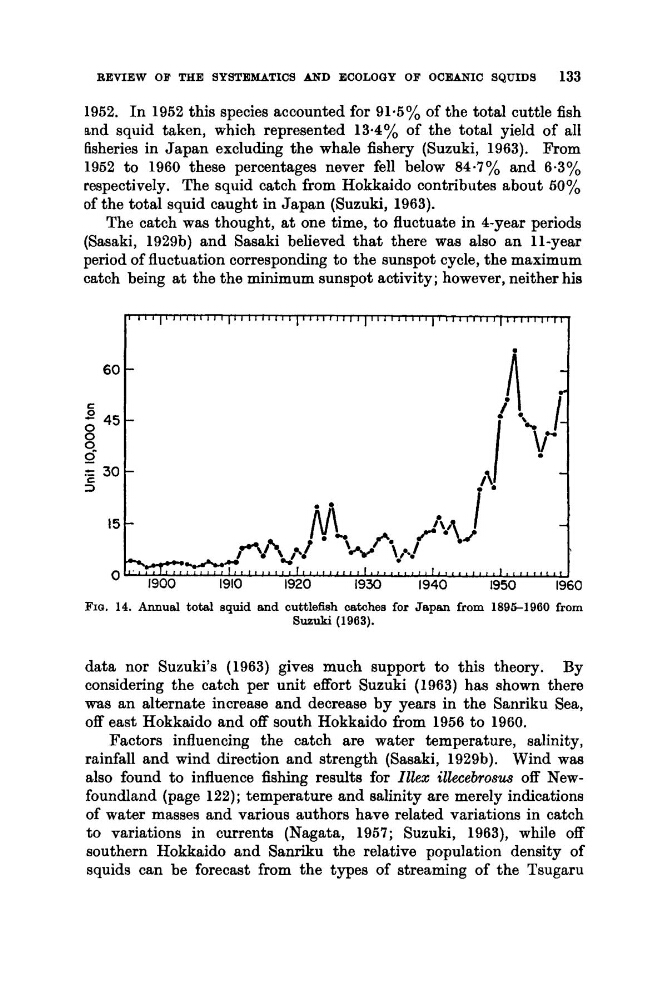
The catch was thought, at one time, to fluctuate in 4-year periods
(Sasaki, 1929b) and Sasaki believed that there was also an 11-year
period of fluctuation corresponding to the sunspot cycle, the maximum
catch being at the the minimum sunspot activity; however, neither his
FIQ. 14. Annual total squid and cuttlefish catches for Japan from 1895-1960 from
Suzuki (1903).
data nor Suzuki's (1963) gives much support to this theory. By
considering the catch per unit effort Suzuki (1963) has shown there
was an alternate increase and decrease by years in the Sanriku Sea,
off east Hokkaido and off south Hokkaido from 1956 to 1960.
Factors influencing the catch are water temperature, salinity,
rainfall and wind direction and strength (Sasaki, 192913). Wind was
also found to influence fishing results for Illex illecebrosua off Newfoundland (page 122); temperature and salinity are merely indications
of water masses and various authors have related variations in catch
to variations in currents (Nagata, 1957; Suzuki, 1963), while off
southern Hokkaido and Sanriku the relative population density of
squids can be forecast from the types of streaming of the Tsugaru
SQUIDS
133
1952. In 1952 this species accounted for 91.5% of the total cuttle fish
and squid taken, which represented 13.4% of the total yield of all
fisheries in Japan excluding the whale fishery (Suzuki, 1963). From
1952 to 1960 these percentages never fell below 84.7% and 6.3%
respectively. The squid catch from Hokkaido contributes about 50%
of the total squid caught in Japan (Suzuki, 1963).
The catch was thought, at one time, to fluctuate in 4-year periods
(Sasaki, 1929b) and Sasaki believed that there was also an 11-year
period of fluctuation corresponding to the sunspot cycle, the maximum
catch being at the the minimum sunspot activity; however, neither his
FIQ. 14. Annual total squid and cuttlefish catches for Japan from 1895-1960 from
Suzuki (1903).
data nor Suzuki's (1963) gives much support to this theory. By
considering the catch per unit effort Suzuki (1963) has shown there
was an alternate increase and decrease by years in the Sanriku Sea,
off east Hokkaido and off south Hokkaido from 1956 to 1960.
Factors influencing the catch are water temperature, salinity,
rainfall and wind direction and strength (Sasaki, 192913). Wind was
also found to influence fishing results for Illex illecebrosua off Newfoundland (page 122); temperature and salinity are merely indications
of water masses and various authors have related variations in catch
to variations in currents (Nagata, 1957; Suzuki, 1963), while off
southern Hokkaido and Sanriku the relative population density of
squids can be forecast from the types of streaming of the Tsugaru