

Trials ot 3-6 per day
(C)
Tmining to polorizotion plane
1 0 experienced onimols - o second experiment
11 inexperienced animals I with the group already troined in (c)
0
n
Nan-spontoneous runs
Non-spontoneous runs
20!,L :
=
=
:
3
I 2
21
30
3
12
21
30
39
48
55
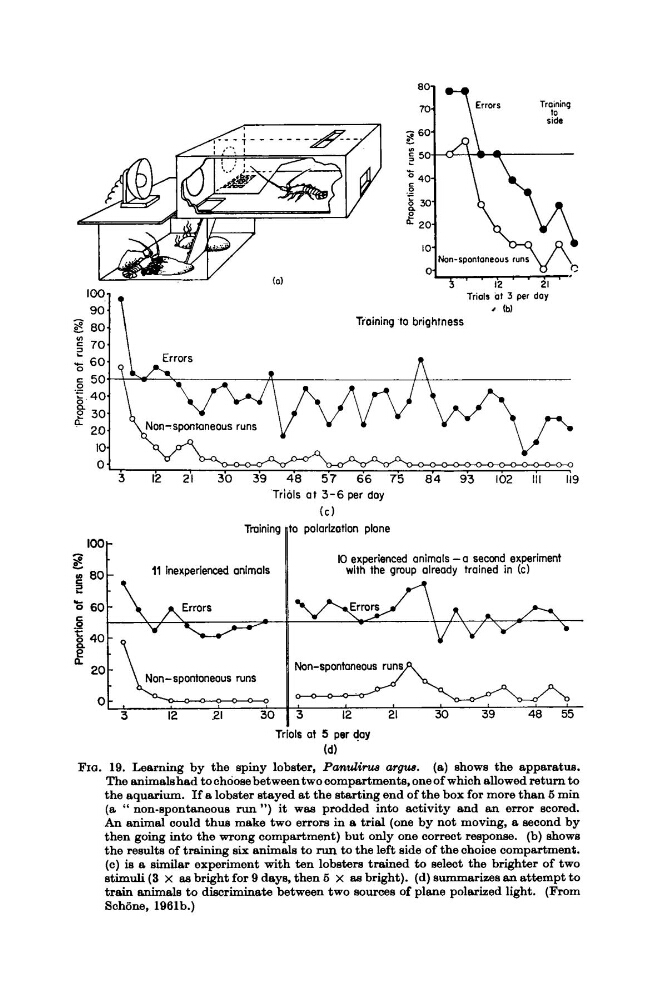
FIG. 19. Learning by the spiny lobster, Panulinu, argue. (a) shows the apparatus.
The animals had to choose between two compartments, one of which allowed return to
the aquasiUm. If a lobster stayed at the starting end of the box for more than 6 min
(a '' non-spontaneous run ") it waa prodded into activity and an error scored.
An animal could thus make two errom in a trial (one by not moving, a second by
then going into the wrong compartment) but only one correct response. (b) shows
the results of training six animals to run to the left side of the choice compartment.
(c) ia a similar experiment with ten lobsters trained to select the brighter of two
stimuli (3 x aa bright for 9 days, then 6 x as bright). (d) summarizes an attempt to
train animals to discriminate between two sources of plane polarized light. (From
Schane, 1961b.)
(C)
Tmining to polorizotion plane
1 0 experienced onimols - o second experiment
11 inexperienced animals I with the group already troined in (c)
0
n
Nan-spontoneous runs
Non-spontoneous runs
20!,L :
=
=
:
3
I 2
21
30
3
12
21
30
39
48
55
FIG. 19. Learning by the spiny lobster, Panulinu, argue. (a) shows the apparatus.
The animals had to choose between two compartments, one of which allowed return to
the aquasiUm. If a lobster stayed at the starting end of the box for more than 6 min
(a '' non-spontaneous run ") it waa prodded into activity and an error scored.
An animal could thus make two errom in a trial (one by not moving, a second by
then going into the wrong compartment) but only one correct response. (b) shows
the results of training six animals to run to the left side of the choice compartment.
(c) ia a similar experiment with ten lobsters trained to select the brighter of two
stimuli (3 x aa bright for 9 days, then 6 x as bright). (d) summarizes an attempt to
train animals to discriminate between two sources of plane polarized light. (From
Schane, 1961b.)