

30
M. J. WELLS
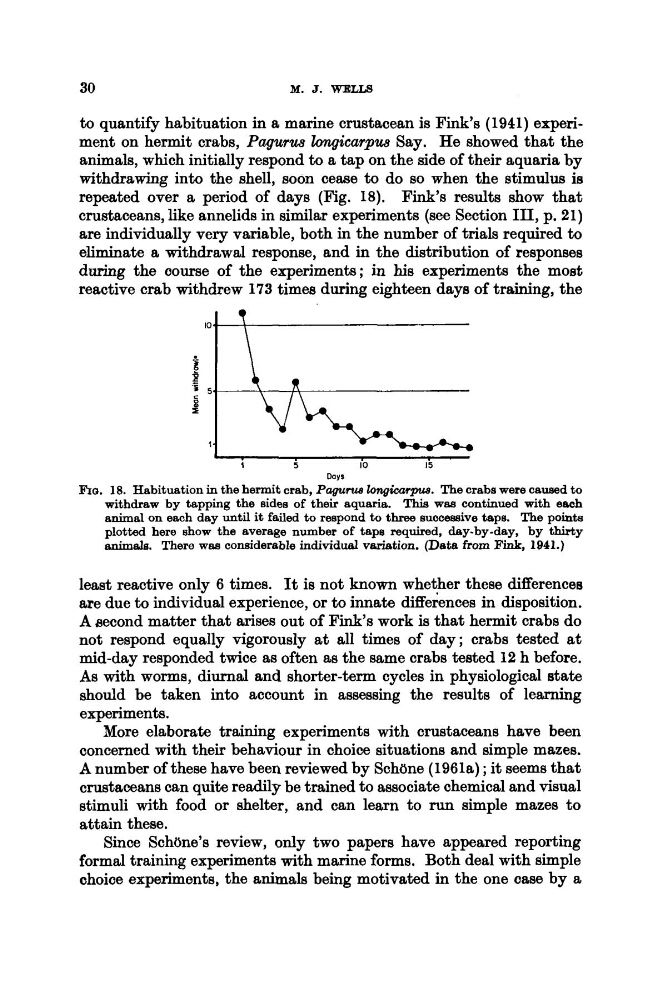
to quantify habituation in a marine crustacean is Fink‘s (1941) experiment on hermit crabs, Pagurzcs longicarpus Say. He showed that the
animals, which initially respond to a tap on the side of their aquaria by
withdrawing into the shell, soon cease to do so when the stimulus is
repeated over a period of days (Fig. 18). Fink’s results show that
crustaceans, like annelids in similar experiments (see Section 111, p. 21)
are individually very variable, both in the number of trials required to
eliminate a withdrawal response, and in the distribution of responses
during the course of the experiments; in his experiments the most
reactive crab withdrew 173 times during eighteen days of training, the
4
5
1 0
15
Days
FIG. 18. Habituation in the hermit crab, Pagurue longka~pu.8. The crabs were cawed to
withdraw by tapping the sides of their aquaria. This was continued with each
animal on each day until it failed to respond to three successive taps. The points
plotted here show the average number of taps required, day-by-day, by thirty
animals. There waa considerable individual vsristion. (Data from Fink, 1941.)
least reactive only 6 times. It is not known whether these differences
are due to individual experience, or to innate differences in disposition.
A second matter that arises out of Fink’s work is that hermit crabs do
not respond equally vigorously at all times of day; crabs tested at
mid-day responded twice as often as the same crabs tested 12 h before.
As with worms, diurnal and shorter-term cycles in physiological state
should be taken into account in assessing the results of learning
experiments.
More elaborate training experiments with crustaceans have been
concerned with their behaviour in choice situations and simple mazes.
A number of these have been reviewed by Sch6ne (19614 ; it seems that
crustaceans can quite readily be trained to associate chemical and visual
stimuli with food or shelter, and can learn to run simple mazes to
attain these.
Since Sch6ne’s review, only two papers have appeared reporting
formal training experiments with marine forms. Both deal with simple
choice experiments, the animals being motivated in the one case by a
M. J. WELLS
to quantify habituation in a marine crustacean is Fink‘s (1941) experiment on hermit crabs, Pagurzcs longicarpus Say. He showed that the
animals, which initially respond to a tap on the side of their aquaria by
withdrawing into the shell, soon cease to do so when the stimulus is
repeated over a period of days (Fig. 18). Fink’s results show that
crustaceans, like annelids in similar experiments (see Section 111, p. 21)
are individually very variable, both in the number of trials required to
eliminate a withdrawal response, and in the distribution of responses
during the course of the experiments; in his experiments the most
reactive crab withdrew 173 times during eighteen days of training, the
4
5
1 0
15
Days
FIG. 18. Habituation in the hermit crab, Pagurue longka~pu.8. The crabs were cawed to
withdraw by tapping the sides of their aquaria. This was continued with each
animal on each day until it failed to respond to three successive taps. The points
plotted here show the average number of taps required, day-by-day, by thirty
animals. There waa considerable individual vsristion. (Data from Fink, 1941.)
least reactive only 6 times. It is not known whether these differences
are due to individual experience, or to innate differences in disposition.
A second matter that arises out of Fink’s work is that hermit crabs do
not respond equally vigorously at all times of day; crabs tested at
mid-day responded twice as often as the same crabs tested 12 h before.
As with worms, diurnal and shorter-term cycles in physiological state
should be taken into account in assessing the results of learning
experiments.
More elaborate training experiments with crustaceans have been
concerned with their behaviour in choice situations and simple mazes.
A number of these have been reviewed by Sch6ne (19614 ; it seems that
crustaceans can quite readily be trained to associate chemical and visual
stimuli with food or shelter, and can learn to run simple mazes to
attain these.
Since Sch6ne’s review, only two papers have appeared reporting
formal training experiments with marine forms. Both deal with simple
choice experiments, the animals being motivated in the one case by a