

32
M. J. WELLS
desire to get back into the water, in the other by the need to get out of
it. I n the former, Schone's (1961b) study of learning in the spiny
lobster, Panulirus argus (Latreille), the animals were tested in the
apparatus shown in Fig. 19a. In order to get back into their aquarium
the animals had to make a left-right or a brightness choice. The
results of the two experiments are plotted in Fig. 19b and c, together
( a )
Reversal group
G
t \
L 7 ,
U
1
5
(0
Trials~
Reversal group
Control group
i
5
i 0
Successive reversals
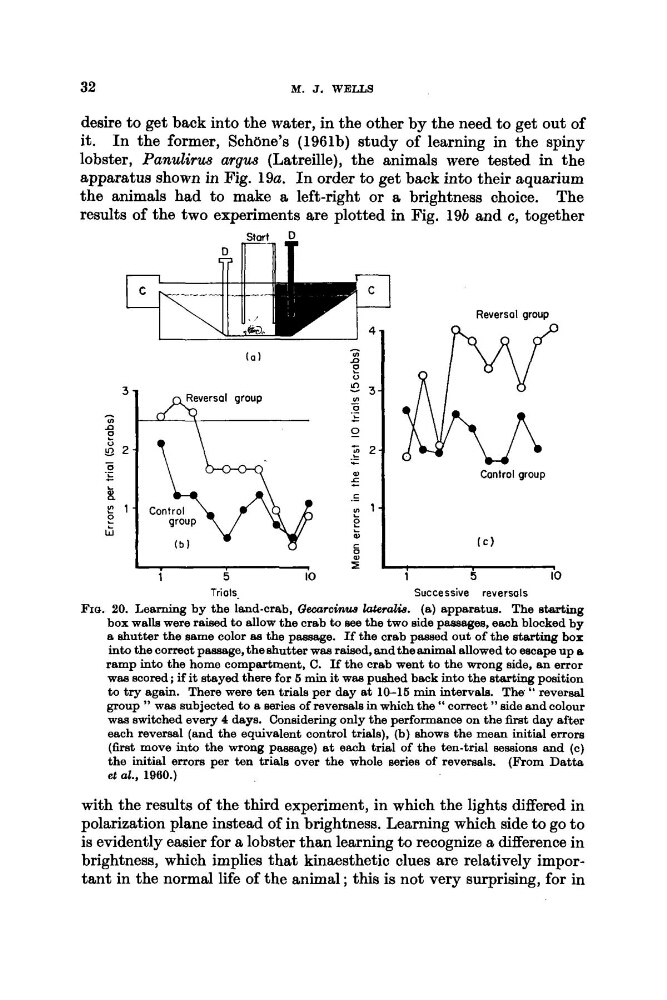
FIG. 20. Learning by the land-crab, Uecarcinw, lateralk. (a) apparatus. The starting
box walls were raised to allow the crab to me the two side passages. each blocked by
a shutter the same color EE the passage. If the crab passed out of the starting box
into the correct passage, the shutter waa raised, and the animal allowed to escape up e
ramp into the home compartment, C. If the crab went to the wrong side, an error
waa scored ; if it stayed there for 6 min it waa pushed back into the starting position
to try again. There were ten trials per day at 10-16 min intervals. The " reversal
group " waa subjected to a series of reversals in which the " correct " side and colour
was switched every 4 days. Considering only the performance on the first day after
each reversal (and the equivalent control trials), (b) shows the mean initial errors
(first move into the wrong pasaage) at each trial of the ten-trial sessions and (c)
the initial errom per ten trials over the whole series of reversals. (From Datta
et al., 1960.)
with the results of the third experiment, in which the lights differed in
polarization plane instead of in brightness. Learning which side to go to
is evidently easier for a lobster than learning to recognize a difference in
brightness, which implies that kinaesthetic clues are relatively important in the normal life of the animal ; this is not very surprising, for in
M. J. WELLS
desire to get back into the water, in the other by the need to get out of
it. I n the former, Schone's (1961b) study of learning in the spiny
lobster, Panulirus argus (Latreille), the animals were tested in the
apparatus shown in Fig. 19a. In order to get back into their aquarium
the animals had to make a left-right or a brightness choice. The
results of the two experiments are plotted in Fig. 19b and c, together
( a )
Reversal group
G
t \
L 7 ,
U
1
5
(0
Trials~
Reversal group
Control group
i
5
i 0
Successive reversals
FIG. 20. Learning by the land-crab, Uecarcinw, lateralk. (a) apparatus. The starting
box walls were raised to allow the crab to me the two side passages. each blocked by
a shutter the same color EE the passage. If the crab passed out of the starting box
into the correct passage, the shutter waa raised, and the animal allowed to escape up e
ramp into the home compartment, C. If the crab went to the wrong side, an error
waa scored ; if it stayed there for 6 min it waa pushed back into the starting position
to try again. There were ten trials per day at 10-16 min intervals. The " reversal
group " waa subjected to a series of reversals in which the " correct " side and colour
was switched every 4 days. Considering only the performance on the first day after
each reversal (and the equivalent control trials), (b) shows the mean initial errors
(first move into the wrong pasaage) at each trial of the ten-trial sessions and (c)
the initial errom per ten trials over the whole series of reversals. (From Datta
et al., 1960.)
with the results of the third experiment, in which the lights differed in
polarization plane instead of in brightness. Learning which side to go to
is evidently easier for a lobster than learning to recognize a difference in
brightness, which implies that kinaesthetic clues are relatively important in the normal life of the animal ; this is not very surprising, for in