

BIOLOGY OF SEAWEEDS OF ECONOMIC IIIIZPORTANOE
123
in 1917, compared with the peak yield for the years 1941-46 of 62 LO2
tons in 1942 (detailed records are available in Tseng, 1947). Tseng
estimated that the productivity of the Pacific coast kelp beds could equal
about 3 million tons per annum (Aleem, 1956a,b places the standing
crop at 25-40 tonslacre). The figures for British Columbia waters were
considered to be too low by Scagel (1961) owing to previous surveys
being carried out at unfavourable stages of the tide. He considered
IMPORTANT SEAWEEDS IN NORTH h R I 0 A
in tons freah weight
868 600
696 920
Tseng (1947)
Woodward (1962)
Scagel (1961)
Shrum (1962)
-
-
-
900 000
200 000 MacFarlane
(1952a,b; 19668)
that readily accessible kelps may approach 750 000-1 000 000 tons
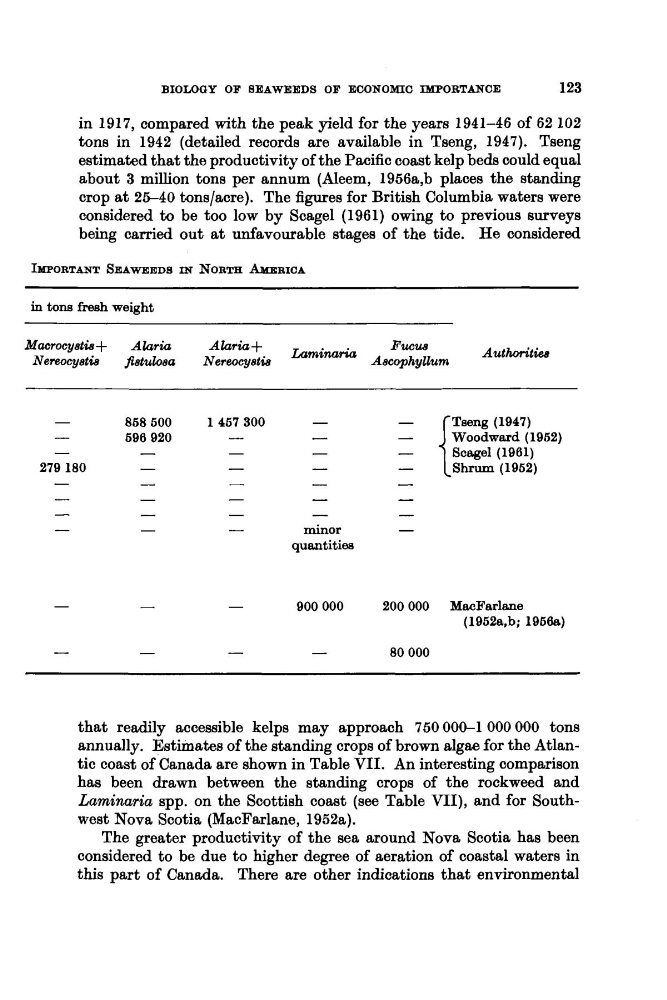
annually. Estimates of the standing crops of brown algae for the Atlantic coast of Canada are shown in Table VII. An interesting comparison
has been drawn between the standing crops of the rockweed and
Laminaria spp. on the Scottish coast (see Table VII), and for Southwest Nova Scotia (MacFarlane, 1952a).
The greater productivity of the sea around Nova Scotia has been
considered to be due to higher degree of aeration of coastal waters in
this part of Canada. There are other indications that environmental
123
in 1917, compared with the peak yield for the years 1941-46 of 62 LO2
tons in 1942 (detailed records are available in Tseng, 1947). Tseng
estimated that the productivity of the Pacific coast kelp beds could equal
about 3 million tons per annum (Aleem, 1956a,b places the standing
crop at 25-40 tonslacre). The figures for British Columbia waters were
considered to be too low by Scagel (1961) owing to previous surveys
being carried out at unfavourable stages of the tide. He considered
IMPORTANT SEAWEEDS IN NORTH h R I 0 A
in tons freah weight
868 600
696 920
Tseng (1947)
Woodward (1962)
Scagel (1961)
Shrum (1962)
-
-
-
900 000
200 000 MacFarlane
(1952a,b; 19668)
that readily accessible kelps may approach 750 000-1 000 000 tons
annually. Estimates of the standing crops of brown algae for the Atlantic coast of Canada are shown in Table VII. An interesting comparison
has been drawn between the standing crops of the rockweed and
Laminaria spp. on the Scottish coast (see Table VII), and for Southwest Nova Scotia (MacFarlane, 1952a).
The greater productivity of the sea around Nova Scotia has been
considered to be due to higher degree of aeration of coastal waters in
this part of Canada. There are other indications that environmental