

124
A. D. BONEY
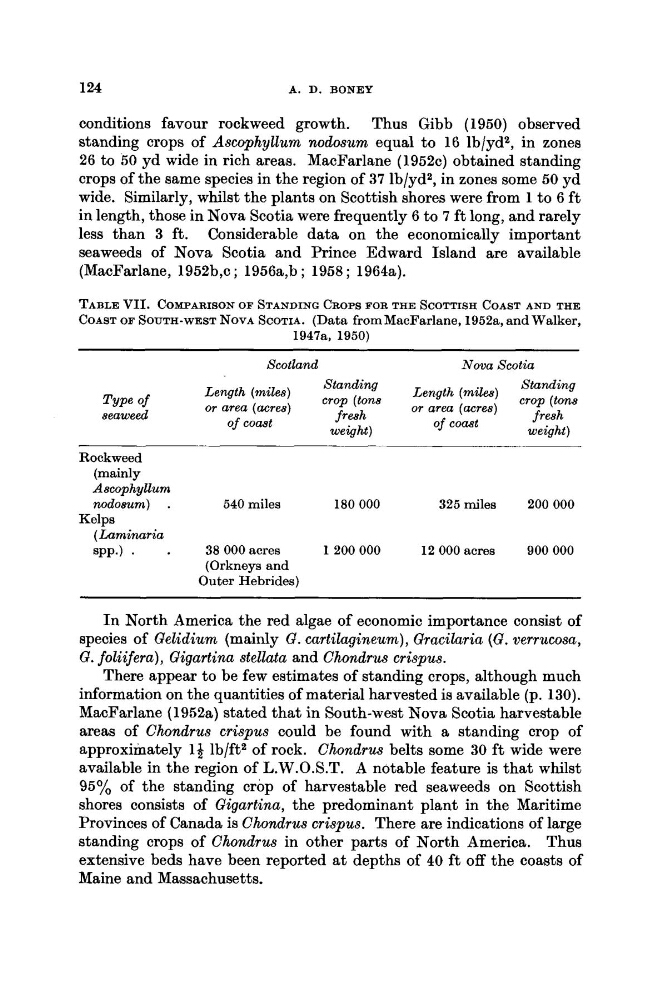
conditions favour rockweed growth. Thus Gibb (1950) observed
standing crops of Ascophyllum nodosum equal to 16 lb/yd2, in zones
26 to 50 yd wide in rich areas. MacFarlane (19520) obtained standing
crops of the same species in the region of 37 lb/yd2, in zones some 50 yd
wide. Similarly, whilst the plants on Scottish shores were from 1 to 6 ft
in length, those in Nova Scotia were frequently 6 to 7 ft long, and rarely
less than 3 ft. Considerable data on the economically important
seaweeds of Nova Scotia and Prince Edward Island are available
(MacFarlane, 1952b,c ; 1956a,b ; 1958 ; 1964a).
TABLE VII. COMPARISON OF STANDING CROPS FOR THE SCOTTISH COAST AND THE
COAST OF SOUTH-WEST NOVA SCOTIA. (Data fromMacFarlane, 1952a, and Walker,
1947a, 1950)
Scotland
Nova Scotia
Standing
Standing
Length (miles)
crop (tons
Length ( m i l 4 crop (tons
fresh
weight)
or area (acres)
of coast
fresh
weight)
or area (acres)
Type of
seaweed
of coast
Rockweed
(mainly
Ascophyllum
nodosum) .
540 miles
180 000
325 miles
200 000
(Laminuria
SPP.) .
. 38 000acres
1 200 000
12 000 acres
900 000
Kelps
(Orkneys and
Outer Hebrides)
In North America the red algae of economic importance consist of
species of Gelidium (mainly G. cartilagineum), Gracilaria (G. verrucosa,
G. foliifera), Gigartina stellata and Chondrus crispus.
There appear to be few estimates of standing crops, although much
information on the quantities of material harvested is available (p. 130).
MacFarlane (1952a) stated that in South-west Nova Scotia harvestable
areas of Chondrus crispus could be found with a standing crop of
approximately 1+ lb/ft2 of rock. Chondrus belts some 30 ft wide were
available in the region of L.W.O.S.T. A notable feature is that whilst
95% of the standing crop of harvestable red seaweeds on Scottish
shores consists of Gigartina, the predominant plant in the Maritime
Provinces of Canada is Chondrus crispus. There are indications of large
standing crops of Chondrus in other parts of North America. Thus
extensive beds have been reported at depths of 40 ft off the coasts of
Maine and Massachusetts.
A. D. BONEY
conditions favour rockweed growth. Thus Gibb (1950) observed
standing crops of Ascophyllum nodosum equal to 16 lb/yd2, in zones
26 to 50 yd wide in rich areas. MacFarlane (19520) obtained standing
crops of the same species in the region of 37 lb/yd2, in zones some 50 yd
wide. Similarly, whilst the plants on Scottish shores were from 1 to 6 ft
in length, those in Nova Scotia were frequently 6 to 7 ft long, and rarely
less than 3 ft. Considerable data on the economically important
seaweeds of Nova Scotia and Prince Edward Island are available
(MacFarlane, 1952b,c ; 1956a,b ; 1958 ; 1964a).
TABLE VII. COMPARISON OF STANDING CROPS FOR THE SCOTTISH COAST AND THE
COAST OF SOUTH-WEST NOVA SCOTIA. (Data fromMacFarlane, 1952a, and Walker,
1947a, 1950)
Scotland
Nova Scotia
Standing
Standing
Length (miles)
crop (tons
Length ( m i l 4 crop (tons
fresh
weight)
or area (acres)
of coast
fresh
weight)
or area (acres)
Type of
seaweed
of coast
Rockweed
(mainly
Ascophyllum
nodosum) .
540 miles
180 000
325 miles
200 000
(Laminuria
SPP.) .
. 38 000acres
1 200 000
12 000 acres
900 000
Kelps
(Orkneys and
Outer Hebrides)
In North America the red algae of economic importance consist of
species of Gelidium (mainly G. cartilagineum), Gracilaria (G. verrucosa,
G. foliifera), Gigartina stellata and Chondrus crispus.
There appear to be few estimates of standing crops, although much
information on the quantities of material harvested is available (p. 130).
MacFarlane (1952a) stated that in South-west Nova Scotia harvestable
areas of Chondrus crispus could be found with a standing crop of
approximately 1+ lb/ft2 of rock. Chondrus belts some 30 ft wide were
available in the region of L.W.O.S.T. A notable feature is that whilst
95% of the standing crop of harvestable red seaweeds on Scottish
shores consists of Gigartina, the predominant plant in the Maritime
Provinces of Canada is Chondrus crispus. There are indications of large
standing crops of Chondrus in other parts of North America. Thus
extensive beds have been reported at depths of 40 ft off the coasts of
Maine and Massachusetts.