

POPULATION CYCLES IN SMALL MAMMALS
325
All studies indicate that Clethrionomys reaches the annual peak
late in the fall. For this reason we must be suspicious of data which
are obtained from only one or two trappings a year or from field
samples collected for only a short summer period.
There are only three records of winter breeding in Clethrionomys,
and this genus would seem to differ from lemmings and Microtus in that
winter breeding is rare. No one has investigated why Microtus is able
to breed in some winters while Clethrionomys usually does not. Evernden
1963
1964
1965
1966
1967
1968
1969
1970
1971
YEAR
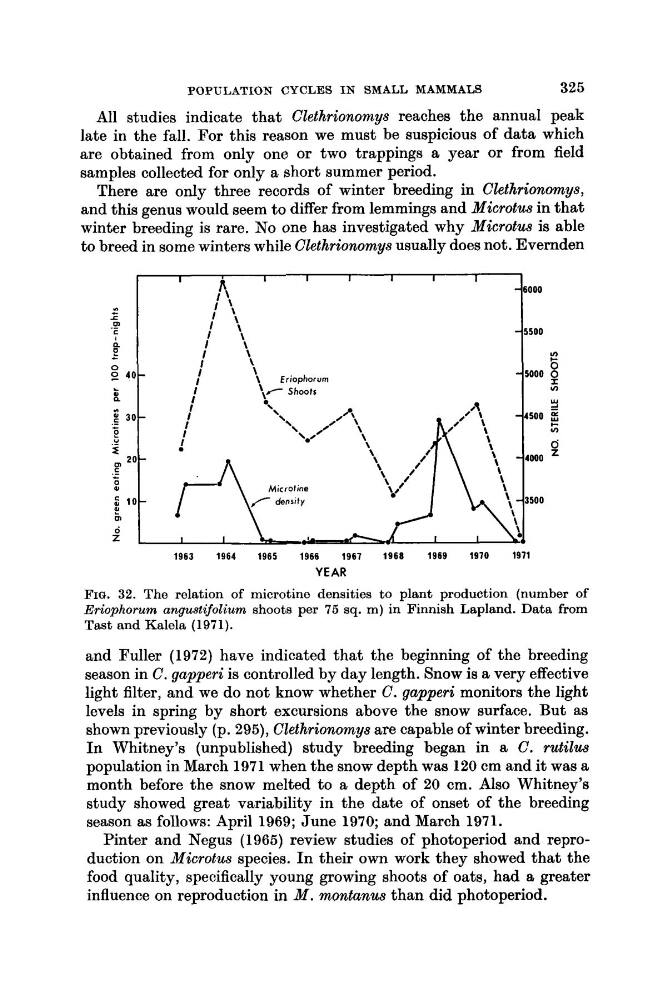
FIU. 32. The relation of microtine densities to plant production (number of
Eriophoruwa angustifoliuna shoots per 75 sq. m) in Finnish Lapland. Data from
Tast and Kalela (1971).
and Fuller (1972) have indicated that the beginning of the breeding
season in C. gapperi is controlled by day length. Snow is a very effective
light filter, and we do not know whether C. gapperi monitors the light
levels in spring by short excursions above the snow surface. But as
shown previously (p. 295), Clethrionomys are capable of winter breeding.
In Whitney’s (unpublished) study breeding began in a C. rutilus
population in March 1971 when the snow depth was 120 cm and it was a
month before the snow melted to a depth of 20 cm. Also Whitney’s
study showed great variability in the date of onset of the breeding
season as follows: April 1969; June 1970; and March 1971.
Pinter and Negus (1965) review studies of photoperiod and reproduction on Microtus species. In their own work they showed that the
food quality, specifically young growing shoots of oats, had a greater
influence on reproduction in M . montanus than did photoperiod.
325
All studies indicate that Clethrionomys reaches the annual peak
late in the fall. For this reason we must be suspicious of data which
are obtained from only one or two trappings a year or from field
samples collected for only a short summer period.
There are only three records of winter breeding in Clethrionomys,
and this genus would seem to differ from lemmings and Microtus in that
winter breeding is rare. No one has investigated why Microtus is able
to breed in some winters while Clethrionomys usually does not. Evernden
1963
1964
1965
1966
1967
1968
1969
1970
1971
YEAR
FIU. 32. The relation of microtine densities to plant production (number of
Eriophoruwa angustifoliuna shoots per 75 sq. m) in Finnish Lapland. Data from
Tast and Kalela (1971).
and Fuller (1972) have indicated that the beginning of the breeding
season in C. gapperi is controlled by day length. Snow is a very effective
light filter, and we do not know whether C. gapperi monitors the light
levels in spring by short excursions above the snow surface. But as
shown previously (p. 295), Clethrionomys are capable of winter breeding.
In Whitney’s (unpublished) study breeding began in a C. rutilus
population in March 1971 when the snow depth was 120 cm and it was a
month before the snow melted to a depth of 20 cm. Also Whitney’s
study showed great variability in the date of onset of the breeding
season as follows: April 1969; June 1970; and March 1971.
Pinter and Negus (1965) review studies of photoperiod and reproduction on Microtus species. In their own work they showed that the
food quality, specifically young growing shoots of oats, had a greater
influence on reproduction in M . montanus than did photoperiod.