

324
CHARLES J. KREBS AND JUDITH H. MYERS
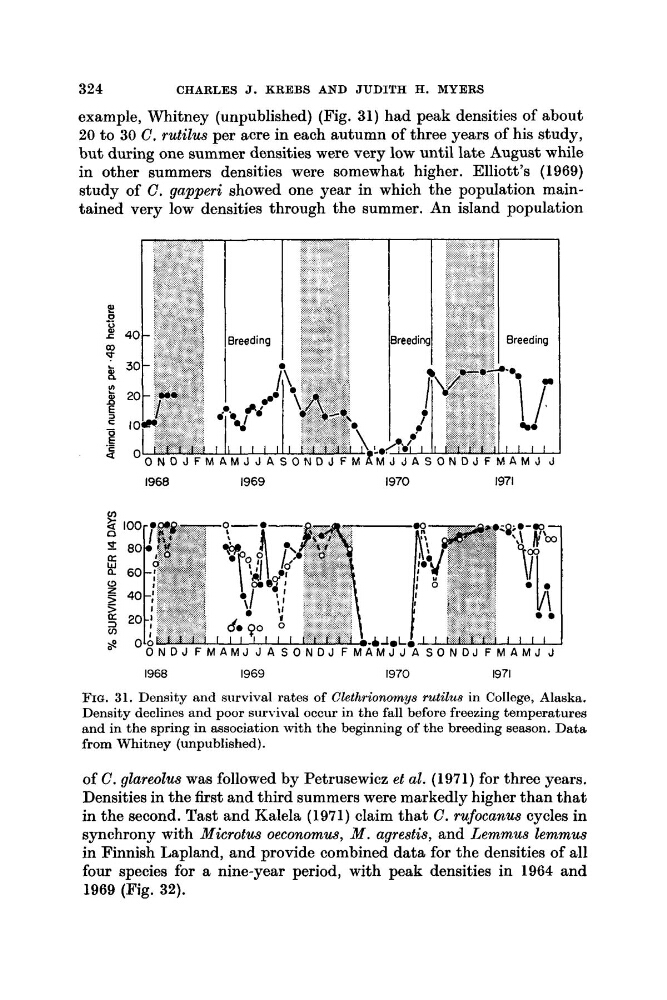
example, Whitney (unpublished) (Fig. 31) had peak densities of about
20 to 30 C. rutilus per acre in each autumn of three years of his study,
but during one summer densities were very low until late August while
in other summers densities were somewhat higher. Elliott’s (1969)
study of C. gapperi showed one year in which the population maintained very low densities through the summer. An island population
1968
1969
I970
1971
1968
1969
1970
1971
FIG. 31. Density and survival rates of Clethrionomgs rutilus in College, Alaska.
Density declines and poor survival occur in the fall before freezing temperatures
and in the spring in association with the beginning of the breeding eeason. Data
from Whitney (unpublished).
of C. glareolus was followed by Petrusewicz et al. (1971) for three years.
Densities in the first and third summers were markedly higher than that
in the second. Tast and Kalela (1971) claim that C. rufocanus cycles in
synchrony with Microtus oeconomus, M . agrestis, and Lemmus lemmus
in Finnish Lapland, and provide combined data for the densities of all
four species for a nine-year period, with peak densities in 1964 and
1969 (Fig. 32).
CHARLES J. KREBS AND JUDITH H. MYERS
example, Whitney (unpublished) (Fig. 31) had peak densities of about
20 to 30 C. rutilus per acre in each autumn of three years of his study,
but during one summer densities were very low until late August while
in other summers densities were somewhat higher. Elliott’s (1969)
study of C. gapperi showed one year in which the population maintained very low densities through the summer. An island population
1968
1969
I970
1971
1968
1969
1970
1971
FIG. 31. Density and survival rates of Clethrionomgs rutilus in College, Alaska.
Density declines and poor survival occur in the fall before freezing temperatures
and in the spring in association with the beginning of the breeding eeason. Data
from Whitney (unpublished).
of C. glareolus was followed by Petrusewicz et al. (1971) for three years.
Densities in the first and third summers were markedly higher than that
in the second. Tast and Kalela (1971) claim that C. rufocanus cycles in
synchrony with Microtus oeconomus, M . agrestis, and Lemmus lemmus
in Finnish Lapland, and provide combined data for the densities of all
four species for a nine-year period, with peak densities in 1964 and
1969 (Fig. 32).