

326
CHARLES J. KREBS AND JUDITH H. MYERS
Data are not available for a detailed comparison of Microtus and
Clethrionomys. We might predict that Clethrionomys with only rare
winter breeding would fluctuate less than Microtus which can breed all
year. Also Clethrionomys should have a lesser impact on its woodland
habitat than the grassland-dwelling Microtus, which again might act
to buffer fluctuations. There are no data available to test these simple
suggestions. Clethrionomys show many of the demographic characteristics of fluctuating microtines (see section V). Whitney’s work shows
that in the same study area, C . rutilus reached similar densities in the
autumns of the three years of the study, while Microtus oeconomus
reached peak densities in one summer and declined to extremely low
densities thereafter. Studies comparing sympatric and allopatric
populations of Microtus and Clethrionomys may help us to determine
more specifically those characteristics which distinguish cycling microtine populations and to determine the influence of habitat on population
phenomena.
2. The effect of microtine grazing on the food supply
Do foraging activities of microtines remove a significant proportion
of the food supply? Thompson (195513) and Pitelka (1958) report
extensive forage utilization preceding declines of brown lemming
populations at Barrow, Alaska. However, Chitty (1960) and Krebs
(1964a) reviewed studies in which neither habitat destruction nor
starvation were observed to be associated with declining vole and
lemming populations.
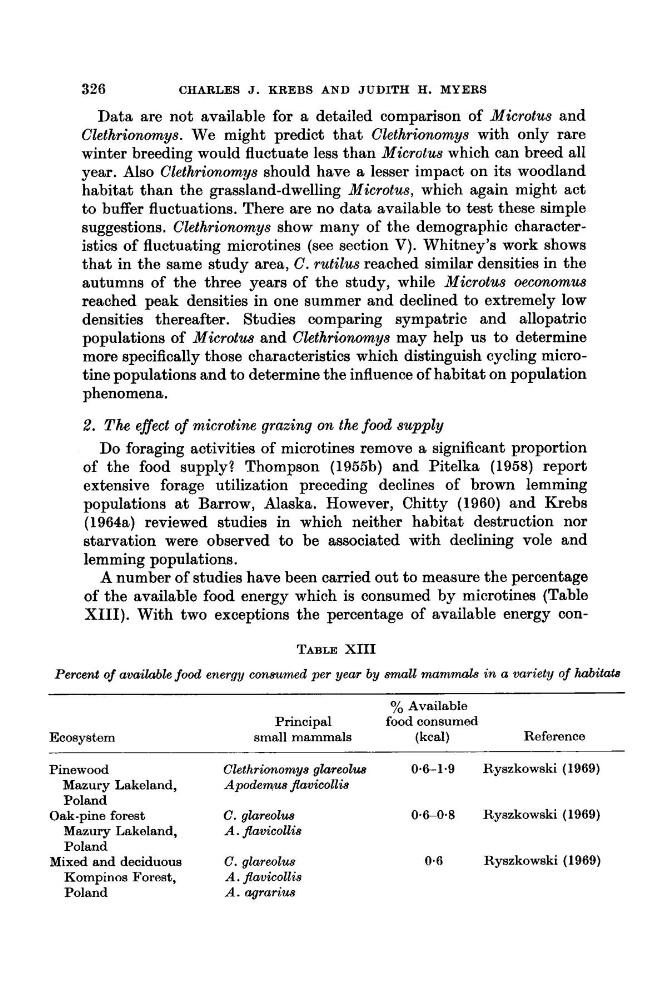
A number of studies have been carried out to measure the percentage
of the available food energy which is consumed by microtines (Table
XIII). With two exceptions the percentage of available energy conTABLE XI11
Percent of available food energy consumed per year by small mammals in a variety of habitata
Ecosystem
yo Available
Principal
food consumed
small mammals
(kcal)
Reference
Pinewood
Clethrionomys glareolus
0.6-1.9
Ryszkowski (1969)
Mazury Lakeland,
Apodemus Jlavicollis
Poland
Mazury Lakeland,
A . Jlavicollis
Poland
Kompinos Forest,
A . Jlavicollis
Poland
A . agrarius
Oak-pine forest
C. glareolus
0+0+3
Ryszkowski (1969)
Mixed and deciduous
C. glareolus
0.6
Ryszkowski (1969)
CHARLES J. KREBS AND JUDITH H. MYERS
Data are not available for a detailed comparison of Microtus and
Clethrionomys. We might predict that Clethrionomys with only rare
winter breeding would fluctuate less than Microtus which can breed all
year. Also Clethrionomys should have a lesser impact on its woodland
habitat than the grassland-dwelling Microtus, which again might act
to buffer fluctuations. There are no data available to test these simple
suggestions. Clethrionomys show many of the demographic characteristics of fluctuating microtines (see section V). Whitney’s work shows
that in the same study area, C . rutilus reached similar densities in the
autumns of the three years of the study, while Microtus oeconomus
reached peak densities in one summer and declined to extremely low
densities thereafter. Studies comparing sympatric and allopatric
populations of Microtus and Clethrionomys may help us to determine
more specifically those characteristics which distinguish cycling microtine populations and to determine the influence of habitat on population
phenomena.
2. The effect of microtine grazing on the food supply
Do foraging activities of microtines remove a significant proportion
of the food supply? Thompson (195513) and Pitelka (1958) report
extensive forage utilization preceding declines of brown lemming
populations at Barrow, Alaska. However, Chitty (1960) and Krebs
(1964a) reviewed studies in which neither habitat destruction nor
starvation were observed to be associated with declining vole and
lemming populations.
A number of studies have been carried out to measure the percentage
of the available food energy which is consumed by microtines (Table
XIII). With two exceptions the percentage of available energy conTABLE XI11
Percent of available food energy consumed per year by small mammals in a variety of habitata
Ecosystem
yo Available
Principal
food consumed
small mammals
(kcal)
Reference
Pinewood
Clethrionomys glareolus
0.6-1.9
Ryszkowski (1969)
Mazury Lakeland,
Apodemus Jlavicollis
Poland
Mazury Lakeland,
A . Jlavicollis
Poland
Kompinos Forest,
A . Jlavicollis
Poland
A . agrarius
Oak-pine forest
C. glareolus
0+0+3
Ryszkowski (1969)
Mixed and deciduous
C. glareolus
0.6
Ryszkowski (1969)