

309
POPULATION CYCLES IN SMALL MAMMALS
survival of adults and juveniles in a simplified life-table computation.
The basic variables are the adult survival rate per 14 days and the
index of early juvenile survival. The constants in the life table are the
litter size at birth (4.54 in Microtus pennsylvanicus), the age a t sexual
maturity and the age at first capture. For a series of simplified calculations with M . pennsylvanicus we have assumed the age at f i s t capture
and the age at sexual maturity both to average five weeks. The index
of early juvenile survival in association with the litter size at birth
and the age a t first capture determines the survival between birth and
SlJRVlVAL RATE PER 14 DAYS
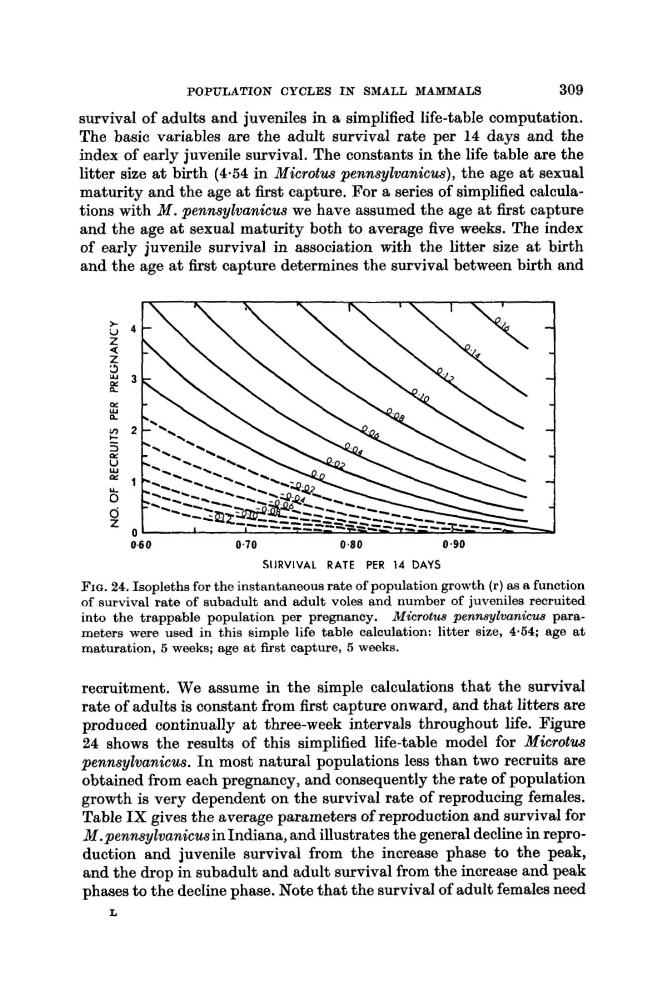
FIG. 24. Isopleths for the instantaneous rate of population growth (r) as a function
of survival rate of subadult and adult voles and number of juveniles recruited
into the trappable population per pregnancy. Microtwr pennsylvanicwr parameters were used in this simple life table calculation: litter size, 4.54; age a t
maturation, 5 weeks; age at first capture, 5 weeks.
recruitment. We assume in the simple calculations that the survival
rate of adults is constant from first capture onward, and that litters are
produced continually at three-week intervals throughout life. Figure
24 shows the results of this simplified life-table model for Microtus
pennsylvanicus. In most natural populations less than two recruits are
obtained from each pregnancy, and consequently the rate of population
growth is very dependent on the survival rate of reproducing females.
Table IX gives the average parameters of reproduction and survival for
M . pennsylvanicus in Indiana, and illustrates the general decline in reproduction and juvenile survival from the increase phase to the peak,
and the drop in subadult and adult survival from the increase and peak
phases to the decline phase. Note that the survival of adult females need
L
POPULATION CYCLES IN SMALL MAMMALS
survival of adults and juveniles in a simplified life-table computation.
The basic variables are the adult survival rate per 14 days and the
index of early juvenile survival. The constants in the life table are the
litter size at birth (4.54 in Microtus pennsylvanicus), the age a t sexual
maturity and the age at first capture. For a series of simplified calculations with M . pennsylvanicus we have assumed the age at f i s t capture
and the age at sexual maturity both to average five weeks. The index
of early juvenile survival in association with the litter size at birth
and the age a t first capture determines the survival between birth and
SlJRVlVAL RATE PER 14 DAYS
FIG. 24. Isopleths for the instantaneous rate of population growth (r) as a function
of survival rate of subadult and adult voles and number of juveniles recruited
into the trappable population per pregnancy. Microtwr pennsylvanicwr parameters were used in this simple life table calculation: litter size, 4.54; age a t
maturation, 5 weeks; age at first capture, 5 weeks.
recruitment. We assume in the simple calculations that the survival
rate of adults is constant from first capture onward, and that litters are
produced continually at three-week intervals throughout life. Figure
24 shows the results of this simplified life-table model for Microtus
pennsylvanicus. In most natural populations less than two recruits are
obtained from each pregnancy, and consequently the rate of population
growth is very dependent on the survival rate of reproducing females.
Table IX gives the average parameters of reproduction and survival for
M . pennsylvanicus in Indiana, and illustrates the general decline in reproduction and juvenile survival from the increase phase to the peak,
and the drop in subadult and adult survival from the increase and peak
phases to the decline phase. Note that the survival of adult females need
L