

308
CHARLES J. KREBS AND JUDITH H. MYERS
used were mean values covering the “summer” or “winter” portions
of the year (corresponding approximately to the breeding season and
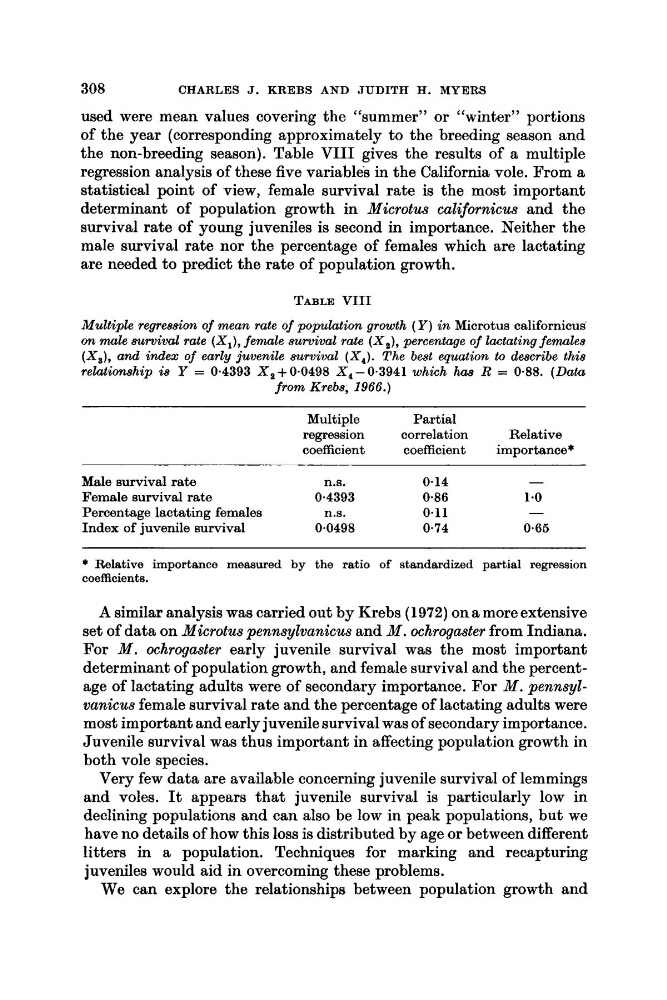
the non-breeding season). Table VIII gives the results of a multiple
regression analysis of these five variables in the California vole. From a
statistical point of view, female survival rate is the most important
determinant of population growth in Microtus californicus and the
survival rate of young juveniles is second in importance. Neither the
male survival rate nor the percentage of females which are lactating
are needed to predict the rate of population growth.
TABLE V I I I
Multiple regression of mean rate of population growth ( Y ) in Microtus californicus’
on mule survival rate (XI), femule survival rate (XJ, percentage of lactating females
( X 8 ) , and index of early juvenile survival (X4). The best equation to describe this
relationship is Y = 0.4393 X,+O.O498 X,-O.3941 which has R = 0.88. (Data
from Krebs, 1966.)
Multiple
Partial
regression
correlation
Relative
coefficient
coefficient
importance*
Male survival rate
n.s.
0.14
-
Female survival rate
0.4393
0-86
1 -0
Index of juvenile survival
0.0498
0.74
0.66
Percentage lactating females
n.8.
0.11
-
* Relative importance measured by the ratio of standardized partial regression
coefficients.
A similar analysis was carried out by Krebs (1972) on a more extensive
set of data on Microtus pennsylvanicus and M . ochrogaster from Indiana.
For M . ochrogaster early juvenile survival was the most important
determinant of population growth, and female survival and the percentage of lactating adults were of secondary importance. For M . pennsylvanicus female survival rate and the percentage of lactating adults were
most important and early juvenile survival was of secondary importance.
Juvenile survival was thus important in affecting population growth in
both vole species.
Very few data are available concerning juvenile survival of lemmings
and voles. It appears that juvenile survival is particularly low in
declining populations and can also be low in peak populations, but we
have no details of how this loss is distributed by age or between different
litters in a population. Techniques for marking and recapturing
juveniles would aid in overcoming these problems.
We can explore the relationships between population growth and
CHARLES J. KREBS AND JUDITH H. MYERS
used were mean values covering the “summer” or “winter” portions
of the year (corresponding approximately to the breeding season and
the non-breeding season). Table VIII gives the results of a multiple
regression analysis of these five variables in the California vole. From a
statistical point of view, female survival rate is the most important
determinant of population growth in Microtus californicus and the
survival rate of young juveniles is second in importance. Neither the
male survival rate nor the percentage of females which are lactating
are needed to predict the rate of population growth.
TABLE V I I I
Multiple regression of mean rate of population growth ( Y ) in Microtus californicus’
on mule survival rate (XI), femule survival rate (XJ, percentage of lactating females
( X 8 ) , and index of early juvenile survival (X4). The best equation to describe this
relationship is Y = 0.4393 X,+O.O498 X,-O.3941 which has R = 0.88. (Data
from Krebs, 1966.)
Multiple
Partial
regression
correlation
Relative
coefficient
coefficient
importance*
Male survival rate
n.s.
0.14
-
Female survival rate
0.4393
0-86
1 -0
Index of juvenile survival
0.0498
0.74
0.66
Percentage lactating females
n.8.
0.11
-
* Relative importance measured by the ratio of standardized partial regression
coefficients.
A similar analysis was carried out by Krebs (1972) on a more extensive
set of data on Microtus pennsylvanicus and M . ochrogaster from Indiana.
For M . ochrogaster early juvenile survival was the most important
determinant of population growth, and female survival and the percentage of lactating adults were of secondary importance. For M . pennsylvanicus female survival rate and the percentage of lactating adults were
most important and early juvenile survival was of secondary importance.
Juvenile survival was thus important in affecting population growth in
both vole species.
Very few data are available concerning juvenile survival of lemmings
and voles. It appears that juvenile survival is particularly low in
declining populations and can also be low in peak populations, but we
have no details of how this loss is distributed by age or between different
litters in a population. Techniques for marking and recapturing
juveniles would aid in overcoming these problems.
We can explore the relationships between population growth and