

POPULATION CYCLES IN SMALL MAMMALS
307
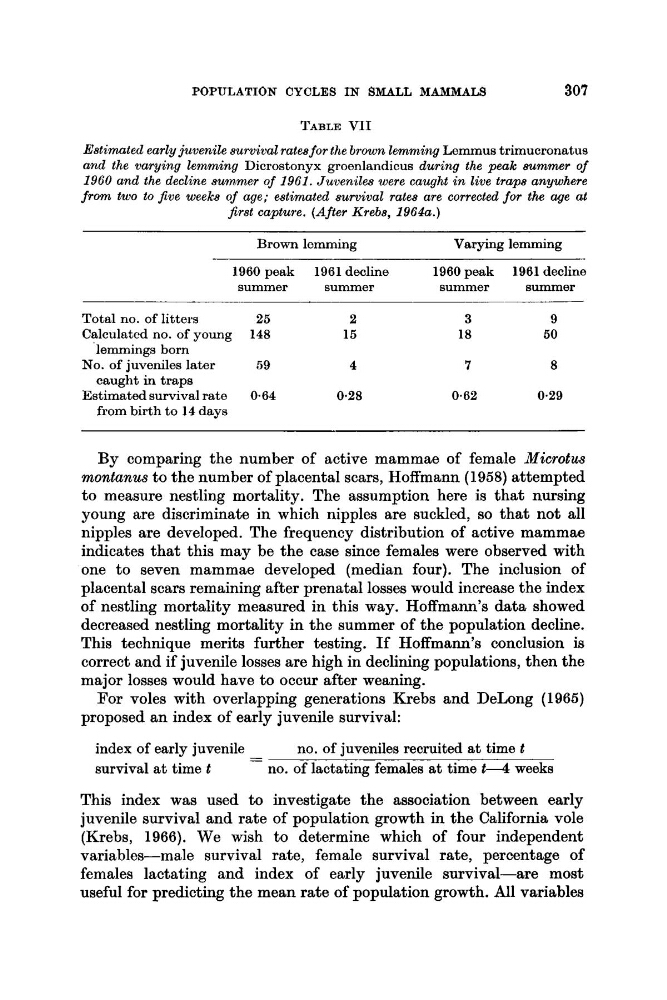
TABLE VII
Estimated early juvenile survival rates for the brown lemming Lemmus trimucronatus
and the varying lemming Dicrostonyx groenlandicus during the peak Bummer of
1960 and the decline summer of 1961. Juveniles were caught in live traps anywhere
from two to five weeks of age; estimated survival rates are corrected for the age at
first capture. (After Krebs, 1964a.)
Brown lemming
Varying lemming
1960 peak
1961 decline
1960 peak 1961 decline
summer
summer
summer
summer
Total no. of litters
25
2
3
9
Calculated no. of young 148
15
18
60
No. of juveniles later
59
4
7
8
Estimated survival rate
0.64
0.28
0.62
0.29
lemmings born
caught in traps
from birth to 14 days
By comparing the number of active mammae of female Microtus
montanus to the number of placental scars, Hoffmann (1958) attempted
to measure nestling mortality. The assumption here is that nursing
young are discriminate in which nipples are suckled, so that not all
nipples are developed. The frequency distribution of active mammae
indicates that this may be the case since females were observed with
one to seven mammae developed (median four). The inclusion of
placental scars remaining after prenatal losses would increase the index
of nestling mortality measured in this way. Hoffmann’s data showed
decreased nestling mortality in the summer of the population decline.
This technique merits further testing. If Hoffmann’s conclusion is
correct and if juvenile losses are high in declining populations, then the
major losses would have to occur after weaning.
For voles with overlapping generations Krebs and DeLong (1965)
proposed an index of early juvenile survival:
no. of juveniles recruited at time t
no. of lactating females at time t 4 weeks
index of early juvenile - -
survival at time t
This index was used to investigate the association between early
juvenile survival and rate of population growth in the California vole
(Krebs, 1966). We wish to determine which of four independent
variables-male
survival rate, female survival rate, percentage of
females lactating and index of early juvenile survival-are
most
useful for predicting the mean rate of population growth. All variables
307
TABLE VII
Estimated early juvenile survival rates for the brown lemming Lemmus trimucronatus
and the varying lemming Dicrostonyx groenlandicus during the peak Bummer of
1960 and the decline summer of 1961. Juveniles were caught in live traps anywhere
from two to five weeks of age; estimated survival rates are corrected for the age at
first capture. (After Krebs, 1964a.)
Brown lemming
Varying lemming
1960 peak
1961 decline
1960 peak 1961 decline
summer
summer
summer
summer
Total no. of litters
25
2
3
9
Calculated no. of young 148
15
18
60
No. of juveniles later
59
4
7
8
Estimated survival rate
0.64
0.28
0.62
0.29
lemmings born
caught in traps
from birth to 14 days
By comparing the number of active mammae of female Microtus
montanus to the number of placental scars, Hoffmann (1958) attempted
to measure nestling mortality. The assumption here is that nursing
young are discriminate in which nipples are suckled, so that not all
nipples are developed. The frequency distribution of active mammae
indicates that this may be the case since females were observed with
one to seven mammae developed (median four). The inclusion of
placental scars remaining after prenatal losses would increase the index
of nestling mortality measured in this way. Hoffmann’s data showed
decreased nestling mortality in the summer of the population decline.
This technique merits further testing. If Hoffmann’s conclusion is
correct and if juvenile losses are high in declining populations, then the
major losses would have to occur after weaning.
For voles with overlapping generations Krebs and DeLong (1965)
proposed an index of early juvenile survival:
no. of juveniles recruited at time t
no. of lactating females at time t 4 weeks
index of early juvenile - -
survival at time t
This index was used to investigate the association between early
juvenile survival and rate of population growth in the California vole
(Krebs, 1966). We wish to determine which of four independent
variables-male
survival rate, female survival rate, percentage of
females lactating and index of early juvenile survival-are
most
useful for predicting the mean rate of population growth. All variables