

306
CHARLES J. KREBS AND JUDITH H. MYERS
reach the trappable population of adult voles. Sampling techniques that
could catch large numbers of small juveniles would be most useful,
but at present none exist (cf. Andrzejewski and Rajska, 1972).
Chitty (1952) reported that juvenile losses in Microtus agrestis were
high during the first half of the peak summer breeding season but were
reduced in the late summer and early fall. Godfrey (1955) reported high
juvenile losses in this species during the summer of two decline years.
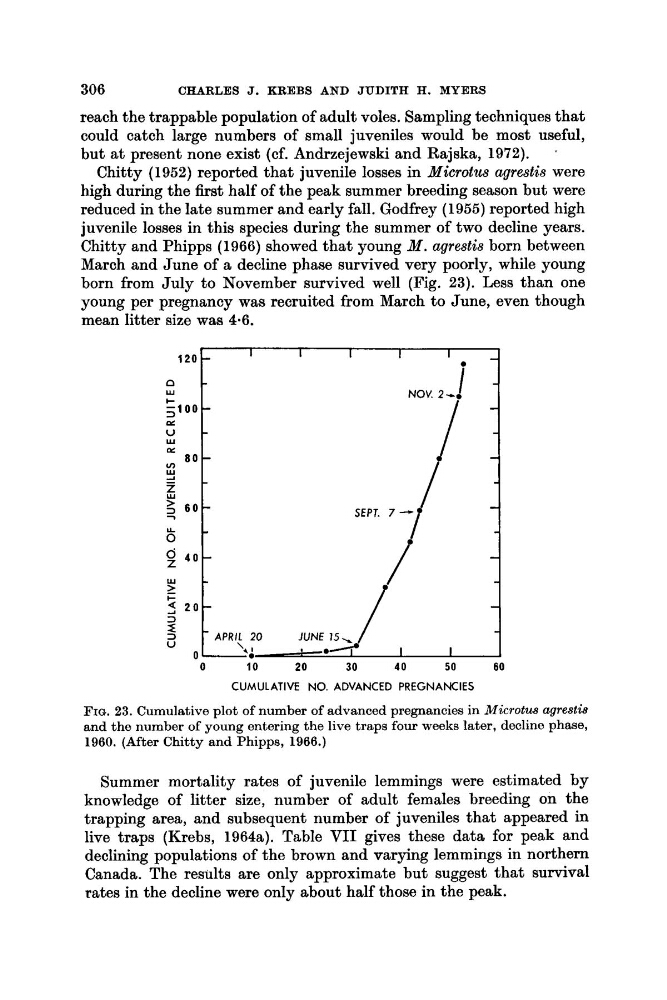
Chitty and Phipps (1966) showed that young M . agrestis born between
March and June of a decline phase survived very poorly, while young
born from July to November survived well (Fig. 23). Less than one
young per pregnancy was recruited from March to June, even though
mean litter size was 4-6.
'
0
10
20
30
40
50
60
CUMULATIVE NO. ADVANCED PREGNANCIES
FIG. 23. Cumulative plot of number of advanced pregnancies in Microtus agrestis
and the number of young entering the live traps four weeks later, decline phase,
1960. (After Chitty and Phipps, 1960.)
Summer mortality rates of juvenile lemmings were estimated by
knowledge of litter size, number of adult females breeding on the
trapping area, and subsequent number of juveniles that appeared in
live traps (Krebs, 1964a). Table VII gives these data for peak and
declining populations of the brown and varying lemmings in northern
Canada. The results are only approximate but suggest that survival
rates in the decline were only about half those in the peak.
CHARLES J. KREBS AND JUDITH H. MYERS
reach the trappable population of adult voles. Sampling techniques that
could catch large numbers of small juveniles would be most useful,
but at present none exist (cf. Andrzejewski and Rajska, 1972).
Chitty (1952) reported that juvenile losses in Microtus agrestis were
high during the first half of the peak summer breeding season but were
reduced in the late summer and early fall. Godfrey (1955) reported high
juvenile losses in this species during the summer of two decline years.
Chitty and Phipps (1966) showed that young M . agrestis born between
March and June of a decline phase survived very poorly, while young
born from July to November survived well (Fig. 23). Less than one
young per pregnancy was recruited from March to June, even though
mean litter size was 4-6.
'
0
10
20
30
40
50
60
CUMULATIVE NO. ADVANCED PREGNANCIES
FIG. 23. Cumulative plot of number of advanced pregnancies in Microtus agrestis
and the number of young entering the live traps four weeks later, decline phase,
1960. (After Chitty and Phipps, 1960.)
Summer mortality rates of juvenile lemmings were estimated by
knowledge of litter size, number of adult females breeding on the
trapping area, and subsequent number of juveniles that appeared in
live traps (Krebs, 1964a). Table VII gives these data for peak and
declining populations of the brown and varying lemmings in northern
Canada. The results are only approximate but suggest that survival
rates in the decline were only about half those in the peak.