

310
CHARLES J. KREBS AND JUDITH H. MYERS
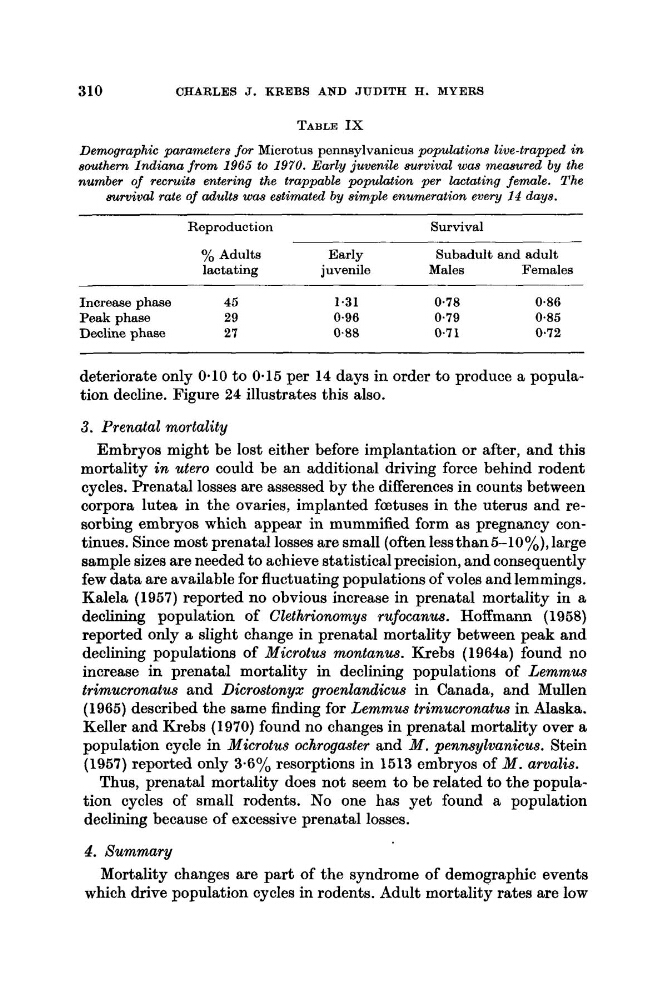
TABLE IX
Demographic parameters for Microtus pennsylvanicus populations live-trapped in
southern Indiana from 1965 to 1970. Early juvenile survival was measured by the
number of recruits entering the trappable population per lactating female. The
aurvival rate of adults was estimated by simple enumeration every 14 days.
Reproduction
Survival
yo Adults
Early
Subadult and adult
lactating
juvenile
Males
Females
Increase phase
45
1-31
0.78
0.86
Peak phase
29
0.96
0.79
0.85
Decline phase
27
0.88
0-7 1
0.72
deteriorate only 0.10 to 0.15 per 14 days in order to produce a population decline. Figure 24 illustrates this also.
3. Prenatal mortality
Embryos might be lost either before implantation or after, and this
mortality in utero could be an additional driving force behind rodent
cycles. Prenatal losses are assessed by the differences in counts between
corpora lutea in the ovaries, implanted foetuses in the uterus and resorbing embryos which appear in mummified form as pregnancy continues. Since most prenatal losses are small (often lessthan5-10%), large
sample sizes are needed to achieve statistical precision, and consequently
few data are available for fluctuating populations of voles and lemmings.
Kalela (1957) reported no obvious increase in prenatal mortality in a
declining population of Clethrionomys rufocanus. Hoffmann (1958)
reported only a slight change in prenatal mortality between peak and
declining populations of Microtus montanus. Krebs (1964a) found no
increase in prenatal mortality in declining populations of Lemmzls
trimucronatus and Dicrostonyx groenlandicus in Canada, and Mullen
(1965) described the same finding for Lemmus trimucronatus in Alaska.
Keller and Krebs (1970) found no changes in prenatal mortality over a
population cycle in Microtus ochrogaster and M . pennsylvanicus. Stein
(1957) reported only 3.6% resorptions in 1513 embryos of M . arvalis.
Thus, prenatal mortality does not seem to be related to the population cycles of small rodents. No one has yet found a population
declining because of excessive prenatal losses.
4. Summary
Mortality changes are part of the syndrome of demographic events
which drive population cycles in rodents. Adult mortality rates are low
CHARLES J. KREBS AND JUDITH H. MYERS
TABLE IX
Demographic parameters for Microtus pennsylvanicus populations live-trapped in
southern Indiana from 1965 to 1970. Early juvenile survival was measured by the
number of recruits entering the trappable population per lactating female. The
aurvival rate of adults was estimated by simple enumeration every 14 days.
Reproduction
Survival
yo Adults
Early
Subadult and adult
lactating
juvenile
Males
Females
Increase phase
45
1-31
0.78
0.86
Peak phase
29
0.96
0.79
0.85
Decline phase
27
0.88
0-7 1
0.72
deteriorate only 0.10 to 0.15 per 14 days in order to produce a population decline. Figure 24 illustrates this also.
3. Prenatal mortality
Embryos might be lost either before implantation or after, and this
mortality in utero could be an additional driving force behind rodent
cycles. Prenatal losses are assessed by the differences in counts between
corpora lutea in the ovaries, implanted foetuses in the uterus and resorbing embryos which appear in mummified form as pregnancy continues. Since most prenatal losses are small (often lessthan5-10%), large
sample sizes are needed to achieve statistical precision, and consequently
few data are available for fluctuating populations of voles and lemmings.
Kalela (1957) reported no obvious increase in prenatal mortality in a
declining population of Clethrionomys rufocanus. Hoffmann (1958)
reported only a slight change in prenatal mortality between peak and
declining populations of Microtus montanus. Krebs (1964a) found no
increase in prenatal mortality in declining populations of Lemmzls
trimucronatus and Dicrostonyx groenlandicus in Canada, and Mullen
(1965) described the same finding for Lemmus trimucronatus in Alaska.
Keller and Krebs (1970) found no changes in prenatal mortality over a
population cycle in Microtus ochrogaster and M . pennsylvanicus. Stein
(1957) reported only 3.6% resorptions in 1513 embryos of M . arvalis.
Thus, prenatal mortality does not seem to be related to the population cycles of small rodents. No one has yet found a population
declining because of excessive prenatal losses.
4. Summary
Mortality changes are part of the syndrome of demographic events
which drive population cycles in rodents. Adult mortality rates are low