

POPULATION CYCLES IN SMALL MAMMALS
291
V. DEMOGRAPHIC MACHINERY
A. R E P R O D U C T I O N
Populations rise and fall because of changes in birth, death and
dispersal rates, and we now turn to consider these three. Birth rates in
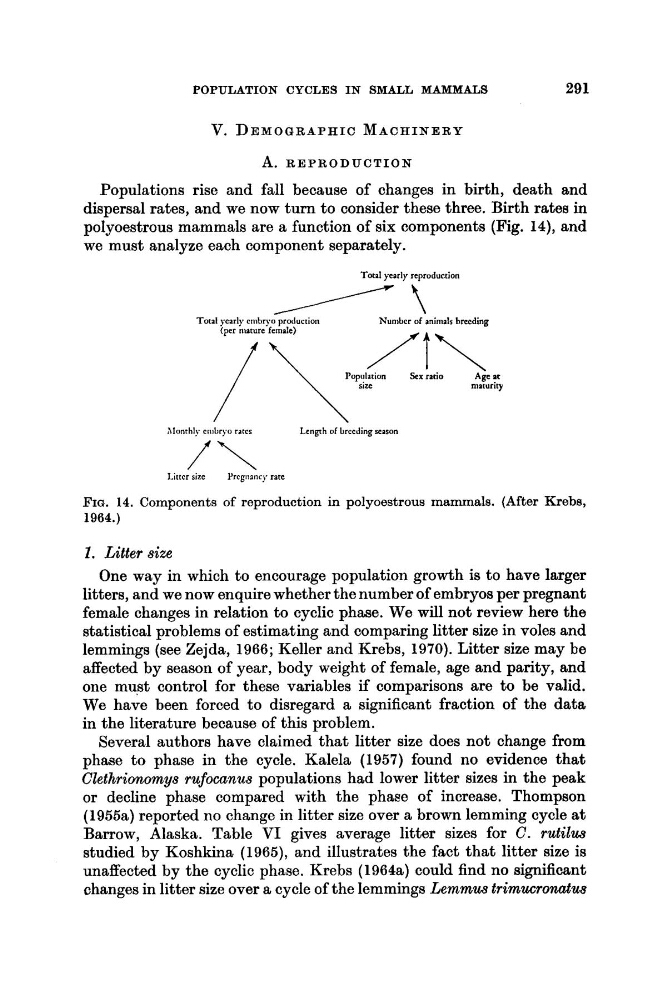
polyoestrous mammals are a function of six components (Fig. 14), and
we must analyze each component separately.
Total yearly reproduction
/ \ Nunibcr of animals breeding
Total p r l y cmliryo praluction
(per niature female)
Population
Sex ratio
Age at
/\si/l\
maturity
Alonthly cnhryo ntcs
Lengrh of breeding season
Litter sire
Yrcgnancy rare
FIG. 14. Components of reproduction in polyoestrous mammals. (After Krebs,
1964.)
1. Litter size
One way in which to encourage population growth is to have larger
litters, and we now enquire whether the number of embryos per pregnant
female changes in relation to cyclic phase. We will not review here the
statistical problems of estimating and comparing litter size in voles and
lemmings (see Zejda, 1966; Keller and Krebs, 1970). Litter size may be
affected by season of year, body weight of female, age and parity, and
one must control for these variables if comparisons are to be valid.
We have been forced to disregard a significant fraction of the data
in the literature because of this problem.
Several authors have claimed that litter size does not change from
phase to phase in the cycle. Kalela (1957) found no evidence that
Clethrionomys rufocanus populations had lower litter sizes in the peak
or decline phase compared with the phaee of increase. Thompson
(195Sa) reported no change in litter size over a brown lemming cycle at
Barrow, Alaska. Table VI gives average litter sizes for C. rutilus
studied by Koshkina (1965), and illustrates the fact that litter size is
unaffected by the cyclic phase. Krebs (1964a) could find no significant
changes in litter size over a cycle of the lemmings Lemmus trimwronatus
291
V. DEMOGRAPHIC MACHINERY
A. R E P R O D U C T I O N
Populations rise and fall because of changes in birth, death and
dispersal rates, and we now turn to consider these three. Birth rates in
polyoestrous mammals are a function of six components (Fig. 14), and
we must analyze each component separately.
Total yearly reproduction
/ \ Nunibcr of animals breeding
Total p r l y cmliryo praluction
(per niature female)
Population
Sex ratio
Age at
/\si/l\
maturity
Alonthly cnhryo ntcs
Lengrh of breeding season
Litter sire
Yrcgnancy rare
FIG. 14. Components of reproduction in polyoestrous mammals. (After Krebs,
1964.)
1. Litter size
One way in which to encourage population growth is to have larger
litters, and we now enquire whether the number of embryos per pregnant
female changes in relation to cyclic phase. We will not review here the
statistical problems of estimating and comparing litter size in voles and
lemmings (see Zejda, 1966; Keller and Krebs, 1970). Litter size may be
affected by season of year, body weight of female, age and parity, and
one must control for these variables if comparisons are to be valid.
We have been forced to disregard a significant fraction of the data
in the literature because of this problem.
Several authors have claimed that litter size does not change from
phase to phase in the cycle. Kalela (1957) found no evidence that
Clethrionomys rufocanus populations had lower litter sizes in the peak
or decline phase compared with the phaee of increase. Thompson
(195Sa) reported no change in litter size over a brown lemming cycle at
Barrow, Alaska. Table VI gives average litter sizes for C. rutilus
studied by Koshkina (1965), and illustrates the fact that litter size is
unaffected by the cyclic phase. Krebs (1964a) could find no significant
changes in litter size over a cycle of the lemmings Lemmus trimwronatus