

284
CHARLES J. KREBS AND JUDITH H. MYERS
1967
1968
1969
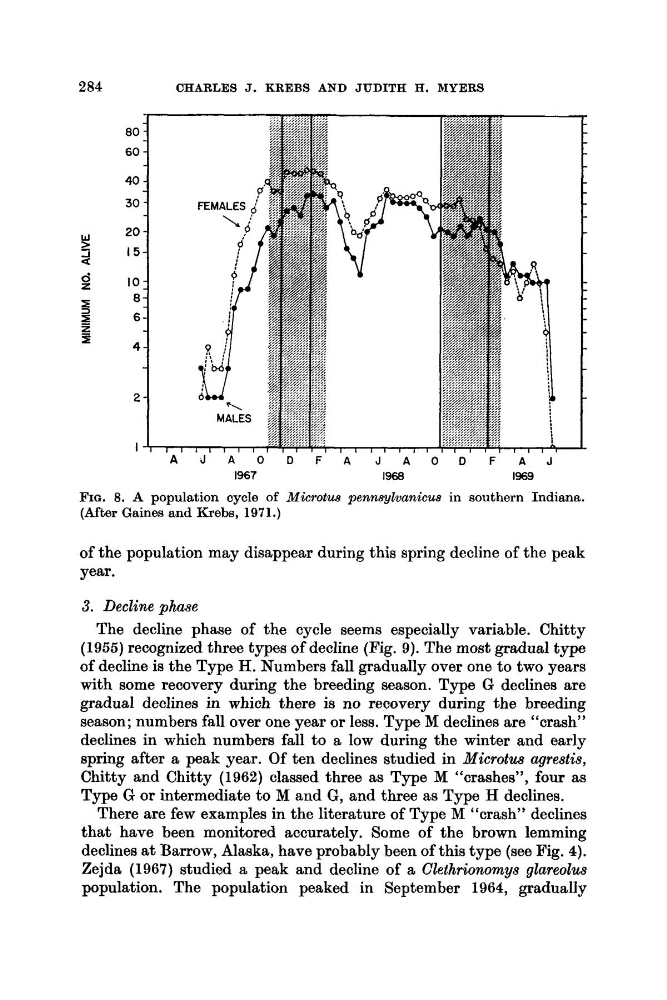
FIU. 8. A population cycle of Microtus pennsylvanicue in southern Indiana.
(After Gaines and Krebs, 1971.)
of the population may disappear during this spring decline of the peak
year.
3. Decline phase
The decline phase of the cycle seems especially variable. Chitty
(1955) recognized three types of decline (Fig. 9). The most gradual type
of decline is the Type H. Numbers fall gradually over one to two years
with some recovery during the breeding season. Type G declines are
gradual declines in which there is no recovery during the breeding
season; numbers fall over one year or less. Type M declines are “crash”
declines in which numbers fall to a low during the winter and early
spring after a peak year. Of ten declines studied in Microtus agrestis,
Chitty and Chitty (1962) classed three as Type M “crashes”, four as
Type G or intermediate to M and G, and three as Type H declines.
There are few examples in the literature of Type M “crash” declines
that have been monitored accurately. Some of the brown lemming
declines at Barrow, Alaska, have probably been of this type (see Fig. 4).
Zejda (1967) studied a peak and decline of a Clethrionomys glareolus
population. The population peaked in September 1964, gradually
CHARLES J. KREBS AND JUDITH H. MYERS
1967
1968
1969
FIU. 8. A population cycle of Microtus pennsylvanicue in southern Indiana.
(After Gaines and Krebs, 1971.)
of the population may disappear during this spring decline of the peak
year.
3. Decline phase
The decline phase of the cycle seems especially variable. Chitty
(1955) recognized three types of decline (Fig. 9). The most gradual type
of decline is the Type H. Numbers fall gradually over one to two years
with some recovery during the breeding season. Type G declines are
gradual declines in which there is no recovery during the breeding
season; numbers fall over one year or less. Type M declines are “crash”
declines in which numbers fall to a low during the winter and early
spring after a peak year. Of ten declines studied in Microtus agrestis,
Chitty and Chitty (1962) classed three as Type M “crashes”, four as
Type G or intermediate to M and G, and three as Type H declines.
There are few examples in the literature of Type M “crash” declines
that have been monitored accurately. Some of the brown lemming
declines at Barrow, Alaska, have probably been of this type (see Fig. 4).
Zejda (1967) studied a peak and decline of a Clethrionomys glareolus
population. The population peaked in September 1964, gradually