

POPULATION CYCLES IN SMALL MAMMALS
283
2. Peuk phase
The peak phase is defined as a period of little change in numbers from
one spring to the next (Chitty and Chitty, 1962). The peak phase is
usually obvious, since population densities are typically much higher
than they are in other phases of the cycle. Some species, however, do
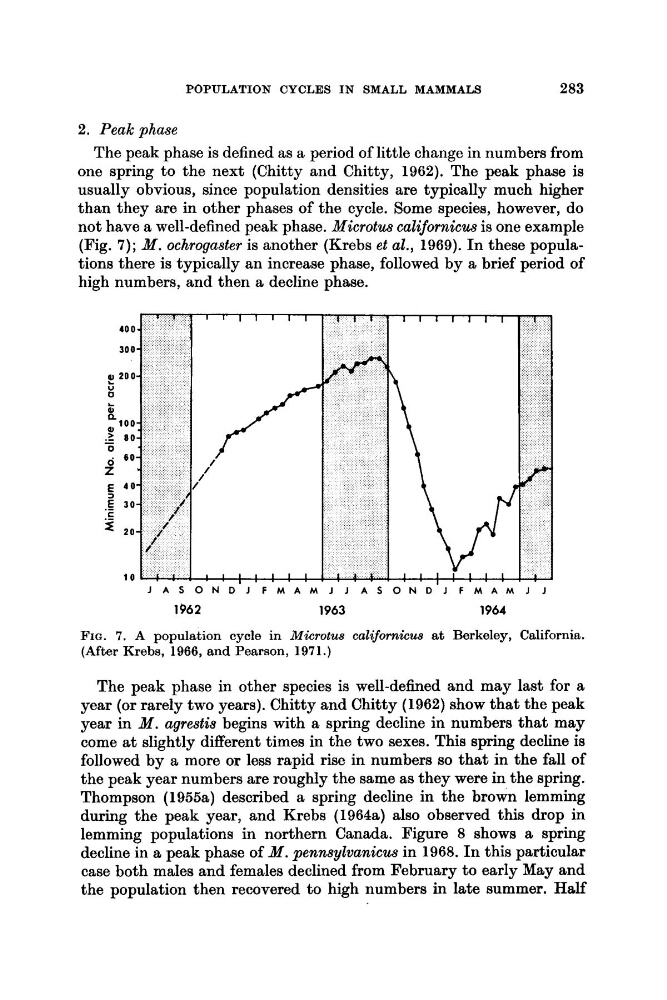
not have a well-defined peak phase. Microtus californicus is one example
(Fig. 7 ) ; M. ochroguster is another (Krebs et al., 1969). In these populations there is typically an increase phase, followed by a brief period of
high numbers, and then a decline phase.
1962
1963
1964
FIG. 7. A population cycle in Microtus calqornicw at Berkeley, California.
(After Krebs, 1966, and Pearson, 1971.)
The peak phase in other species is well-defined and may last for a
year (or rarely two years). Chitty and Chitty (1962) show that the peak
year in M. agrestis begins with a spring decline in numbers that may
come at slightly different times in the two sexes. This spring decline is
followed by a more or less rapid rise in numbers so that in the fall of
the peak year numbers are roughly the same as they were in the spring.
Thompson (1955a) described a spring decline in the brown lemming
during the peak year, and Krebs (1964a) also observed this drop in
lemming populations in northern Canada. Figure 8 shows a spring
decline in a peak phase of M. pennsylvanicus in 1968. I n this particular
case both males and females declined from February to early May and
the population then recovered to high numbers in late summer. Half
283
2. Peuk phase
The peak phase is defined as a period of little change in numbers from
one spring to the next (Chitty and Chitty, 1962). The peak phase is
usually obvious, since population densities are typically much higher
than they are in other phases of the cycle. Some species, however, do
not have a well-defined peak phase. Microtus californicus is one example
(Fig. 7 ) ; M. ochroguster is another (Krebs et al., 1969). In these populations there is typically an increase phase, followed by a brief period of
high numbers, and then a decline phase.
1962
1963
1964
FIG. 7. A population cycle in Microtus calqornicw at Berkeley, California.
(After Krebs, 1966, and Pearson, 1971.)
The peak phase in other species is well-defined and may last for a
year (or rarely two years). Chitty and Chitty (1962) show that the peak
year in M. agrestis begins with a spring decline in numbers that may
come at slightly different times in the two sexes. This spring decline is
followed by a more or less rapid rise in numbers so that in the fall of
the peak year numbers are roughly the same as they were in the spring.
Thompson (1955a) described a spring decline in the brown lemming
during the peak year, and Krebs (1964a) also observed this drop in
lemming populations in northern Canada. Figure 8 shows a spring
decline in a peak phase of M. pennsylvanicus in 1968. I n this particular
case both males and females declined from February to early May and
the population then recovered to high numbers in late summer. Half